A deal, but will it stick?

By Sunday morning those of us in Bamako had all heard the news that broke late Saturday night: after weeks of deadlock, negotiators from the Economic Community of West African States (ECOWAS) had reached an agreement with Mali’s CNRDRE junta, and interim president Dioncounda Traoré would remain president during the transition. The junta’s leader Captain Amadou Sanogo himself appeared briefly on ORTM television to announce that he would abide by the agreement. Facing renewed international sanctions, the junta appears to have backed down from its insistence on holding a national convention to choose Mali’s next head of state, and the state newspaper L’Essor today trumpets that the country’s institutional crisis is over.

Most of us have learned to be circumspect, however, especially where Captain Sanogo is concerned. As he pointed out, the agreement announced late Saturday is only an agreement “in principle,” and many details remained unresolved. Some of these “accompanying measures” have surfaced in the last 36 hours: according to the AFP, Captain Sanogo will be granted the status of a former head of state, which we understand means a hefty salary (roughly 50 times his current army pay) and a nice home at government expense, among other perks. Dioncounda’s term in office will be set at 12 months. It is not yet clear what exactly his powers will be, however, and what role the CNRDRE may continue to play. We are still waiting to hear what Captain Sanogo says about the deal if and when he addresses the nation in the Bamanan language, when he is likely to put a different spin on things than he does in French. Even if Sanogo won’t be president of the transition, nobody in Bamako thinks we’ve seen the last of this man.

ORTM coverage of the deal has been muted, to the point that many of us wonder how much editorial control the junta retains in the newsroom there. The 1 p.m. news edition on Sunday didn’t even mention it until the end of the broadcast, as an afterthought. The 8 p.m. edition led with the story, and much was made of the fact that Dioncounda appeared wearing a grand boubou of white damask, making him look more presidential than his usual rumpled suits. This story, however, was followed immediately by an item about a parallel initiative by a pro-putsch political front (la Coordination des Organisations Patriotiques du Mali, or COPAM) to forge ahead with a national convention anyway, contesting Dioncounda’s extended term in office and reopening the whole debate that had seemed closed for at least a few hours this weekend.

COPAM, claiming to represent Malian civil society, frames its action as resistance to a foreign imposition (because Dioncounda’s term of office was negotiated by ECOWAS) that tramples on Mali’s sovereignty, in favor of a democratic choice by “the Malian people.”

Never mind that Captain Sanogo himself has continually referred to a vague plan to let “the people” decide. Never mind that Dioncounda, as the most recent speaker of Mali’s National Assembly, has constitutional legitimacy as transitional president, or that his powers will be limited at best. Never mind that Mali is a member of ECOWAS and has unfailingly supported its decisions concerning other member states.

In the “what could go wrong next” department, we can consider a couple possible scenarios. One, the rank-and-file troops who mounted the March coup and have backed Sanogo ever since could accuse him of cutting a sweetheart deal and selling them out. They could reject the new accord and refuse to recognize Dioncounda’s authority. Two, COPAM’s two-day “national convention” — which was hastily called on Sunday and began this morning at the Centre International de Conférence de Bamako, or CICB– could divide Mali’s political class and seriously weaken Dioncounda’s power.
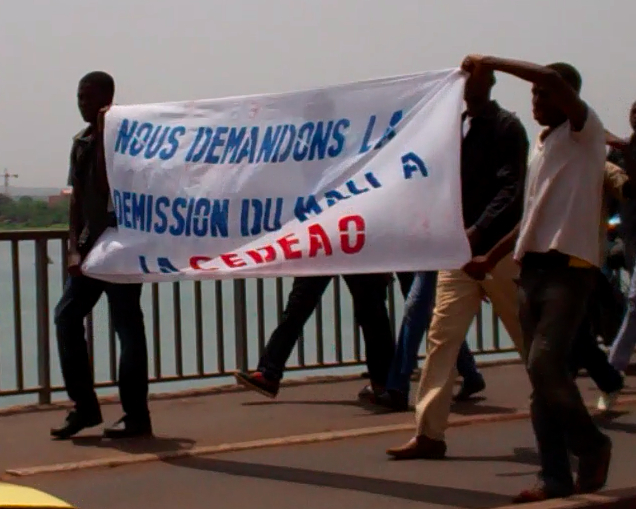
Anti-ECOWAS protestors on the King Fahd Bridge, May 21; the banner reads “We demand Mali’s resignation from ECOWAS”

This second scenario may be already underway, as anti-Dioncounda forces are mobilizing. For the first time since May 1, I received an SMS alert from the U.S. Embassy this morning reading “Demonstration ongoing between Independence Monument and CICB Convention Center on River Road. Recommend avoiding these areas.” The southbound lanes of the King Fahd Bridge were blocked by protestors around 1100 GMT, and all northbound traffic was being diverted toward the CICB. A large crowd gathered at the prime minister’s office, not far from there, while another contingent of anti-Dioncounda demonstrators reportedly went to Koulouba, where the presidential palace is located. I also saw a band of young men in my neighborhood this morning carrying a banner demanding that Mali “resign” from ECOWAS; they were shouting “Down with ECOWAS” and “Dioncounda is a thief!”
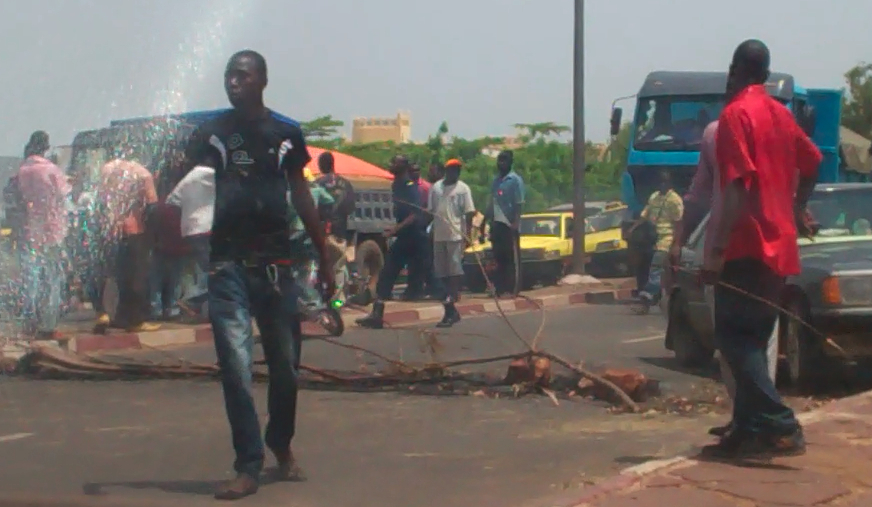
Protestors setting up impromptu roadblock on King Fahd Bridge, May 21

I’m starting to wonder how relevant Captain Sanogo’s intentions are in this affair. As one Malian journalist commented today, “It’s not enough for ECOWAS to want something, and for Captain Sanogo to come out in favor of it, for us to rest easy. Because in truth, neither the captain nor ECOWAS have convinced Malians.” If they don’t do a better job of convincing Bamakois to make this deal stick, it looks like we are in for more trouble ahead.

Update, 1700 GMT: I’d heard rumors about this throughout the afternoon, now confirmed by the BBC — Dioncounda Traore was attacked and knocked unconscious by protestors earlier today. Such is the antipathy in certain segments of society toward Dioncounda that there are apparently few members of the security forces willing to take a punch for him. Never mind a bullet. Still, the fact than an elderly man (Dioncounda is 70) can get roughed up by young thugs is a chilling sign that longstanding social taboos in Mali have fallen by the wayside. Recent media reports make it clear that the second scenario outlined above is moving right along.

1945 GMT: Prime Minister Cheikh Modibo Diarra just gave a short address in Bamanan on ORTM. Speaking without notes, prompting, or hesitation, he eloquently expressed his indignation and grave concern about today’s events. Sabali, he kept imploring viewers — the term means patience or calm, but it means a lot more than that. He urged Malians not to try to take the law into their own hands, not to destabilize the country further. For a fellow who’s spent most of his career working for NASA and Microsoft, he plays the part of a Malian elder with gravitas and aplomb. “We have made it through the day,” he concluded. “Let us make it through the night in peace.”

Posted in Uncategorized | Tagged , , , , | 13 Comments

False passports, false hopes, and false flags

Here in Bamako we’re in waiting mode while negotiations drag on over who will be the country’s president during the transition period to new elections. The CNRDRE junta’s recent call for a “national convention” on the matter appears to have fallen flat, and even its bid to convoke a closed-door meeting of diplomats has been called off, in part due to U.S. unwillingness to legitimize the junta by engaging with it. We understand that several prominent members of Bamako’s diplomatic community met at the U.S. embassy here on Thursday, shortly before the CNRDRE’s gathering was supposed to take place. It has also come to light that the junta has begun issuing diplomatic passports, signed by junta leader Captain Amadou Sanogo, to some of its members. Refusing to grant a visa to an applicant bearing one such document, officials at the local French consulate pointed out that only Mali’s minister of foreign affairs can authorize Malian diplomatic passports.

The Chérif of Nioro, in black turban, being greeted by Captain Sanogo in Kati on Thursday, May 17

In another sign of the junta’s growing importance on the national stage, one of Mali’s most senior religious figures, the Chérif of Nioro, paid a private visit to Captain Sanogo on Thursday. The Chérif, head of the Hamalliyya brotherhood, is a man whose word carries a great deal of weight in this region. This was no mere social call; the Chérif does not make the 350-km trip from Nioro to Kati lightly. We’ve heard some speculation that he came to persuade Sanogo not to provoke the wrath of the international community, to avoid persisting in his opposition to a renewed mandate for current interim president Dioncounda Traoré, and not to seek the presidency himself. If this was indeed the Chérif’s mission, some expect that he could succeed where ECOWAS, UN and other emissaries failed. Others think former president Moussa Traoré could serve that role. But given the junta’s obstinacy so far, these could simply be false hopes.

Lately I’ve noticed a recurring pattern of rumors alleging that shadowy forces have been trying to provoke an uprising against the junta. One rumor interprets the panic that swept Bamako on May 2, when students reportedly heard that Hammadoun Traoré, wounded two days before, had died. These reports were untrue, and many now say they were circulated by unnamed politicians linked to the ancien régime of deposed president Amadou Toumani Touré. The goal, by this interpretation, was to get students into the streets, where they would be fired upon by hidden mercenaries (hired by the politicians), thus unleashing a mass uprising that would topple the junta.

This rumor is often paired with a second one concerning an event that took place 21 years ago: the popular uprising that ousted President Moussa Traoré from power. While Traoré was later tried and convicted for having ordered his troops to fire on unarmed protesters, killing over 300, the rumor circulating now is that mercenaries (perhaps sent by the French) actually did the shooting.

When one group in a conflict poses as partisans of the other side, either to infiltrate or discredit its enemies, this is called a “false flag” operation. Stories of false flags abound in Mali these days. Speaking to the BBC, for example, a Tuareg member of the MNLA rebel movement alleges that the human right abuses — killing, raping and looting — of which his group has been frequently accused over the past two months have in fact been perpetrated by non-rebels flying the MNLA flag on their vehicles. (This is the only false flag story I’ve come across here that involves actual flags.)

According to popular imagination here, politics is a surreal, contorted web of lies. Nothing is what it appears to be, and the real motivations for events are always hidden from view. This imagination feeds into the widespread mistrust, even hatred, of politicians at several levels of society. So extreme is this antipathy that rumors circulated in early February, several days after dozens of Malian soldiers were massacred at Aguel Hoc, that President Touré had actually ordered the massacre — i.e., that the rebellion itself was Touré’s own false-flag operation. (The thinking here was that by inciting a civil war, Touré would be able to remain in office after his constitutional mandate expired this year.) One recurring story is that Malian troops recovered a satellite phone from Tuareg rebels and that the most recent call had been received from Touré. In early February, these rumors helped fuel protests in Kati and Bamako against Touré’s rule, foreshadowing the mutiny that would drive him from power several weeks later.

If you’ve followed this blog for very long, you know it’s my nature to be skeptical, and as a social scientist I find this disposition suits me well in my work. Conspiracy theories most often turn out to be unfounded; not all flags are false; sometimes things are merely what they appear to be. (This isn’t a statement I often articulate to my Malian friends, most of whom would find it hopelessly naive.) While the rumors themselves are interesting analytically, they are also a big part of Mali’s current problem: when a population lacks education and critical insight, it is vulnerable to all kinds of misinformation. The coup in March could not have taken place in an atmosphere where ordinary citizens refused to believe rumors.

“The truth will come out eventually,” people keep repeating. “History will judge.” (Sanogo himself has said this many times, referring to the crimes allegedly committed by Touré and his government.) But that’s the sad thing — the truth may never come out. Instead of cutting through the layers of rumor and innuendo, we’ll just get new layers added on top. Malians will remain in the thrall of the wildest forms of speculation about their leaders’ actions and intentions. None of which can be good for democracy.

Posted in Uncategorized | Tagged , , , , , | 20 Comments

The problem with the political class

This past Monday Captain Amadou Sanogo, leader of Mali’s CNRDRE (the group most foreign media mistakenly label the “ex-junta”), announced that he had asked Mali’s prime minister to organize a “national convention” to choose a president to oversee the transition to new elections. It’s unlikely this request, which has divided public opinion here and been rejected by the current interim president, will be honored. The anti-putsch camp has voiced its opposition; meanwhile, the local press buzzes with reports that Sanogo wants the job of president for himself.

And time to resolve the matter is even shorter than we knew: the state-run newspaper L’Essor stated this week that the 40-day interim period ends not on Tuesday, May 22, as most of us had thought, but on Sunday, May 20 — since the period officially began with the Malian supreme court’s declaration of a “vacancy” in the presidency on April 10, rather than the interim president’s swearing-in two days later.

As of this writing, the deadlock persists between Mali’s civilian authorities, who want to advance the country’s transition process through existing political institutions, and the CNRDRE’s supporters who prefer to wipe the slate clean and start fresh. The latter approach is what Sanogo’s proposed national convention is all about, and underlies a pattern of extra-institutional measures the junta has proposed or pursued over the last two months.

The root of the problem is this: Malians don’t trust their politicians. Okay, politicians everywhere are mistrusted, but in Mali what’s known as the classe politique — the ensemble of elected officials, candidates for public office, and their highly placed associates — has an especially bad name.

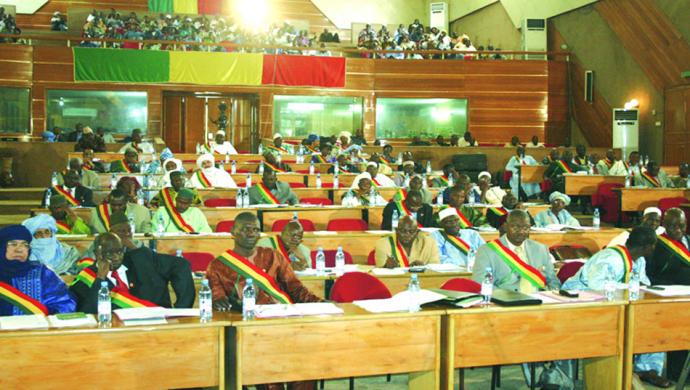
Den of thieves? Mali’s National Assembly

Recently I interviewed a Bamako talk show host who frequently debates politics with listeners phoning in to his program. His callers tend to define politicians as people in power who pursue personal ambitions. “They phone in all the time saying ‘Those people think only of themselves and their interests,'” he told me, “and that’s why some even say ‘We don’t want politicians anymore.'” This sentiment explains strong local support for the junta and its bid to exclude politicians en masse from Mali’s transitional government. We keep hearing rumors that Sanogo has a dossier on every crime committed by the country’s politicians since the early 1990s, and that for the good of all Malians he is seeking to keep those criminals out of the political process.

You could describe this sentiment as an extreme version of the anti-incumbent fever that periodically sweeps the United States, but it goes further than that. The political class, according to this mentality, is not merely a predatory or parasitic entity that feeds off the people’s resources for its own selfish ends. It’s also an alien entity, utterly divorced from the people; it was not sent by them, was not maintained in office by them, and has no mandate from them.

President (now ex-president) Touré

When you read critiques by Malian journalists and intellectuals of their country’s democratic system of the past decade, this is the argument you most often get these days. Amadou Toumani Touré, the ousted president, was a puppet of outside (especially French) interests who never cared about Mali’s welfare; he and his clan subverted the country’s democratic mechanisms for private gain. “Democracy was a veritable thieves’ banquet to the point that the people became nostalgic for dictatorship,” wrote Issa N’Diaye recently. “To want to go back to such institutions, so rejected by the people, is that democracy?”

Such sentiments are entirely understandable, given ordinary Malians’ widespread disappointment with the governance of their country. “A fish rots from the head,” goes a common expression here casting corruption as a problem that trickles down from the political class. As tempting as it is to blame Mali’s problems entirely on a clique of greedy politicians (and, directly or indirectly, on their foreign backers), however, it is also misleading, even disingenuous.

Flouting the law in Mali is hardly the sole prerogative of elected officials or civil servants. Everybody does it, literally everybody, from merchants who bribe customs agents to give them a break on import duties, to drivers who never bother to register their vehicles or obtain drivers’ licenses, to sidewalk vendors who illegally occupy Bamako’s public thoroughfares. And the temptation to embezzle public resources arises not merely from individual greed: it is driven by social pressures that are extremely difficult to resist.

“When you succeed in Mali, there are many people whom you must take care of,” the talk show host told me. “I know people here who were cabinet ministers and who wanted to do serious work, and they were opposed because they wouldn’t let those around them engage in their little business, stealing left and right. We all do this. Even me, in my car, if the police pull me over I’ll give them 1000 francs to let me go. That’s how corruption starts. So when we have in our heads, ‘Every man for himself, every man for himself,’ it’s difficult to change that from one day to the next.”

The problem with the political-class-as-vampire-squid notion is that it overlooks the social structures in which Mali’s political class is embedded, the webs of reciprocal obligation that connect politicians with their local clienteles. It highlights the links between Malian elites and foreign interests, but obscures the links between Malian elites and ordinary Malians. Africanist scholars from Jean-François Bayart to Patrick Chabal and Jean-Pascal Daloz have gone so far as to argue that it’s not the state that preys on society in this part of the world, but the reverse.

More than once, listening to Bamakois vent their frustrations at their unresponsive government and politicians, I’ve been reminded of my own country, where we have the best Congress money can buy and where corporations have the freedom to bankroll candidates who advance their interests over and above the common good. Whether in Washington or in Bamako, we need to confront the power imbalances that keep democracy from functioning.

At the same time, however, ignoring Malians’ everyday complicity in their government’s failures will not serve their interests in the long run. Even if the country somehow rids itself of its entire political class and starts over from scratch, bad governance will persist as long as the social roots of corruption and clientelism go unaddressed. The danger of populist, extra-institutional approaches like those proposed by the junta and its supporters these days is that they blind people to the structural causes of the problem.

Experience has shown that all too often, the “remedy” such approaches offer turns out to be worse than the disease it is supposed to cure.

Posted in Uncategorized | Tagged , , , , | 28 Comments

President Sanogo?

The preoccupation in Bamako lately is what will happen on Tuesday, May 22. That’s the day when Mali’s constitutionally mandated interim period ends, and the 40-day term of office of Dioncounda Traoré, the man who’s been serving as interim president, expires.

By law, the interim period is intended for the president to organize new elections, an outcome ruled out by Mali’s de facto partition since early April. So what next? Yesterday I listened to a panel of local jurists on a radio talk show discuss what Mali’s constitution calls for in this case, and whether it would allow Dioncounda to remain as interim president in the absence of new elections. I came away fully edified on two points: One, there’s no legal consensus on either question; Two, local jurists cannot discuss these questions without shouting at each other. Those favorable to Dioncounda (and therefore, in the eyes of many Bamakois, favorable to the country’s ancien régime) say the constitution clearly allows him to stay on, while those hostile to him say this is a legal impossibility.

If not Dioncounda as president during the upcoming transitional period, then who? A number of Malians are in favor of seeing Captain Amadou Sanogo, the leader of Mali’s military junta, assume the presidency. Spokesmen for the junta have said that the army is the only “neutral umpire” capable of guiding the transition. On the BBC’s “Network Africa” program this morning, correspondent Martin Vogl echoed statements we’ve been hearing for days in the Malian press: “It’s absolutely certain that there’s a faction within the junta that want Captain Sanogo to take over.”

That faction may or may not include Captain Sanogo himself, who has been characteristically cagey on the question. In an interview televised on ORTM Saturday evening, journalist Youssouf Touré asked Sanogo (at the 17:45 mark), “Are you a candidate to be president of the transition?”

“That makes me laugh a bit,” Sanogo responded with a chuckle. “I believe that on March 22 [the date of the coup d’état in which the junta toppled President Amadou Toumani Touré from power] I specified something to my people — who are the most important, the Malian people…. We came with motivations. To remake a worthy, republican army. To face up to our major challenges. These are my objectives, the rest matters little to me.”

The interviewer asked a few minutes later, “So Captain Sanogo is not a candidate to be president of the transition?”

Sanogo replied “If you say ‘candidate’ it’s as though there are elections. But in any case I have my priorities.”

The interviewer later asked, “You made a declaration at a certain moment, you said ‘After the 40 days of the transition, not a moment more, I will take my responsibilities.’ How do you analyze that sentence? What does it mean?”

Sanogo’s answer: “That sentence was quite simple. ‘After the 40 days, not an hour more, sans quoi je prendrai mes responsabilités.’ ‘Taking my responsibilities,’ it’s coming back to the accord-cadre [the agreement signed on April 6 between the junta and ECOWAS]. Whatever doesn’t come out of the accord-cadre, I’m not for it. It’s a document that was established by consensus between the committee and ECOWAS, I don’t see any reason one or the other party would deviate from it. That’s the reason.”

Interviewer: “And if somehow after the 40 days, there’s still no president of the transition on whom you can agree, can you imagine what that will mean?”

Sanogo: “The Malian people will decide on that. Who will be their president.”

Interviewer: “You’re awaiting their answer?”

Sanogo: “I’m awaiting the people’s answer.”

[You can find a transcript of the interview in French provided by Info Matin.]

Since the accord-cadre was signed last month, Sanogo has used it to justify everything he’s done. The problem is that this agreement is unclear on what happens after the 40-day period, just as it’s unclear on what role the junta should play going forward. It was never intended to be a definitive document, merely the framework for further negotiations. ECOWAS mediators and foreign governments do not share Sanogo’s interpretation of this text. What does he mean when he says the Malian people will decide? Which people, exactly? How will their decision be made? Who determines which candidates will be up for the people’s consideration?

One of the ways Sanogo has appealed to Malians thus far is by appearing to be both outside and above politics. When he hides behind the vague accord-cadre and refuses to speak clearly about his intentions, however, he is merely playing politics. The question is whether he realizes this, or whether he maintains a messianic vision of himself as the man who will save Mali from its politicians.

So the question of who will be Mali’s interim president remains. ECOWAS negotiators left Mali on Saturday after days of talks with the junta failed to resolve the issue. They are scheduled to return tomorrow for further negotiations. Meanwhile Captain Sanogo has called for a national convention to determine who will be president. Bamakois are holding their breath, hoping the resolution will be a peaceful one.

Posted in Uncategorized | Tagged , , , , | 12 Comments

On teaching, and not teaching, in Bamako

I didn’t teach class yesterday. Normally I give a two-hour lecture on Friday afternoons, the sole weekly meeting of my “Anthropology and Development” course at Bamako’s Université des Lettres et des Sciences Humaines (ULSH). Then again, there’s been absolutely nothing “normal” about this school year where public higher education in Mali is concerned.

I arrived in Bamako last August to begin the school year, and classes should have started up in October. Unfortunately, things were held up by a drawn-out administrative restructuring process that saw the former Université de Bamako split into four newly autonomous entities. First we heard that the resumption of classes would be delayed until November, then December, then January. Even after the rentrée universitaire was finally announced on January 15, I had to wait another month before I could teach my own course. On the first scheduled Friday of classes, none of the morning instructors showed up, so the fourth-year sociology students (who attend classes all day Friday and Saturday) went home at midday. The next Friday, classes were cancelled due to an angry protest in Bamako of the government’s mishandling of the rebellion. The Friday after that was a religious holiday.

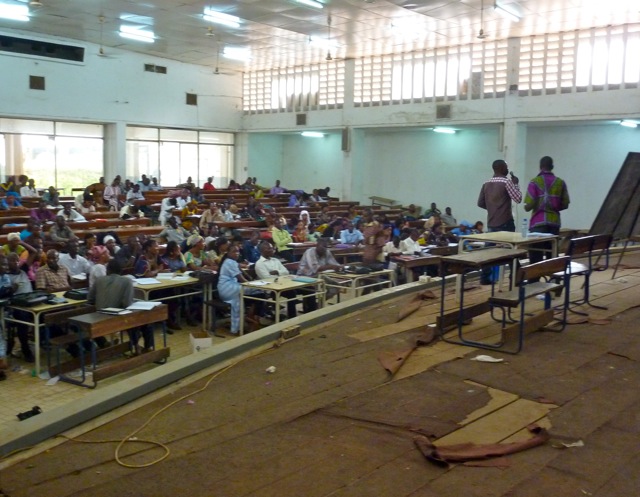
On February 17, more than halfway through my 10-month stint here, I got to teach at long last. Since there are not enough large classrooms at the ULSH, we meet in the amphitheater of the Ecole Normale Supériure in the Quartier du Fleuve. Officially there are over 400 students enrolled in my class, and the amphitheater at ENSup is probably big enough for that many, but I don’t think we’ve had more than 250 students in the room at any one time.

The amphithéâtre Kani Dembélé at the École Normale Supérieure

Since that first day twelve weeks ago, class has met for six Fridays, and has not met for another six. Reasons for not meeting have been entirely beyond my control, and have included the March 22 coup d’état, a blackout, midterm exams, and most recently the violence of the April 30 “counter-coup” and its aftermath. A week ago the government declared that all schools in Bamako, from the primary to the university level, would remain closed to head off potential unrest, and we just heard this evening that they will reopen this Monday, May 14.

The worry now is that classes have been delayed too long for course work and exams to be completed, and that the government will have to declare another année blanche — a d0-over, meaning students will have to start the school year over again in October. There have been several années blanches in recent years.

The university system here faces a host of challenges. One is the lack of resources: there are over 100,000 students in the various branches that used to comprise the University of Bamako, but fewer than 1000 faculty members and nowhere near enough classrooms. With such outsized classes, the only way to evaluate students is through exams, and with hundreds to grade for each class, and no assistants to help, instructors often give one final exam in which students must synthesize what they learned from the entire course into a few hundred words.

Forget about PowerPoint or showing films to your students: instructors are limited to a blackboard, chalk, and if they’re lucky a microphone that works. Forget about computer labs and printers: students must usually rely on private cybercafes. Forget about bookstores: even if the books were here, hardly anyone could afford to buy them. Oh, and one other thing you can forget about: the University of Bamako has been without a working library since its establishment in 1996. In a way, pedagogy here works like it did in Europe before the advent of the printing press: the instructor lectures, students take notes, then memorize those notes to reproduce on the exam. (Luckily we can assign short readings for students to photocopy on their own dime, so it’s a strange pre-Gutenberg, post-Xerox age we’re teaching in.)

In light of all the things the public university in Mali lacks, I’m not sure we even can consider it a university at all. Professors teach there, and students attend classes, but not enough learning takes place. Some of my colleagues tell me they don’t expect more than 10 percent of students to understand what’s being taught. Part of the problem is that public schools at the primary and secondary level have been so dysfunctional in recent years that even those lucky enough to pass their baccalaureate exams at the end of 12th grade — a tiny fraction of all students who begin primary school — often arrive at university without the basic skills necessary to succeed.

On top of under-resourced professors and under-prepared students, you have the problem of a highly politicized student union (the Association des Élèves et Étudiants du Mali, or AEEM) and a somewhat less politicized, but still very militant, faculty union (the Syndicat National de l’Enseignement Supérieur or SYNESUP). Both are highly prone to calling strikes, and if there’s been one bit of good luck this school year, it’s that there haven’t been strikes at my university. But without the AEEM’s active role in Bamako’s current political crisis, it’s unlikely that schools would have been shut down for the past week. When its members aren’t busy getting their skulls cracked by police, the AEEM occasionally mobilizes its own thugs to terrorize students and even university staff.

Then you have the problem of systemic corruption, which spans the entire system, from instructors selling passing grades to students, to administrators over-invoicing their purchases. A branch of the university system recently purchased Toyota Prado Landcruisers for 55 million CFA francs each (US$110,000!), well over their market value. I wonder how anyone could justify such a purchase as an appropriate use of scarce public resources in a context where students don’t have books to read.

Politics, higher education, and plots are increasingly interwoven in Bamako. Of course there’s the AEEM, which has taken a stand against Mali’s ruling CNRDRE junta and whose leaders are often suspected of being manipulated by shadowy politicians. Then, as I mentioned in my previous post, a rector of one of Bamako’s newly autonomous universities was arrested earlier this month and remains in detention. One recent article in the Malian press claims he is suspected of having weapons. I can’t say I know the man well, and I’ve never discussed politics with him. But I just can’t believe that he’s been hiding a weapons cache any more than I’d believe my own department chair at Lehigh was an Al Qaeda sleeper agent (hi Judy!).

It’s tempting to think that the challenges described above are merely growing pains that will abate as Mali’s public higher education system matures. Given how entrenched many of these problems are, however, I think it’s more realistic to expect more strikes, more années blanches, and more unrest to come. Unless Mali’s new government decides to make a serious investment in its universities, the long decline of these institutions will continue. This won’t bother the Malian elite, who can afford to send their children to private universities here or abroad. But it will be a tragedy for the majority of Malians who, despite their lack of means, hope to send their children to university someday.

Postscript, 18 March 2013: Professor Isaie Dougnon, an anthropologist affiliated with the same department for which I taught while in Bamako, has published a scathing critique of Mali’s higher education system on the website University World News.

Postscript 2, 5 May 2013: Read this article by a Malian journalist about the various rackets to which Bamako university students are subjected, most notably by the AEEM and its system of “mafia practices.”

Postscript 3, 25 August 2013: The French website Rue89 has published a scathing investigation of conditions at the various University of Bamako campuses, detailing under-resourced departments, the sale of grades and degrees, and widespread fraud.

Posted in Uncategorized | Tagged , , , | 11 Comments

Briefs for Wednesday, May 9: Afghanistan-on-the-Niger?

We are hearing more and more worrisome news from the north. Reports from both RFI and the Algerian press indicate that jihadis from Pakistan have been arriving in Timbuktu and Kidal to join forces with Al Qaeda in the Islamic Maghreb (AQIM) and the local Salafist movement Ansar Dine. Mujao, the shadowy new Islamist group in the region, has issued an ultimatum that it will kill the seven Algerian diplomats it kidnapped last month if a 15-million Euro ransom is not paid. These reports come in the wake of the desecration of the tomb of Sidi Mahmoud Ben Amar in Timbuktu by Salafists, a symbolic act that has provoked verbal discord between “Sufist” and “reformist” Muslims in Bamako. Add to this the mounting humanitarian crisis, and it’s no wonder Benin President Yayi Boni has raised the specter of the region’s “Afghanistanization“.
Meanwhile in southern Mali, the hunt for alleged “mercenaries” continues, with the recent arrest of 18 Senegalese and an unknown number of Cameroonians in Bamako, and fears of mercenary presence in Koulikoro. Legitimate crackdowns, or arbitrary harassment of defenseless foreigners? There is a long, sad history of African governments scapegoating African migrants for all sorts of terrible things (on this subject, see the conclusion of my book, Migrants and Strangers in an African City.) And while I would like to say that time will tell, unfortunately the truth of such matters has a way of never quite coming to light around here. Rumors and misinformation merely give way to more rumors and misinformation.

Hamadoun Traoré, secretary general of the AEEM student syndicate who survived an apparent attempt to kill him on April 30, is still alive. It was earlier reported that he was gravely wounded, then it was rumored that he had died, then we heard from some sources that he had never in fact been injured at all. (A more recent article based on interviews with AEEM members and eyewitnesses to the attack claims that Traoré was indeed wounded and is recovering.) It was the rumor of his death on May 2 that prompted a student demonstration, the dispersion of which caused the panic in Bamako that day. A theory is afoot that dastardly politicians spread the rumor and paid off AEEM leaders to get students in the streets in hopes of fomenting a wider uprising against the junta. Whatever the case, given the AEEM’s status as a highly politicized organization, with the power to mobilize students (or at least prevent classes from being held), some are wondering whether its purpose should be reevaluated. Since the violence of April 30-May 1, schools in Bamako, from the primary to the university level, have remained closed as a security measure “until further notice.”

A university rector named Salif Berthé has been under arrest since May 1, the day after the attempted “counter-coup.” It’s unknown what Berthé might have done to get on the wrong side of the junta. A linguist by training, he was only named rector of the Université de Bamako last June, and subsequently was put in charge of the newly autonomous Université des Sciences Juridiques et Politiques (USJP, the ex-FSJP).

There have also been reports of a wave of arrests among members of the armed forces, which so far have included high-ranking officials such as ATT’s former military chief of staff, a son of former President Alpha Oumar Konaré, one of Konaré’s former bodyguards, and the army’s commander for the Sikasso region.

And to close, I offer a bit of news concerning me directly: this week the Fulbright program  terminated its grants in Mali due to the security situation, meaning I no longer carry any affiliation with the U.S. Embassy in Bamako or with the State Department (which administers Fulbright grants abroad). I intend to stay on for a few more weeks to finish up my research — though I must add that all-purpose disclaimer insha’allah (God willing), because in Bamako these days, we just never know what will happen next….

Posted in Uncategorized | Tagged , , | 19 Comments

Pushing all the right buttons

Mali’s strongman is a skillful communicator

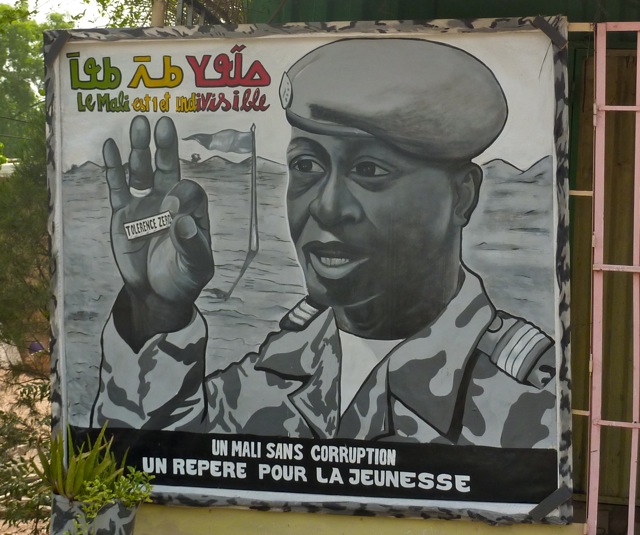
Mural on a Bamako business depicting Capt. Sanogo; the text reads, “Mali cannot be divided / Mali is one and indivisible / A Mali without corruption, a landmark for youth”

Since the coup d’état six weeks ago, Malians at home and abroad have been desperate to gauge the character and motivations of the men who carried it out. Starting in the early morning of March 22, they have closely followed media appearances by the leaders of the Comité National pour le Redressement de la Démocratie et la Restauration de l’Etat (CNRDRE), in particular its president, Captain Amadou Haya Sanogo. Although he rarely leaves his headquarters at the Kati army garrison — out of concern for his security, we hear — he has often spoken on Malian television and radio, and sometimes on international media outlets.

Although officially he’s no longer in charge, having agreed to hand over power to constitutionally designated civilian authorities a month ago, Sanogo and his junta obviously retain a great deal of power, and Sanogo himself has consistently maintained that the April 6 “accord-cadre” signed between the CNRDRE and regional body ECOWAS guarantees the junta an enduring, if ill-defined, role in Mali’s political transition process. Many Bamakois see Sanogo as the man truly in command of the country and its security apparatus; it’s no coincidence that journalists clamor for his attention.

On Sunday evening, May 6, Africable TV broadcast a recently recorded interview of Captain Sanogo conducted by one of its editors, Abdoulaye Barry, in Sanogo’s Kati office. Previously I had little respect for Barry, whose commentary on the death of Muammar Gaddafi last October was so fawning over the late Libyan dictator it could have been written by Gaddafi’s own propaganda machine. Interviewing Sanogo, however, Barry earned his journalistic credentials through direct, hard-hitting questions. (A transcript in French is available, slightly abridged in spots.) In the course of this 50-minute interview, conducted in French, it became clear that Sanogo is not only politically savvy but an effective communicator who knows how to reach an audience and push the right buttons.

There are many revealing moments in this interview. Sanogo says his top priority is “the North” (i.e., reunifying the country), a statement he repeats a few minutes later; this is exactly what most Malians, impatient with the state’s inaction in the face of the country’s de facto partition, want to hear. Sanogo says he abides by the accord-cadre and is fully subordinate to Mali’s new civilian government; this is exactly what Mali’s neighbors and donors, anxious to prevent the junta from setting a dangerous precedent, want to hear. Whether Sanogo’s intentions will match his statements is another matter. What I want to focus on here, however, is an exchange that begins 37 minutes into the interview, when Sanogo tries both to justify the coup d’état and to show that he respects democracy far more than the elected leaders he helped topple. The following is my own translation.

Barry: In Africa, where our democracies are often characterized by unlimited terms of office, Mali set a good example. Now Malians hang their heads abroad, because they’re like any other Africans again. They’re no longer proud, they’re ashamed because their country that had been an example has fallen. Do you feel any remorse when you think that ultimately you’re responsible for their shame?

Sanogo: I tell you, it’s now that Malians should hold their heads high. It’s now that Malians should be proud, because [their] democracy was only a shell. A democracy cannot happen without a strong, republican army, and we didn’t have one…. There cannot be democracy with… corrupt, rotten leaders, a hierarchy, I don’t know, without ideas, without motivations citoyennes, because when at a high level of responsibility in the state, you allow yourself to look a citizen in the eyes and lie to him, when you allow yourself to rig elections, when you allow yourself to buy off elections, when you allow yourself to buy off his conscience and lead him where he shouldn’t go, is that what you call democracy? No.

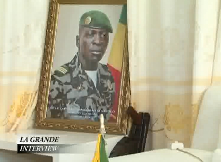
Still image from Africable interview showing Sanogo’s office; note AK-47 sticking out next to portrait

It’s now that Mali can lift up its head a little, it’s now that Mali has regained its pride a little. Because [Malians] have the opportunity again to sit down, make adjustments, and elect whom they want based on principle, not money. To elect whom they want according to their reputation or their power. This means no Malian is all-powerful. A Malian is a Malian. Offering the same chance, the same opportunity to everyone at every level, that’s what I call democracy, and not the other democracy, where a head of state steals, loots, defrauds, betrays his country, is that democracy? … When a government in place doesn’t really serve the mission it should for its country, to save the people, is that a democracy? When elected officials are ready to put everything to work — money, weapons, plots — to achieve their personal goals, is that a democracy? I would say no, but now the people have the chance to restore this democracy.

Barry: Captain, whatever the limits and weaknesses of Malian democracy, of the Malian democratic project, it remains an example in Africa. We’ve seen what’s happened on the continent, leaders who don’t even have respect for their own people. The former Malian president, whatever one accuses him of, was among the first Africans to take power by force and then respect his people, organize democratic elections and step down, then return ten years later to office by democratic means…. in the name of democracy, one should have instead consolidated that project.

Sanogo: What proves to you that he was going to step down [after elections this year]?

Barry: Well, he said it, we could take him at his word.

Sanogo: He said it, and I think this was the same head of state who said in 1991 that he had no ambition to return [to power]. He came a second time to rig everything, the people know all about it. In short, there was no democracy. The people are a witness. There was none. And this fellow was not going to step down…. History will judge.

Barry: But we were a month from the presidential election–

Sanogo: Just like we were a month from scandal in Bamako, from another civil war, because of this same fellow. I tell you, history will remember this one day.

Barry: Didn’t your coup send Mali back 20 years?

Sanogo: I think the coup brought Mali forward 20 years. Through this coup, the average citizen has seen and understood what he hadn’t understood, has seen what he hadn’t had the opportunity to see, to know what was being hidden from him about his own country, in the same of what democracy?

Here Sanogo masterfully changes the narrative. By his telling, it is not he who undermined democracy by ousting an elected government. In fact, it is he who rescued true democracy from the clutches of a corrupt clique of power-hungry elitists who would stop at nothing to subvert the will of the people. It was not he who upended the institutional foundations of the state (e.g., elections); in fact, he acted to restore institutions already fatally weakened by irresponsible politicians. He did not instigate the political violence that has befallen Bamako since the coup; in fact, he headed off an even bigger threat — a looming “civil war.”

Whatever you think of Sanogo’s narrative, it is a compelling one for a large cross-section of people in Bamako disappointed with their government’s failures over the last several years. In a future post I hope to engage with the classe politique-as-vampire-squid notion that has become so widespread here since the coup. These narratives have caught on for good reason, but they also do not tell the whole truth.

Whether Sanogo sincerely believes these narratives is an open question, and an important one. Whether he sincerely desires to give up power is another: he shows growing signs of self-importance (third-person references to himself, his very presidential-looking framed portrait, his insistence on his men calling him “Président).

For now, though, one thing we can say with certainty is that the captain is extremely effective in delivering these narratives, adapting them to fit the situation, and ultimately reframing the terms of Mali’s political debate.

[Postscript: A not-quite-complete transcript of the original interview has appeared on the website Abidjan Direct.]

Posted in Uncategorized | Tagged , , , | 18 Comments

Au revoir Sarko

What if you were to take an opinion poll in Bamako (a purely hypothetical case — such things almost never happen) and ask, “Which world leader do you hate most?” I’m quite certain Nicolas Sarkozy would top the list. This is a town where it’s possible to hear people express favorable opinions about everyone from Saddam Hussein to Muammar Gaddafi to Robert Mugabe and even, occasionally, George W. Bush. But I literally have never met a Bamakois with a kind word to say about Sarkozy.

Sarko & ATT: No winners here

Even before becoming France’s president in 2007, Sarkozy was a despised figure here. As interior minister under Jacques Chirac, he took a hard anti-immigration line, increasing the number of deportations of undocumented migrants and pressuring the Malian government to stem the flow of its citizens to France. No sooner was he elected president than he gave a now-infamous speech in Dakar stating, among other things, that colonialism wasn’t all bad and suggesting that Africans’ marginalization in the present world order has been largely their own fault. The African, Sarkozy claimed, “never launched himself towards the future. The idea never came to him to get out of this repetition and to invent his own destiny.”

His rating among Malians only fell from there, and seemed to plunge ever deeper as Mali’s own fortunes fell. A good many people here see the sinister hand of Sarkozy behind the resurgence of the Tuareg-led rebellion earlier this year. It’s certainly true that the Tuareg have a sympathetic following among the French and that rebel spokesmen have frequently appeared in the French media. It’s also true that, through his support for NATO’s campaign to oust Gaddafi last year, Sarkozy helped bring about certain side effects such as the return of heavily armed Tuareg fighters to Mali. And there may well be French interest in certain natural resources that might someday be exploited in northern Mali.

The notion that Sarkozy has been actively destabilizing Mali became so widespread here that France’s ambassador here had to write an open letter denying allegations of a French conspiracy against the country. In some of the more nuanced versions of this conspiracy theory, such as the one articulated by altermondialiste Aminata Dramane Traoré, Sarkozy is just a prominent cog in a global imperialist machine seeking to oppress the African continent. In other versions, he has singlehandedly spearheaded a campaign to bring Mali to its knees. One thing most Malians agree on is that Sarkozy has been “the worst president in the history of modern France.”

This evening it was announced that President Sarkozy narrowly lost his reelection bid to Socialist candidate François Hollande. People in Bamako now wonder, with a new resident soon to occupy the Elysée (France’s presidential palace), what will change for relations between Mali and France? Will “Françafrique,” the web of “incestuous relations” between top politicians of France and former French colonies in Africa that has existed since the 1960s, finally be dismantled?

Hollande has promised to do dismantle it, but then again, so have many of his predecessors. As Malian editorialist Adam Thiam recently wrote, “men change in the Elysée but France’s policy in Africa endures.”

Posted in Uncategorized | Tagged , , | 11 Comments

Update for Friday, 4 May

Briefs

18:30 GMT: The city was calm throughout the day and I haven’t heard shots for a couple of days now. The Bamako airport has reopened and some outbound flights managed to depart on Thursday. A team of Nigerian footballers who got stuck here when the airport closed is looking forward to going home, having been visited at their hotel yesterday morning by heavily armed Malian troops, no doubt on the hunt for those infamous mercenaries at large.

According to media reports, life in Bamako has been gradually returning to normal since Thursday. One report on RFI describes the resumption of daily routines. And there have been some positive signs on the diplomatic front, as ECOWAS seems to be taking a more productive, less bellicose stance toward Mali’s junta; at a summit in Dakar yesterday that included Mali’s interim president and prime minister, the regional body affirmed that it would not send troops to Mali without the request of the Malian government.

ORTM continues to broadcast mostly pre-recorded programming (i.e., recorded years ago), TM2 has been completely off air since Tuesday morning, and apparently the area around the ORTM compound in Bozola has been completely sealed off by the army. I haven’t seen a journal télévisé since the “counter-coup” on Monday, only occasional “flash infos” like the one below showing Captain Sanogo visiting his troops in Kati who were wounded in the fighting this week.

You can also watch an extended “flash infos” from Thursday, May 3, which at the ten-minute mark includes video (without audio) of a visit by U.S. Ambassador to Mali Mary Beth Leonard to Interim President Dioncouna Traoré at the Koulouba presidential palace on Monday, just hours before the “counter-coup” began. It’s worth noting that, unlike many of her counterparts in Bamako, Ambassador Leonard has made a point of not going to visit CNRDRE junta leader Captain Amadou Sanogo in Kati.

[Postscript, Saturday morning, May 5: There has been, however, at least one ORTM evening news broadcast this week, airing at 21:00 GMT on Friday May 4. Topics covered included: the ECOWAS summit in Dakar and the Malian government spokesman’s reaction to it; a request to all members of the army’s airborne regiment — i.e., red berets — to visit a “welcome center” at a Bamako gendarmerie to be counted and “physically checked” before May 10; prayers for peace in Bamako and Mopti; the decision to reopen schools and universities (closed since Tuesday) on Monday May 7; union messages to Mali’s workers; World Press Freedom Day. The newscaster wraps up saying “ORTM suffered no loss of life during the events of the beginning of this week.”]

Do try this at home

Following my last post on Wednesday afternoon, in which I shared some observations from a trip downtown, I was reminded that the U.S. Embassy’s advice to American citizens in Bamako is to continue to “shelter in place” — i.e., stay home. So for the benefit of readers in Bamako, even if you haven’t received an SMS alert from the embassy for a few days, don’t assume it is safe to go out. As the embassy’s latest emergency message reads, the SMS alert system “does not have a 100% success rate due to the volume of calls currently moving through the Malian cell phone network.” And you can check the embassy website for new emergency messages.

So, until advised to do otherwise, we are sheltering in place, or “sipping” as we Yanks like to say. This term comes up a great deal in conversation lately among American expats in Bamako, as you can see from the sample dialogues I have reconstructed below:

  • Fred: “Say, Barney, I thought I’d call ’cause I haven’t seen ya lately. What ya been up to?”
  • Barney: “Just sipping.”
  • Fred: “Yeah? Me too.”
  • Children: “Hey dad, what are we doing today?”
  • Father: “Sipping.”
  • Children: “Sipping again? Yay!”

You get the picture. Sipping presents many opportunities for fun. If you have electricity, you can watch television, digital video discs, or maybe even surf the information superhighway and obsess about current events. If the power’s out, as it was for a good chunk of today in our neighborhood, you can entertain the kids with games of hide and seek, or fill up wash basins in the courtyard for them to cool off in. (Today’s high: 106 degrees F, 41 degrees C.)

Sip safely, everyone!

Posted in Uncategorized | Tagged , | 5 Comments

Fears, foreigners, and falsehoods

Although the day started out on a note of calm routine, the climate in Bamako has been tense since late morning, for reasons that remain unclear. As with previous days of unrest, our first warning sign came from our son’s daycare staff: around 11:40 this morning, they phoned to tell us they’d be closing early due to “troubles in town.” (At least we got him out of the house for 3 hours today.)

When the call came I was in a taxi near the Ecole Normale Superieure (in Quartier du Fleuve), where a normally two-way street had suddenly and quite spontaneously become one-way east-bound, with both lanes moving in the same direction, albeit slowly due to heavy congestion. I heard a few shots fired near the Central Bank tower but couldn’t see where they’d come from or what caused them.

In the neighborhoods my taxi traversed, offices and many businesses (especially banks and gas stations) closed early, and a steady stream of traffic moved away from downtown. I took the precaution of phoning ahead to the various people I had to visit — in Cité du Niger, the central artisanat (artisans’ market) in Bagadadji, and the Dibida market. In each case the situation was calm. The west side of the artisanat, one of my favorite people-watching spots in town, was thick with Bamakois coming and going; there was no sign of panic or tension, despite the artisanat‘s proximity to the National Assembly, a perennial hot spot for demonstrations. When I asked what had happened downtown and why so many businesses had closed, nobody could tell me. But everyone had heard that some shapeless trouble was brewing.

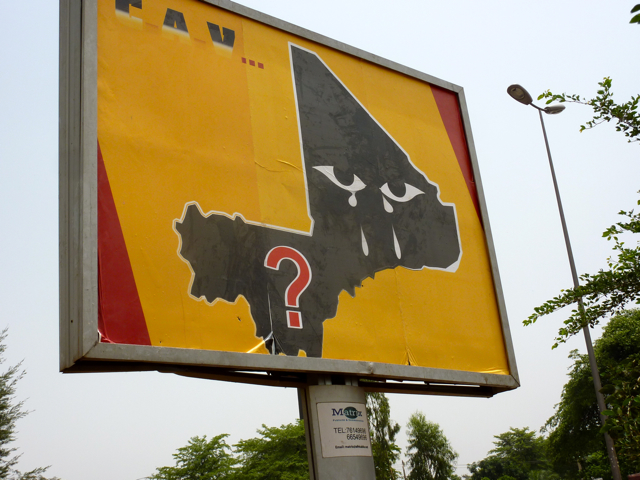
This cryptic billboard has begun popping up all over town recently. Can someone identify what the letters C.A.V. (upper left) stand for?

By the time I got to Dibida around 2 p.m., many of the businesses in Dibida were also closed or about to close up early. My friend there told me that the shooting I’d heard in Quartier du Fleuve before noon was related to a foreign mercenary who had been killed.

For the last two days, the foreign mercenary has become a bogeyman in Bamako. It was late Monday night that Captain Amadou Sanogo, leader of Mali’s CNRDRE military junta, blamed the unrest that had started several hours earlier on foreign mercenaries who had infiltrated the city in the service of ill-intentioned, unidentified Malians. The junta’s statement on ORTM television Tuesday morning repeated these allegations, adding that some foreigners had been captured alongside the Malian paratroopers who had attacked junta strongholds Monday evening.

Suddenly Bamakois began seeing foreign mercenaries lurking in every corner. These mercenaries most commonly are said to be from Burkina Faso and Côte d’Ivoire.

Do these mercenaries really exist, though? I have yet to see any proof that they do. It’s certainly in Captain Sanogo’s interest to frame the current conflict as pitting Malians against outsiders, rather than pitting pro-putsch Malians against anti-putsch Malians. He knows it’s easy to manipulate fears of foreigners in a context of instability.

Although Mali is regarded as welcoming toward outsiders — rightly so, in my view — Malians are not immune to the temptation to demonize foreigners, especially foreign Africans, for the flimsiest of reasons. Bamako has seen periodic waves of hysteria around alleged “penis shrinkers” (when they touch you, your penis disappears!); as Jean-Jacques Mandel observed a few years ago, those accused are usually Hausa men from Niger. English-speaking Africans (Liberians, Sierra Leoneans and Nigerians) are frequently suspected of being con artists and thieves. In 2009 and 2010 it was men from Guinea who were most often suspected of criminal activity in Bamako.

Last week the West African regional body ECOWAS took a firm stance (and an unproductive one, I argue) against Mali’s junta, and vowed to send troops to secure Mali’s civilian transitional authorities. The tough ECOWAS position gave Captain Sanogo a convenient hook on which to hang his accusations of outside meddling in Malian affairs. The current ECOWAS chairman, Ivoirian President Alassane Dramane Ouattara, has been leading the anti-junta push, while Burkina Faso’s President Blaise Compaoré has been overseeing ECOWAS negotiations with Malian civilian and military representatives. On Monday there were rumors that ECOWAS troops had crossed into Mali’s Sikasso region — which borders on Burkina Faso and Côte d’Ivoire — and were heading to Bamako. These rumors were false. Is it a coincidence that now the “mercenaries” in Bamako are alleged to be from Côte d’Ivoire and Burkina Faso, whose governments have suddenly become unpopular here?

Shortly before 18:00 GMT this evening, Mali’s transitional prime minister Cheikh Modibo Diarra addressed the nation on ORTM, his first such address since the fighting began Monday. He talked first in Bamanan, then in French; his spoken Bamanan is eloquent, which is one thing you could never say about ousted president Amadou Toumani Touré. Diarra spoke of an “attempt to destabilize” the country, and said that Mali’s security forces had achieved an “incomplete victory” against these destabilizing forces. He never mentioned foreigners or mercenaries, and he went out of his way to quell certain rumors: no, he said, the AEEM secretary general, wounded Monday, is not dead; no, the CNRDRE is not distributing guns to civilians; no, troops have not occupied the bridges; no, the Bamako airport is not closed. (That last came as a surprise to me, as I’ve heard from several sources that the airport was closed until May 7. Apparently it’s reopened.) Diarra called on people to remain calm, to get back to work, and not to listen to rumors.

To my mind, the foreign mercenary story is just another of these unfounded rumors until we have evidence to the contrary.

Update, 7:00 a.m. GMT, Thursday May 3: Revised estimates I’ve seen of the death toll from this week’s fighting now range between 22 and 150, with some indications that it may yet go higher.  Junta spokesmen are using the foreign mercenary angle to describe the battle that ended Tuesday as well as the ongoing “mopping up” operations both in and around the city. Eliminating mercenaries sounds better to Malian ears than eliminating red-beret paracommandos,  since the latter had been held in high esteem here; just a week ago, they were considered the heroes of the republic, the elite shock troops who would defeat the Tuareg rebels and restore dignity to the nation. Now they’re being hunted down like vermin.

Anything that happens can become fodder for mercenary hysteria. The crash of a small plane flying from Nouakchott to Bamako, piloted by a Frenchman, has been interpreted by some as evidence that foreign mercenaries are being brought into Mali.

Meanwhile, in Côte d’Ivoire, a newspaper allied with former president Laurent Gbagbo is also supporting the hypothesis of “mercenaries” sent to Bamako by President Ouattara. Using the mercenary angle allows Ouattara’s opponents at home to undermine his credentials as a peacemaker and statesman, and fits into a longstanding narrative among Gbagbo supporters arguing that Ouattara only succeeded in ousting Gbagbo from power last year with the help of foreign mercenaries. The Ouattara/mercenary hypothesis is now being picked up in the Malian press along with other manifestations of mercenary hysteria. In terms of its credibility, you can file this narrative with the penis-shrinker stories.

On the positive side, however, I can point to two promising signs on the political scene. One, interim President Dioncounda has stated that he won’t exceed the constitutionally mandated 40-day period in office, and has thereby removed one of the major sticking points in the transition process. Two, the junta is still engaging in dialogue with ECOWAS via the government of Burkina Faso, with whom a five-member CNRDRE delegation had talks Wednesday in Ouagadougou, and junta representatives continue to insist that the recent disturbances will not derail Mali’s transitional institutions.

Update, 14:00 GMT, Thursday May 3: Today has been another enforced day off for me since the daycare center is closed until Monday, May 7. The U.S. Embassy here also remains closed and an appointment I had scheduled there for the 7th has already been canceled due to the security situation.

ORTM television has broadcast a statement by Mali’s new minister of internal security, General Tiéfing Konaté. He stutters so badly, it’s hard not to feel sorry for the man; he clearly needs to find a spokesperson, at least for TV appearances. According to Konaté, yesterday’s panic in Bamako was the result of a false alarm. He says investigations have been launched into the origins of the recent incidents between military personnel as well as the deadly police assault on the university campus that occurred Monday afternoon.

Mali’s state-run newspaper L’Essor has published a fairly thorough account of those inter-military confrontations, including a few new details (e.g., no attempt to arrest airborne regiment commander Abidine Guindo preceded Monday’s actions, but a visiting delegation of junta officials was roughed up at the regiment’s Djicoroni base on Monday afternoon). A report on the Ivoirian news website koaci.com alleges that Malian PM Cheikh Modibo Diarra is frustrated by his powerlessness and apparent marginalization at the hands of the CNRDRE junta.

Posted in Uncategorized | Tagged , , , , | 39 Comments