Strange days in Bamako

8:00 a.m. GMT: I thought I heard more shooting, but it was just thunder. A rainstorm blew in about half an hour ago.
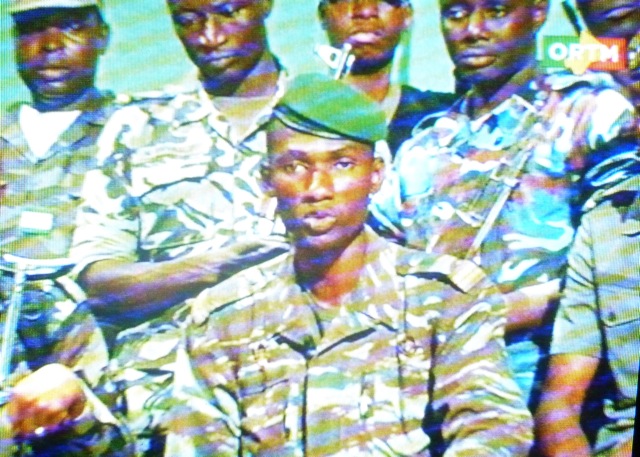
Lt. Mohamed Issa Ouedraogo, CNRDRE

ORTM is broadcasting the same kind of folklore recordings it was playing the morning of March 22, but interrupts them occasionally with a communiqué by the CNRDRE junta, read in French by Lt. Mohamed Issa Ouedraogo. He urges Malians to remain calm. He says that an operation, mounted by Malian and foreign individuals of “various horizons” and backed by  “obscure forces inside Mali” to destabilize the country has been defeated and that the CNRDRE remains in control of the situation. Ouedraogo says the army has killed and captured several men involved in this operation.
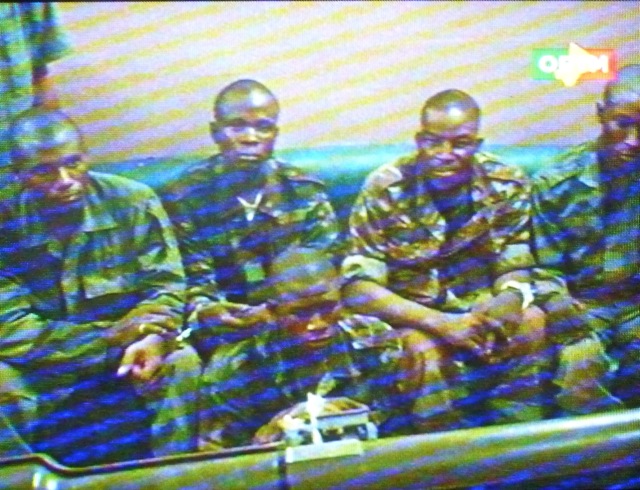
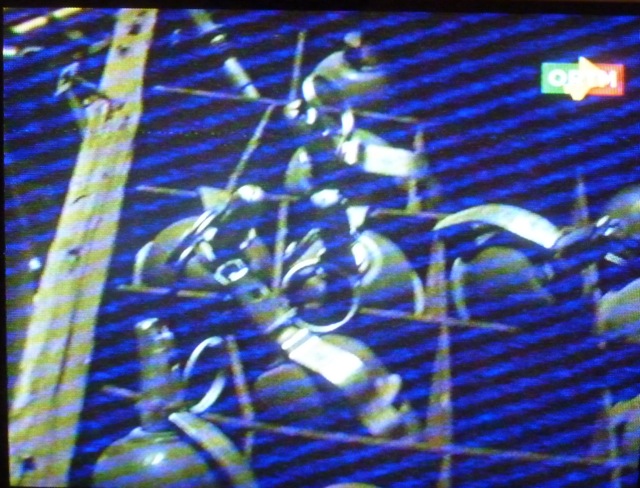
Images show young troops who appear to be prisoners in handcuffs, wearing camouflage fatigues with no insignia; the broadcast also shows images of weapons (assault rifles, hand grenades, a recoilless rifle) that may have been captured. Lt. Ouedraogo finishes the statement, attributing it to Captain Amadou Haya Sanogo, who has not been seen on television since the unrest began yesterday.
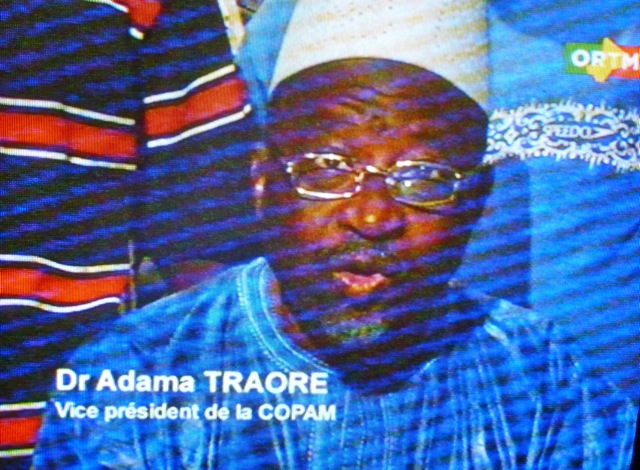
Next, wearing a blue boubou and white cap, appears Dr. Adama Traoré, Vice President of the Coordination des Organisations Patriotiques du Mali (COPAM), a pro-putsch umbrella group formed in the days after last month’s coup d’etat. Flanked by a couple of young men in street clothes, he gives a statement in Bamanan with the same content as Lt. Ouedraogo’s remarks.
An SMS comes from the US Embassy: “Situation remains uncertain. Road blocks reported around Bamako. U.S. citizens advised to remain sheltered in place.”

9:00 a.m. GMT: The rain has subsided, not enough to wash the dust off the bottom-most leaves on the mango trees. So far there’s no information from any sources to contradict the CNRDRE claims of control, though one rumor claims that the junta has been broadcasting its televised message via an ORTM mobile unit and is not actually in control of the ORTM studio. I haven’t yet ventured out to assess the situation in my neighborhood, but everything seems calm. Al Jazeera English is backing up the junta’s position that a “counter-coup” has been successfully repulsed.

10:00 a.m. GMT: Just heard two simultaneous bursts of heavy machine gun fire, coming from two directions — north, near the Pont des Martyrs, and south, near the Pont Fahd. Sporadic bursts of rifle and machine gun fire continue emanating from the north. Not sure if it’s celebratory or actual fighting, but it doesn’t sound like the shooting we heard after the coup in March, which was all firing in the air. There’s a rumor in our neighborhood that foreign troops have been sighted in the city and that the shooting is by Malian forces engaging with these foreigners. I’m highly skeptical of these rumors.

One big question is on my mind: Assuming the junta is back in control, what will last night’s attempted counter-coup mean for Mali’s political transition? During his phone call broadcast on Radio Kayira several hours ago, Captain Sanogo claimed that the country’s interim president, prime minister, cabinet and legislature were all safe and would continue to go about their work. I’m guessing, however, that in light of recent events, many troops loyal to Sanogo will have a serious bone to pick with interim President Dioncounda Traoré, on whom they will likely blame the recent instability and whom they have already accused of selling out the country to ECOWAS for selfish political gain. Rumors are circulating online that ECOWAS troops have entered Mali from the south, via the Sikasso region, and are heading toward Bamako.

Foreign mediation of Mali’s crisis appears to be dead in the water at this point, as anti-foreign rhetoric has ratcheted up. Sanogo alleged on Radio Kayira that foreign mercenaries were involved in the unrest, and warned Malians to be on the lookout for unknown foreigners. I presume by this he means those who might be part of an ECOWAS intervention force. It’s hard to see how the junta and ECOWAS can get back to the negotiating table now, given how much positions on both sides have radicalized.

Unnamed sources cited by Jeune Afrique indicate that interim president Traoré and prime minister Diarra are safe, and apparently not in military custody.

12:00 GMT: More bursts of gunfire audible from the northeast. Since they are few and far between, I’m going to assume that they are from shooting into the air rather than shots fired in anger. RFI is reporting red berets firing in the air in and around Djicoroni. But I’m still staying home today.

Radio Kayira continues to rebroadcast Captain Sanogo’s telephone call from 12 hours ago on its airwaves. I’m unaware of any further contact with the captain since then and he has not yet appeared on television.

12:45 GMT: More shooting coming from the same direction, including the “boom-boom-boom” of heavy weapons. I’m wondering if I should revisit my hypothesis of shooting into the air. But so far media are still reporting that the fighting in Bamako and Kati is over, and that forces loyal to the CNRDRE junta won.

13:30 GMT: Jeune Afrique reports that junta troops have attacked the Djicoroni base that is home to the airborne regiment and presidential guard. A friend speaking on the phone with relatives in Djicoroni could hear the sound of heavy gunfire.

ORTM television continues to air documentary programs, nothing at all about current events, and the ORTM’s two radio frequencies have also been broadcasting identical pre-recorded content. It seems that ORTM staff are not present in the studios, or at least not in sufficient numbers to produce and air live programs.

15:00 GMT: I phone a friend who works in ACI 2000, not far from Djicoroni. He says soldiers have been passing through the neighborhood on their way to attack the paratroopers’ base, and I can hear gunshots on the other end of the phone. There are still sporadic bursts of fire audible from my house in Badalabougou, still emanating from the northeast.

AFP, citing hospital sources in Bamako, says the casualties so far include 14 dead and 40 wounded among military personnel on both sides.

16:00 GMT: Captain Sanogo appears on ORTM television, shown with fellow junta officers in a salon. He describes the current conflict as having been set in motion by “ill-intentioned elements” that had been infiltrating Bamako in recent days. He continues to express his support for the “accord-cadre” signed with ECOWAS a month ago. Sanogo’s brief (2 min. 30 sec.) appearance is followed by a statement by Hamadoun Touré, minister of communication in the new civilian government. Touré urges Malians to remain calm and to strive for a definitive return of constitutional rule as well as a restoration of the Malian state on all Malian territory (including the north).

I continue to hear sporadic shots from the northeast. Reuters reports that the Djicoroni Para base has been overrun by troops loyal to the junta, and that many red berets fled.

22:00 GMT: All quiet, no shots audible for some hours now. It seems the junta troops have reestablished control. I’d heard that soldiers had taken over the city’s two principal bridges over the Niger, but a friend who crossed the Pont Fahd four hours ago told me he saw no soldiers on or near it.

The airport is closed and all commercial flights in and out have been cancelled until 7 May. Royal Air Maroc has suspended all flights to Bamako for the next two weeks.

One of the two students wounded during yesterday’s police raid at the university campus reportedly died in hospital today, bringing the death toll of that operation to two. Something tells me my anthropology class won’t be meeting this week.

Still nothing but canned programming on ORTM radio and TV, and no journal télévisé tonight. I’m also disappointed with Africable, which after airing some preliminary reports of unrest yesterday stopped covering the situation in Bamako altogether, and has since only aired news from other West African countries. The private network did the same thing after the March coup, broadcasting an early interview with Captain Sanogo before suspending local journalism for several days. Junta’s orders, perhaps? The Bamako newspapers were all mum today too, though it could simply be because of the holiday.

The U.S. Embassy in Bamako has announced that it will be closed tomorrow due to “continued unrest.” I am hoping, however, that schools will reopen, as I am very much in favor of letting my children go bug somebody else for a few hours. If the calm persists, I think we have a good chance of that happening. Otherwise, I will be desperate to avoid another day of sheltering in place.

23:00 GMT: For what it’s worth, today has seen by far the most visits to this blog of any day since I started it in September: about 6,000 hits since midnight GMT, twice as many as the previous highest-traffic day (which was April 4, the day I wrote that Peace Corps was pulling its volunteers out). People seem to like it when I blog about bad news or the sound of gunfire. I can’t exactly promise to keep that stuff coming, however. In fact I can’t wait to get back to blogging about mundane bamakois life — higher education, gender relations, the Djakarta, the local martial arts scene…. For months I’ve been knocking around an idea for a post on the dojos of Bamako. But in light of Mali’s recent political trauma, the thought of writing about such things seems in poor taste. I’ll get to them someday, when all this is over and Bamako is again a rather dull place to be.

Here’s wishing you had a happy May Day/International Workers’ Day/Organization of African Unity Day.

23:42 GMT: Damned if there isn’t more shooting breaking out north of the river. But I’m going to bed anyhow.
Posted in Uncategorized | Tagged , , , , , | 64 Comments

Gunfire across the Niger, again

6:40 p.m. GMT: For the first time since the coup last month, we hear the sound of shots coming from the north. So far some heavy machine gun fire and booms. The gunfire lasts about two minutes then falls silent.

It’s been a strange day, with a great dust cloud hanging over Bamako since Sunday afternoon. The sky is khaki-colored, and the city has been suffused in an unnatural yellowish light. Flights into Bamako International Airport had to be cancelled due to poor visibility (about 100 meters, according to the state meteorological service).

Politically the situation has been tense since the ECOWAS declarations of last week. The junta is feeling justifiably under threat, and has dispatched troops to the airport to guard against any attempt to land an ECOWAS intervention force by air.

We are hoping that soon the dust will settle, literally and figuratively, and that cool heads will prevail.

7:00 p.m. GMT: An SMS arrives from the embassy’s security officer: “Gunfire reported throughout Bamako. Red beret [sic] reported to be active. Shelter in place.”

I receive an e-mail via Malilink reading “Violent clash between security forces and Malian students. Dead and wounded are already being reported.” Last week we heard that Hamadoun Traoré, secretary general of Mali’s AEEM student syndicate had narrowly escaped an assassination attempt, and that the AEEM was organizing a student strike today to protest the junta. The AEEM has long been a highly politicized organization with a prominent role on the national political scene. This is the first I’ve heard of it coming out in opposition to the junta. Local news outlets are reporting that earlier today, AEEM members attacked a radio station (Radio Kayira) run by Oumar Mariko, a vocal member of Mali’s anti-globalization left who until recently was also a vocal backer of the junta; they allege that Mariko was using his radio station to incite violence against AEEM leadership. Later in the day, one student was killed and two (including Hamadoun Traoré) wounded  after police launched an assault on the university campus around 4 p.m.

7:10 p.m. GMT: Another embassy SMS: “Gunfire reported in ACI 2000, vicinity of ORTM and possibly other areas of Bamako. US citizens advised to shelter in place.”

We have heard no more shooting for 30 minutes now. If it was a confrontation between troops and protestors, I suspect the demonstration was broken up and that things will remain quiet now that night has fallen. Tomorrow is a holiday (International Workers Day in most of the world, but African Unity Day in Mali) so schools will be out of session and most offices will be closed.

7:50 p.m. GMT: Africable TV reports that the area around the Djicoroni paratrooper base has been cordoned off, and that a military column was seen moving from the base toward downtown. There is some speculation that the “red berets” (members of the airborne regiment, also charged with protecting Mali’s president) are confronting troops loyal to the junta, but nobody really knows yet what’s been happening.

8:00 p.m. GMT: AFP reports that red berets have confronted junta soldiers after the latter tried to arrest a presidential guard commander. It’s probably Abidine Guindo, who helped Amadou Toumani Touré (ATT) escape the presidential palace after mutineers surrounded it last month. The clashes between students and security forces appear to be a separate development.

ORTM continues to broadcast, though the AFP report cited above suggests that shooting has taken place close to the ORTM studios. The usual 8 p.m. newscast does not come on, however; instead, a documentary is being aired.

8:15 p.m. GMT: Le Journal du Mali is reporting that red berets have taken over the ORTM compound, in what it describes as an “attempted counter-coup.” Apparently the junta is also going with the counter-coup narrative: CNRDRE spokesman Bakary Mariko told Reuters, “These are elements of the presidential guard from the old regime and they’re trying to turn things around,” adding, “We have the situation under control.”

Despite what Mariko and some journalists are saying, I doubt there are many ATT loyalists left in the parachute regiment or elsewhere in the armed forces. I suspect this evening’s conflict is not about ATT at all, but about who has the power to arrest whom and which soldiers will follow orders from the post-ATT leaders of Mali’s transitional government. No further word about the situation from Africable, and ORTM continues to broadcast its documentary. TM2 is showing “The Bodyguard,” with Kevin Costner and the late Whitney Houston.

10:00 p.m. GMT: AFP reports that gunfire has also been heard in Kati, where members of the junta themselves are under fire, and that the red berets have succeeded in taking over the ORTM (which is still broadcasting entertainment programs). According to Malijet, red berets are in control of one of the bridges over the Niger River, though if there’s been any combat there I certainly would have heard it from my house and so far the night is still quiet. Meanwhile, Xinhua is reporting that the red berets are out to “finish off” Captain Sanogo and his junta, and the AP quotes junta spokesman Bakary Mariko as saying that counter-coup forces are trying to take over the airport so they can fly in ECOWAS supporting troops.

11:00 p.m. GMT: According to AFP there are “several dead” at the ORTM compound, which the CNRDRE says it controls despite numerous claims to the contrary in the media. ORTM is now airing a documentary about Lake Chad. Le Journal du Mali reports that red berets now control both ORTM and the Bamako airport.

11:30 p.m. GMT: Adam Nossiter of The New York Times has been in touch with several CNRDRE officers and reports no consensus among them that a “counter-coup” has been taking place, but all of them are quite concerned about fighting between their men and the red berets. It seems most English-language journalists are describing the red berets as “loyalist troops” or “troops loyal to deposed president Amadou Toumani Touré.” I think it’s highly unlikely, however, that anyone is trying to put ATT back in office, and I doubt even ATT would want his old job back at this point.

11:42 p.m. GMT: I’m hearing heavy gunfire again, for the first time in five hours. It seems to be coming from the northeast, the direction of the Pont des Martyrs and the ORTM compound. It lasts only a minute before the quiet returns.

A banner on Maliweb reads “Latest update: The red berets seem to control the city of Bamako – the ORTM, the airport (two planes just landed – uncertain if these are ECOWAS planes). Many deaths at the ORTM. There is no access to the Kati road. Engine sounds from heavy combat vehicles can be heard at the Kati garrison. The meeting in Ouaga scheduled for today has been canceled. A declaration is awaited on the TV.”

1:00 a.m. GMT: Radio France International, which posted nothing at all about events in Bamako to its website on Monday, finally puts up an item saying the situation here is confused. No kidding.

One commenter on this post says he was at the airport from 6 p.m. until midnight and that, while many shots were fired, the airport appeared still to be in the hands of regular army units, and he wasn’t aware of any planes landing during that period.

Capt. Sanogo phones Radio Kayira (the same radio that AEEM demonstrators tried to storm Monday afternoon) a little past midnight and speaks in Bamanan with the on-air host for about ten minutes. Contradicting every news report issued so far, he denies that there has been any conflict between factions of the Malian army, denies that there has been any fighting in Kati, and claims that the airport and ORTM remain under the control of his men. (The fact that ORTM didn’t broadcast any news tonight was due to technical problems, if we buy this explanation.) Sanogo does allege that unspecified foreigners have been infiltrating the city, and claims that his forces have killed some and captured others. He calls on Malians to come out on Tuesday to oppose foreign forces coming into Bamako. To underscore the seriousness of the moment, Kayira is now playing music by the late Djeli Bazoumana Sissoko, a revered griot whose recordings were broadcast on national radio during coups in 1968 and 1991. (You can hear streaming audio from Radio Kayira here; they have been re-broadcasting Captain Sanogo’s call periodically between Bazoumana recordings.)

ORTM, by the way, continues to broadcast its documentaries, and Africable hasn’t aired anything new on the local situation for five hours.

1:42 a.m. GMT: More gunfire coming from the northeast, lasting less than a minute.

I’m turning in for the night. Tuesday promises to be an interesting day and I plan to spend it at home.

Posted in Uncategorized | Tagged , , , | 39 Comments

ECOWAS screws the pooch

Last week Mali’s political scene appeared to be moving in the right direction. Prime Minister Diarra’s transitional government was finally named, and the CNRDRE junta in Kati was keeping relatively quiet, having gone several days without arresting anyone. Even the power outages that were daily throughout the first half of April had become rare. Most regular Bamakois I knew — i.e., those not involved in politics — were satisfied that the state could at last get back to dealing with urgent matters, most notably Mali’s de facto partition after separatist rebels last month took over the northern half of the country.

Yes, there was still uncertainty over how the transition would play out after the 40-day interim period mandated by Mali’s 1992 constitution. There was concern over the junta’s lingering presence in state media outlets (which continue to give more attention to CNRDRE head Captain Amadou Sanogo than to interim president Dioncounda Traoré). And there were objections that the new government had been formed without sufficient consultation of Mali’s so-called “forces vives” — a term which, in Bamako these days, is used more and more to refer to representatives of various political parties, as well as to civil society leaders and virtually anyone else who thinks they have something to say about the state of the nation.

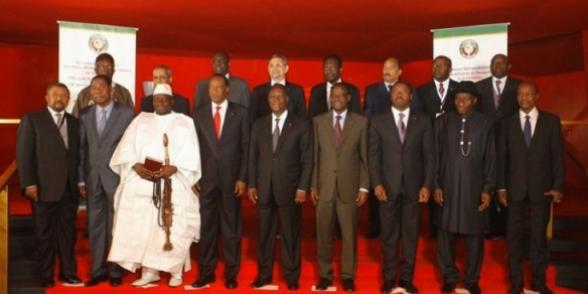
Overall, however, efforts by Mali’s new civilian authorities and by the international community to get the government up and running again, without undue interference by the military, seemed to be working. Then, late Thursday, we learned that a summit of West African heads of state in Abidjan, organized by the Economic Community of West African States (ECOWAS), had decided to fix the duration of Mali’s transitional president and government at 12 months, and to dispatch at least 3000 soldiers to Mali to “secure the transitional government” and “supervise the transition.” And they threatened targeted sanctions against junta leaders who didn’t abide by ECOWAS decisions.

ECOWAS leaders in Abidjan, April 26, 2012
(See that guy in the white robe? He came to power in a coup! So did the one in the red tie….)

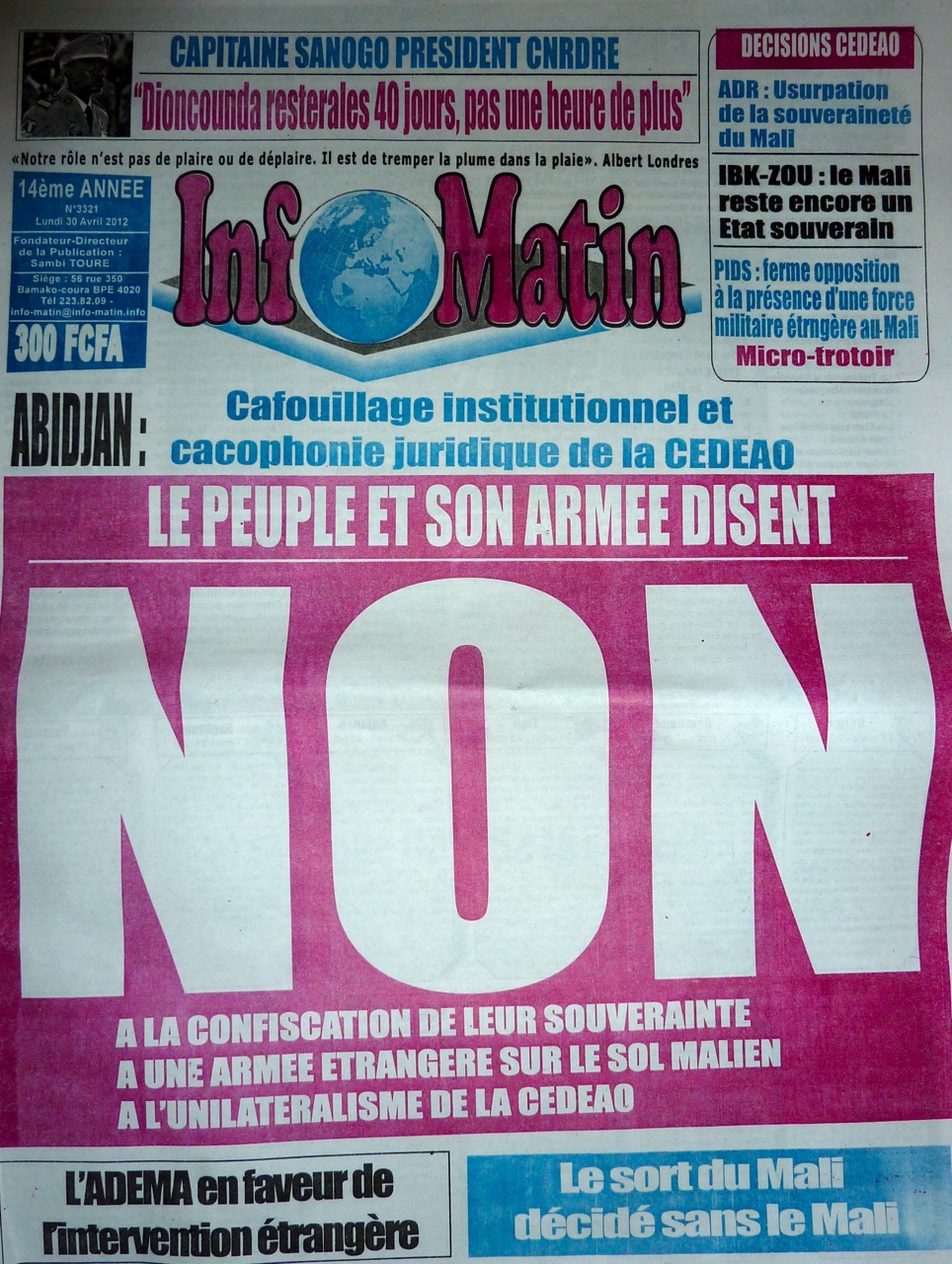
Responses to this declaration from Bamakois have been highly critical. A good many people here see the CNRDRE as having a legitimate role in Mali’s political process, as I wrote a month ago, and they don’t like to see Captain Sanogo and his men threatened. Nobody is keen on having their country’s transition managed by outsiders, especially by foreigners whose own democratic credentials are often dubious at best.

The people and their army say NO… (April 30, Info Matin)

On top of that, Malians wonder how ECOWAS, for all its emphasis on respect for constitutional process, can unilaterally extend the length of the transition beyond the 40 days provided for by Mali’s constitution. 40 days may be too short to achieve very much, but any modification of that period ought to come from within Mali’s political system rather than being imposed from outside.

At the Kati army garrison where the CNRDRE is based, tempers flared. Rowdy troops gathered to jeer at the foreign minister of Burkina Faso, Djibril Bassolé, who had come to represent ECOWAS in talks with junta leaders, and reportedly cocked their weapons to demonstrate their opposition to any compromise. Captain Sanogo, despite the cagey game he’s played to stay in the political picture, has always publicly stated his support for regional mediation of Mali’s crisis, and now it’s unclear whether he can make his men respect any deal brokered with ECOWAS. He has repeatedly rejected any foreign troop deployment in Mali.

Many observers, myself included, have a great deal of respect for the role the Burkinabè, particularly Foreign Minister Bassolé, have played throughout this crisis. Bassolé has demonstrated quiet, effective diplomacy and a knack for heading off conflicts. But the ECOWAS heads of state, with their deadlines and threats, have put him in a difficult position. The risk now is that more Malians (especially those in and around Bamako) will start to perceive the current crisis as pitting Mali’s needs against sinister foreign agendas, as the country’s anti-globalization left has been depicting things all along. Up till now those radical anti-ECOWAS voices have been a tiny fringe, but in light of the heavy-handed tactics recently adopted by ECOWAS, they are growing louder and more numerous by the day, putting further attempts at outside mediation in jeopardy. An anti-ECOWAS rally has already been announced for Thursday.

It’s been said that “diplomacy consists of telling the other guy to go to Hell in such a way that he looks forward to the trip.” Rattling sabers and issuing ultimata may sound great, but it’s ultimately counter-productive in situations like the one Mali faces now. If ECOWAS leaders truly seek a diplomatic solution to Mali’s current political mess, they need to tone down the rhetoric and give Captain Sanogo and his men a face-saving way out.

Lacking that, the progress of the last few weeks will prove to be very short-lived, and Mali’s most pressing goal — reunifying the country — will grow ever more remote.

Posted in Uncategorized | Tagged , , , , , | 12 Comments

Hail the newcomers

On Wednesday, after days of delay, the composition of Prime Minister Cheikh Modibo Diarra’s government was finally announced. Like the prime minister himself, most of the cabinet ministers selected are outsiders to Bamako’s political scene, and could not be easily associated with Mali’s classe politique. None had served in governments under ousted president Amadou Toumani Touré (ATT) over the last decade.

Prime Minister Cheikh Modibo Diarra addressing the nation last week

Observers have already raised a number of objections to Diarra’s cabinet. Some say its key posts have gone to the military, which is true: the ministers of defense, territorial administration, and internal security are all military men. It’s worth noting, however, that the same was true in ATT’s last government, where these same ministries were run by high-ranking army officers. The difference this time is that Mali’s three soldier-ministers are close to the CNRDRE junta. This is especially true of Colonel Moussa Sinko Coulibaly, Minister of Territorial Administration (akin to an interior minister): until yesterday he was junta leader Amadou Sanogo’s chief of staff, and he has already paid a visit to the latter in his Kati headquarters, showing where his first loyalty lies.

Another complaint is that the new government defies the spirit of the transitional agreement signed earlier this month between the junta and the West African regional body ECOWAS. This allegation has been made by both the anti-putsch Front uni pour la défense de la République et de la démocratie (FDR), composed mainly of “old-guard” political parties that had participated in governments under ATT’s rule, and by the formerly pro-putsch Mouvement Populaire du 22 Mars (MP22), composed of some of the most radical critics of ATT’s rule. Their specific objection is that the cabinet is not a “government of national unity” as called for by the transitional accord. What they really mean is that none of their people were chosen for it. MP22’s decision to end its support for the junta in response to the new government’s formation is hardly surprising: the movement’s leader, Oumar Mariko, has been angling for a job in the transitional government since the first days of the coup.

A critique levied by RPM party boss Boubacar Touré, among others, is that the new cabinet shows too much influence from neighboring heads of state, particularly Blaise Compaoré, President of Burkina Faso. The most senior cabinet member, Sadio Lamine Sow, placed in charge of the Ministry of Foreign Affairs, has served as a special adviser to Compaoré in Ouagadougou for several years. The new Minister of Communications and Information Technology is Hamadoun Touré, who as spokesman for the United Nations mission in Côte d’Ivoire last year was seen as someone close to Ivoirian President Alassane Dramane Ouattara. Notably, the cabinet includes several “Maliens de l’exterieur” — like the prime minister himself, these are migrants who’ve spent much of their professional lives abroad.

It’s also true that the government lacks women (only three out of 24), and that northerners are under-represented, in contrast to successive ATT cabinets in which northerners in general, and Tuareg in particular, were highly visible.

But let’s look at the positive side. One noteworthy choice is the new justice minister, Malick Coulibaly. He is a former assistant prosecutor whose claim to fame is having resigned his job nearly four years ago in protest of high-level interference in one of his cases. The case was a banal dispute over a cow, but the prosecutor’s resignation was surprising because such gestures of principle have been rare in Mali (where, all too often, resigning from government means unemployment). Coulibaly’s appointment is therefore highly symbolic. Malians have little faith in their judicial system, as I pointed out in a previous post; one elderly man once told me, “Judges in Mali aren’t 100 percent corrupt. They’re 1000 percent corrupt.” The hope is that Coulibaly will be able to clean house.

Like a lot of Malians I’ve heard from since yesterday’s announcement, I’m inclined to see the formation of this new government as an encouraging sign. Yes, the cabinet shows the continuing influence of the junta, but most of its members appear to have been selected based on professional competence rather than party affiliation or partisan loyalty. This, more than anything else, is what upsets the bigwigs of the classe politique, and that’s just fine with ordinary Bamakois. Given prevailing public distrust of Mali’s established political parties, I doubt that protests by either the FDR or the MP22 against the new government will get much traction. The cabinet’s infusion of “new blood,” on the other hand, has been widely hailed in Bamako as a very good thing. Being a political unknown is an asset these days.

We should be wary, however, of the strong emphasis during this transitional process on the personal integrity of public officials. The way people around here tend to describe things, previous governments were venal and corrupt because the ministers named to them were immoral individuals who never received proper upbringing. Not enough Malians appreciate the extent to which bad governance stems from institutional rather than individual factors. Personal integrity is well and good, but in the absence of effective institutional controls, even upstanding individuals can achieve little in the fight against corruption.

In short, as a New Orleans prosecutor once said, “Corruption is not about greed, and it’s not about need; it’s about opportunity.” As long as public officials have the opportunity to abuse the public trust, with little fear of being caught or punished, they will do so — especially in a social context where high status comes with powerful obligations to reward one’s kin and supporters and to “share the wealth.”

Mali’s new government should be hailed as an important step forward, but it will need to build a climate where the rule of law prevails alongside respect for the state and its institutions. That battle is at least as important as the battle to reunify the country and regain the north, and in the long run Mali can’t succeed without winning it.

Posted in Uncategorized | Tagged , , , | 7 Comments

Life goes on amid crisis

It’s the hot season in Bamako. How hot is it? When you turn on the cold water tap, you get hot water. That’s how hot it is.

Power outages are still a daily occurrence in town, but for the last week or so they’ve been growing shorter — lasting anywhere from two to eight hours daily, instead of ten or eleven, and almost exclusively during the daytime.

As always at this time of year, along the Niger River, flamboyant trees (Delonix regia, an exotic species native to Madagascar but now found throughout the tropics) are in full boom, their orange-red flowers bright against the hazy hot-season sky.

Flamboyants on the Niger’s left bank

Deposed president Amadou Toumani Touré got on a plane last Friday and flew into exile in Senegal, but only after reportedly being accosted and threatened by troops loyal to the CNRDRE junta that ousted him from power. According to an account in the local press, shots were even fired on the airport tarmac as he was getting ready to board his plane, resulting in a disorderly and disgraceful exit for the man who had been Mali’s head of state since 2002 until last month. There was a similar dust-up over the weekend when Soumaila Cissé, injured while trying to escape arrest last week, wanted to fly to France for medical treatment. Ultimately he was allowed to board his plane, but only after the intervention of high-level foreign diplomats.

From Turkey, ORTM’s latest TV soap acquisition, “Noor”

On ORTM, the state television service, the Turkish soap opera “Noor” has replaced the Telemundo telenovelaFrijolito” on weekday afternoons. Many Bamakoises never got to see the ending of “Frijolito” due to power outages. This was a source of much regret for the women in my household.

Apparently the junta continues to exercise some degree of control over the content of state media. Inside the ORTM compound, amid the usual bustle of employees and visitors, dozens of soldiers lounge in small groups. A twin-barreled anti-aircraft gun sits in the back of the courtyard, facing the entrance. It is ideally positioned to take out any nearby threat, such as the Hotel de l’Amitié. If you’re checking in there, I’d avoid getting a room on the upper floors.

(What is it about putschistes and anti-aircraft artillery? As the BBC’s Mark Doyle noted in Guinea a few years back, warfare in Africa almost never involves shooting down enemy planes; yet as soon as a crisis occurs, the army breaks out the triple-A.)

Those familiar with Bamako know that there are many exotic flavors of soft drinks to be found here. As of this month there are two new flavors on the Malian soft drink market. D’jino has a pear-flavored soda, which is not bad, and Youki has introduced ginger soda. Unfortunately I haven’t yet been able to sample the latter as it has not yet been distributed to our neighborhood beverage retailers.

Just when you thought it was safe for old-guard politicians to go out in public again, we’ve gotten word of new arrests by the junta of people in interim president Dioncounda Traoré’s entourage. Which brings us back to the question, Who’s really in charge around here? If it’s the civilian transitional government, why does the army keep detaining political figures connected to it? A CNRDRE representative recently told the Voice of America that the junta exercises no political power and answers solely to civilian officials, but that claim rings about as hollow as last week’s allegations of a sinister plot against the Malian people. At least there was one positive sign in junta-civilian relations this week: CNRDRE head Captain Amadou Sanogo called on President Traoré at the presidential palace, marking the first time he’s visited Mali’s civilian leaders. Up to this point, they’ve always had to drive to Kati to see him. But the presidential palace still hasn’t recovered from the damage and looting that took place last month.

Bamako received its first rainfall in six months last Friday morning, temporarily reducing the hot spell. The rain, however, came around the same time as a deadly accident on the Pont des Martyrs that took the lives of three U.S. military advisers and three Moroccan civilians.

For the rest of us, even in the face of continuing uncertainty and stifling heat, life goes on.

Posted in Uncategorized | Tagged , , , | 2 Comments

Catch and release

Just a few days ago, many observers outside Mali believed that the CNRDRE junta responsible for ousting President Amadou Toumani Touré (ATT) last month had departed the political scene, having handed control of the state to a civilian government. Events of this past week have shown not only that the junta wants to continue wielding power on Mali’s political scene, but that its leaders are skilled political tacticians.

The wave of arrests that shook Bamako’s classe politique between 16 and 18 April cast a wide net. As of this Friday morning those detained have all reportedly been freed, but it’s worth asking what this episode reveals about the junta. I’ll divide the individuals targeted into four categories:

  1. Prominent members of the anti-junta Front du Refus (FDR), like Kassoum Tapo and Tieman Coulibaly, who pose the most immediate political challenge to the junta;
  2. High-ranking figures in the pre-coup state security apparatus, a category composing half of all those detained, such as the former defense minister Sadio Gassama and head of national police Mahamadou Djagouraga;
  3. Former top officials in ATT’s deposed regime, such as ex-prime minister Modibo Sidibé, ex-chief of staff Hamidou Sissoko, and ex-adviser Bani Kanté, who rightly or wrongly with ATT receive much of the blame for the problems currently afflicting the Malian state; and finally,
  4. A residual category of individuals I can’t place in any of the above three categories; these include prominent presidential candidate Soumaila Cissé and a banker named Babaly Ba. While Cissé had no connection to ATT’s government, Ba was reputed to be close to certain members of ATT’s entourage.

I spent much of the last few days puzzling over what this list of detainees signified, and what if anything the individuals arrested have in common. The CNRDRE has issued vague statements that the detainees were hatching a sinister plot, but these statements cannot be considered credible. Nothing links all these individuals together, and it defies belief that these heterogeneous elements could form a cabal… though some of them could conceivably be in league with each other.

Was the junta trying to assure its leaders’ own security by simultaneously targeting its most vocal political opponents (category 1) and top defense and police officials (category 2)? Maybe. On this score it’s noteworthy that since the coup, CNRDRE head Captain Amadou Sanogo has rarely left his headquarters in Kati’s Soundiata Keita army base. He clearly believes his power, and perhaps his life, are threatened. This week top officials in the civilian government went to see him, not the other way around.

The junta might also have been hoping to score political points with ordinary Malians, and especially Bamakois, by going after some of the people most closely associated with the unpopular ATT regime (category 3). These days it’s hard to find people in Bamako who won’t tell you that the political apparatus under ATT was corrupt to the core, or who express sympathy for all those big-shots who have now been humbled. Pro-junta journalists love to speculate about all the sins those arrested might have committed both before and since the coup.

But it’s the combination of all four categories that suggests another purpose to the junta’s crackdown this week, and I suspect I know what that purpose was.

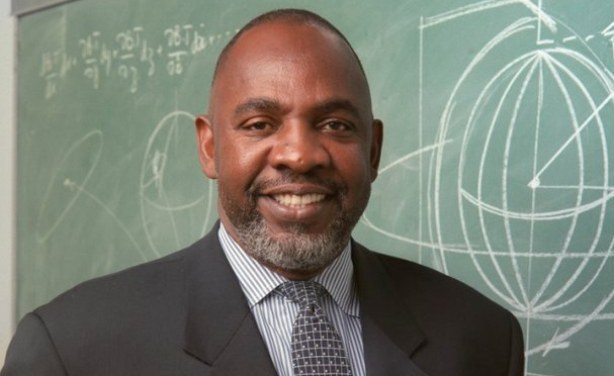
Cheick Modibo Diarra: Politics is not rocket science (it’s much harder)

The arrests began, not coincidentally, at the same moment that Mali’s transitional prime minister was named. Dr. Cheick Modibo Diarra (CMD) is a political outsider but a familiar name here: a physicist by training, he gained fame working on NASA’s Mars Pathfinder mission in the 1990s, then headed Microsoft’s operations in Africa before becoming a candidate for the presidential elections that had been expected later this month. He is now officially in charge of forming a cabinet, organizing elections and reunifying his secession-split country — not necessarily in that order.

Behind the scenes, the CNRDRE has been maneuvering to claim key ministries in CMD’s new government. The haggling over which ministerial portfolios would go to which parties and factions was intense, and lacking outside political support the junta had little leverage in these negotiations.  After the wave of arrests occurred, however, junta leaders had valuable bargaining chips in their possession, notably key figures of two of Mali’s largest and most powerful political parties — ADEMA (Kassoum Tapo) and the URD (Soumaila Cissé). Their being in military custody sent a chill through Bamako’s entire political class, with the heads of all major parties suddenly fearing for their own safety. It seems likely the junta only agreed to set its detainees free in exchange for increased influence in the new government. This would explain the odd mixture of people arrested — a diverse political portfolio — as well as the fact that the military released all of them without a protest, despite having (indirectly) accused them of treasonous activities.

What lesson can we learn from this week’s events? Don’t underestimate the CNRDRE leaders, who have shown more political cunning than many of us initially gave them credit for. They know how to use power to achieve their aims without overplaying their hand. In light of the junta’s keen survival instincts, it will prove difficult to isolate, marginalize or weaken Sanogo and his followers in the weeks to come.

Footnote: My analysis in the last two paragraphs above hinges on the reporting of the Bamako-based daily L’Indépendant which, aside from being one of Mali’s most respectable newspapers, correctly predicted Cheick Modibo Diarra’s nomination as prime minister. But it can still get things spectacularly wrong, as when it reported last week that Cheick Modibo Diarra had persuaded the U.S. to send Apache helicopters to help the Malian government combat the rebellion in the north.

Posted in Uncategorized | Tagged , , , , , | 2 Comments

On the junta for enemies

On Tuesday we started hearing about the arrests. Former prime minister and presidential candidate Modibo Sidibé was taken from his home Monday night by soldiers and brought to the military base in Kati, where the CNRDRE junta is headquartered. This was not a huge surprise, since Sidibé had already been detained by the junta twice in the last few weeks. Closely associated with deposed president Amadou Toumani Touré, he is seen by many as the incarnation of everything that was wrong with the Malian state under ATT’s rule.

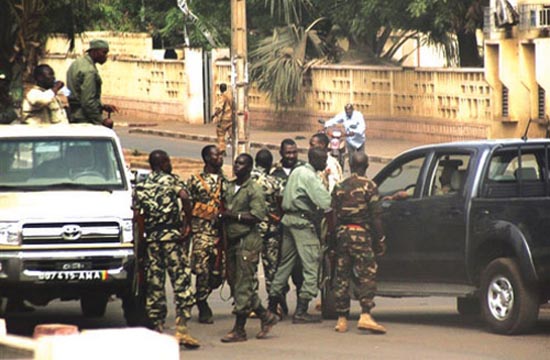
Junta troops in Bamako (source: abidjandirect.net)

Around the same time, the junta arrested several more of ATT’s top officials, including at least three generals. General Hamidou Sissoko, ATT’s ex-chief of staff, and General Sadio Gassama, his former security minister and defense minister, were both nabbed at their homes Monday evening, as was General Mahamadou Djagouraga, former director of Mali’s national police. An unnamed general of the Gendarmerie Nationale was reportedly also picked up.

ATT’s former adviser Bani Kanté, who also oversaw Libyan investments in Mali, was another high-profile figure whose arrest became known on Tuesday. Two more, according to local sources, are Babaly Ba, director of the Banque Malienne de Solidarité, and Adama Sangaré, mayor of Bamako.

Most significant, however, was the arrest of Soumaila Cissé, who frequently served in governments during both terms of President Alpha Oumar Konaré (1992-2002) and who lost the second round of Mali’s presidential election to ATT. Unlike the others arrested (with the possible exception of Babaly Ba), Cissé has no direct links to the ATT regime. He spent most of the last decade in Burkina Faso, where he chaired the body that oversees the region’s common currency.

Cissé was initially reported to have escaped arrest, having fled his home in Badalabougou, but was later picked up nearby by police and transported to Kati in an ambulance. There are indications he was injured either during his initial escape or during the subsequent arrest. Les Echos reports that he had head wounds; L’Essor reports that even the intervention of the ambassador of Burkina Faso could not dissuade the police from arresting Cissé.

Why is the junta going after Cissé? I can’t say, but they’ve been targeting him for some time; let’s recall that armed men ransacked his home on the very first night of the coup.

So far, it’s not clear why any of these individuals have been arrested. No announcements have yet been made by the CNRDRE. Interim President Dioncounda Traoré, for his part, seems not to have been informed of the arrests in advance.

Never mind that the Malian military has no legal authority to arrest civilians. Amid all the confusion, one thing has become perfectly clear: reports of the junta’s demise were greatly exaggerated. Captain Amadou Sanogo, having had a taste of power, is not about to let it go, and has stated as much to the Malian media (though, tellingly, not to the international media).

Sanogo is seeing how far he can push things, and unless political actors with legitimate constitutional mandates start to push back, he will succeed in sidelining the civilian authorities who have been ostensibly put in charge. The question now is whether such political actors can command enough loyalty within the security forces to confront the junta head-on. President Traoré and his newly named prime minister, Cheikh Modibo Diarra, are being put to the test.

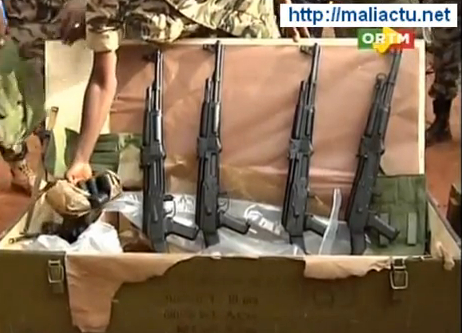
“Captured weapons” on display (ORTM evening news, 18 April)

Update for 8:00 a.m. GMT, Thursday, April 19: More arrests were revealed Wednesday, for a total of 22 persons in custody so far, half of them civilians, half military. Kassoum Tapo, a very senior figure in the ADEMA party, and Tieman Coulibaly, head of the UDD party were both arrested by the junta, in front of the very hotel where Dioncounda Traoré has his headquarters. Both are active in the anti-junta coalition known as the FDR. On Wednesday night, the ORTM news showed images of assault rifles it claimed were discovered in the residences of some of those arrested (without specifying which ones). The CNRDRE is claiming that a “counter-coup” was in the making — further proof, if any was needed, that the junta believes it is still very much in control.

Meanwhile, Senegal’s new president Macky Sall announced in Paris that Mali’s deposed president, Amadou Toumani Touré, has taken refuge at the Senegalese embassy in Bamako.

Posted in Uncategorized | Tagged , , , , | 10 Comments

Is Bamako back to normal?

There’s an adjective I use a lot lately in describing life in post-coup Bamako. That adjective is “normal.” Walking or driving through the city’s neighborhoods, and talking with its residents, one can be surprised by just how little seems amiss. And it’s only been three weeks since Mali’s political scene was completely upended and two decades of democratic rule interrupted.

The sanctions imposed by Mali’s neighbors following the March coup d’état were lifted after less than a week (though there are those who contend the embargo was never really enacted to begin with). The military junta, the so-called CNRDRE, signed a preliminary agreement to hand over power to a constitutionally legitimate civilian leader, Dioncounda Traoré, who was sworn in on April 12 amid great pomp. And long before the political situation stabilized, the people of Bamako were going about their business. Six days after the coup, schools were back in session, government offices had reopened, and the markets looked as busy as usual.

In many ways, “normal” accurately conveys what life in Bamako is like these days. The biggest change for most Bamakois’ daily routines has been power outages, rare and short-lived before the coup but daily 10-hour ordeals since. They are mostly an inconvenience for me, but pose severe problems for many Bamakois. Although we were initially told that these blackouts were a consequence of the ECOWAS embargo (which prevented fuel from coming into the country), they’ve continued in the week since the embargo was lifted. So it’s difficult to know what’s really causing them, although a power company spokesman claims they have nothing to do with recent political upheaval.

The state broadcasting service, ORTM, is airing its regular shows — even if we can’t watch them when the power’s out. It’s been over a week since we’ve seen a news anchor reading CNRDRE communiqué or anyone in camouflage fatigues making a statement. The soldiers who had occupied the ORTM complex have mostly left, and the armored vehicles they had used to block the street in front of the complex are gone. But the street remains partially closed to traffic, and a handful of soldiers can be seen lounging on the corner where the police used to be. (The junta leaders, as I argued last week, seem to be interpreting their withdrawal from the political stage as a 40-day respite rather than a permanent departure, and in fact they were recently in Ouagadougou negotiating the terms of their continued involvement in Mali’s political transition process.)

The Cité Ministerielle, viewed from the south

A few days ago I visited the Cité Ministerielle on the north bank of the Niger River, a Libyan-financed Malian government office complex inaugurated in late 2011 (ironically, just as Gaddafi was being driven from power). It was my first time there since the coup. Driving through the gate, you can see multiple government ministries, with the usual number of  vehicles and people moving about. From the outside, everything’s normal.

Inside the Cité Ministerielle, 13 April 2012

Inside the buildings, however, it’s another story. Corridors are lined with shattered safes busted open by looters during the days after the coup when the complex was closed. Office doors were broken open to get at the computers and office equipment inside; consequently, the ministry employees have nothing to work on. In the courtyards are great piles of trash, broken glass and splintered doors cleaned up since employees came back to work on March 27.

The debris the looters left behind

It’s the same way in every office on every floor of every building in the complex, and there are over a dozen such buildings. The theft was systematic. Pillage on this scale could only have been carried out with the complicity, perhaps even the direct involvement, of elements of the Malian military (specifically the Garde Nationale) tasked with security for the complex.

The same thing happened at Mali’s customs service headquarters, at the defense ministry, at the foreign affairs ministry and even at ORTM, which only continues to broadcast thanks to some of its mobile field units that have since been brought in to Bamako.

Yet no investigation has been launched, let alone any guilty parties charged. If by chance culprits should be identified, they would likely benefit from the amnesty written into the accord between the junta and ECOWAS to restore civilian rule.

And so the culture of impunity rolls on, as a new crop of political actors take advantage of their positions to enrich themselves at the expense of the state and the people they ostensibly came to serve. Those hailed for having ended a regime notorious for its corruption are beginning to mirror its most excessive practices. Already there are reports of junta members buying lavish houses in Bamako for themselves. This is, alas, what passes for “normal” around here.

And in the words of my Canadian togoma Bruce Cockburn, the trouble with “normal” is, it always gets worse.

Posted in Uncategorized | Tagged , | 3 Comments

Vigilante democracy

March 21, 2012, 3:00 p.m.: A band of army mutineers in the garrison of Kati launches an assault on Koulouba, the presidential palace overlooking Bamako. With armored vehicles, automatic weapons and rocket launchers, they target the executive residence, forcing President Amadou Toumani Touré to escape the compound with a few bodyguards and go into hiding. The mutineers take control of state radio and television, and several hours later proclaim themselves the new rulers of Mali.

January 29, 2012, 5:00 a.m.: A young man is caught stealing from a residential courtyard in Bamako’s Djelibougou neighborhood. Neighborhood youths tie him up and beat him before dousing him with gasoline and setting him alight. The young man is burned to death, and his body anonymously disposed of by a local trash collection crew. The stolen goods? Two sacks of charcoal, worth no more than US$5.00 each.

Could these two events be related? I think so. For months, such examples of vigilante justice have been growing more and more frequent in Bamako. Consider these examples gleaned from the Malian press:

  • February 26: “Youths in Doumanzana (Commune I of the District of Bamako) burned a motorcycle thief alive…. That same night, in Banconi not far from the water tower, another thief was burned alive by youths. Two thieves burned in one night and in the same area means the people’s propensity to render justice themselves.”
  • February 16: “A Qur’anic teacher, Baba Adama Sangaré, was killed by armed robbers during an attempted break-in….  The next day, gendarmes in Gouana caught two suspects, Broulaye Samaké and Mohamed Sérémé. Learning of the arrest, the population demanded to lynch the suspects and burned the shed serving as the gendarmes’ outpost. Overwhelmed, the gendarmes called for reinforcements from their brigade in Kalaban-Coro. Before these could arrive, the demonstrators apprehended Broulaye Samaké, a.k.a. Bamba, presumed killer of the Qur’anic teacher, and burned him alive.”
  • January 31: “Two presumed thieves were lynched to death in Nafadji (Commune I) and the Medina market (Commune II) at the end of last week by populations fed up with this recurring banditry and, especially, by the screaming absence of the Malian police and by the laxity, even complicity, of judges.”
  • January 9: “These presumed bandits who allegedly victimized many people were Bakary Monékata and his brother Aboubacar Monékata, both former soldiers dishonorably discharged, according to a source in the Kalaban-Coro gendarmerie…. Aboubacar Monékata… evaded police before being caught by an angry mob which ended up lynching him to death.”

I’ve found reports of seven alleged criminals being killed by mobs in Bamako the first two months of 2012 alone. Surely other cases were never reported.

Mob justice is nothing new in Bamako. Lynching was a common practice in the early 1990s around the time of Mali’s previous coup. Back then, there was “no law and no authority. Enraged people sought justice and wouldn’t hesitate to buy a liter of gasoline at 300 CFA francs and a box of matches at 20 francs to burn the thieves,” a Malian journalist wrote last year. Hence the practice of dousing victims in gasoline and settling them ablaze was nicknamed “Article 320” of the constitution.

As Mali’s democratic transition advanced and the rule of law was reestablished, “Article 320” faded away. Around the middle of last year, however, it again began to rear its ugly head. At least ten cases were reported by the beginning of June, and several journalists observed that lynching was making a comeback, with many Bamako residents openly supporting the practice. Last September a group of youths marched on a police station in Badalabougou, my neighborhood, proclaiming “Let thieves beware: we’ll burn them alive.”

I don’t believe it’s a coincidence that the recent coup d’état in Bamako followed several months of lynching incidents. The coup and vigilante justice are different expressions of a single logic shaped by the state’s perceived failure to enforce the law. When the government is seen as having abdicated its fundamental responsibilities, by this logic, taking charge through violence becomes legitimate and even salutary.

Two points are key here. One, this logic is neither universal nor uncontested. There are many Bamakois opposed to the coup, just as there are many opposed to lynching. If you scan readers’ comments on the news links above, you’ll find some condemning mob justice and others expressing support for it. Two, whatever the actual motivations of the coup leaders — and, as I’ve pointed out, their public justifications have been all over the map — part of the junta’s appeal to Malians in general, and Bamakois in particular, has been its stated intention to end the lawlessness prevailing in Malian society, in affairs of state as much as in everyday life.

Malian police: Would you trust these men?

It’s telling that the Badalabougou youth I mentioned earlier ended their march at a police station. They were serving notice that the state had failed in its duty to protect law-abiding citizens. Consider also that in some of the incidents detailed above, mobs confronted law enforcement personnel who had suspects already in custody. What the recent wave of lynching suggests is that by late 2011, a large number of people here had lost all faith in their justice system’s ability — and even willingness — to punish wrongdoers.

“The harshest sentence issued in the last court session against confessed armed robbers… was no more than five years suspended,” wrote a Bamako journalist last July. “One notes bitterly that at least two out of five criminals are repeat offenders whose sentences were never completed. In light of all these failures of the system, should we be surprised to see populations taking their security into their own hands?”

This mistrust extended to many areas of government. When people no longer trust the institutions of the state to protect their safety or defend their interests, such responses become foreseeable. Bamako’s recrudescence of lynching in mid-2011 should have been a warning sign in this regard, an indication that the regime was in trouble. I wonder whether political scientists studying cross-national data might be able to find a correlation between instances of mob justice and violent internal regime change.

The problem, of course, is that vigilante justice goes too far. When it does not punish the innocent, it metes out disproportionate punishment. With no oversight and no limits, vigilante justice quickly goes awry. The same is true of military juntas and any other regimes improvising their way in the absence of institutional controls, checks and balances.

You cannot rebuild the rule of law through extralegal means. Unfortunately, this is a lesson that not enough people have learned, and I think the cost to Mali will be much greater than that of two sacks of charcoal.

Update, May 10: Here’s a recent article on the “reappearance of Article 320” in Bamako’s Commune I.

Update, August 26 2013: An item on the killing of a 20-year-old suspected motorcycle thief in Bamako’s Boulkassoumbougou neighborhood.

Posted in Uncategorized | Tagged , , | 16 Comments

Captain Sanogo stays in the picture

Over the long weekend in Mali (Easter Monday was a day off for schools and offices here), the country’s process of transition from military to civilian constitutional power was officially launched. President Amadou Toumani Touré appeared on state television on Sunday night, for the first time since before the coup, to announce his resignation. National Assembly speaker Dioncounda Traoré has been meeting with various members of the classe politique in Bamako as well as with the CNRDRE junta, and Mali’s supreme court has convened to pave the way for Traoré’s official designation as the country’s new head of state. This process has been hailed internationally, including by the United Nations, and members of the global media have confidently reported that the coup leaders are stepping down.

There’s just one problem: Not only are the junta’s members still occupying Mali’s political stage, but they may have no intention of leaving it anytime soon.

Capt. Amadou Sanogo on state TV, 9 April

Appearing on state TV on Monday night, CNRDRE head Captain Amadou Sanogo indicated that he means to play a role in Mali’s political transition, a role which may be at odds with the role he was expected to take under the auspices of an agreement reached between the junta and the regional body ECOWAS late last week.

Malians were already suspicious of Sanogo’s willingness to vacate power, and his televised statement on Monday to members of the Malian press, delivered in the Bamanan language, has only fanned the flames. The junta is not being dissolved, its members are not “stepping down,” and moreover they seem intent on having their say in the coming weeks and months of political transition. Below are my translations of two of the more troubling statements Sanogo made during this appearance:

  • “The committee [CNRDRE] is not going anywhere; when a group of soldiers takes power, nobody can sideline them, and that’s no joke.” [starts 12:47 into the video]
  • “After Dioncounda’s 40 days, the CNRDRE and ECOWAS will meet again to decide on the next steps to take.” [starts 13:40 into the video; reiterated at 14:07]

While members of the international community are congratulating themselves for pulling Mali back from the brink and getting the Malian military to hand over power, these remarks suggest that Sanogo thinks he and his fellow coup plotters have given up nothing. The CNRDRE is not being dissolved, and its members mean to play an abiding role in Mali’s political affairs, including naming the prime minister charged with organizing elections and reunifying the country. The interim president, Dioncounda Traoré, will only be in office for 40 days, after which Sanogo and his men will again (or perhaps still?) be overseeing the transition.

Sanogo made statements on Monday afternoon to the effect that the coup he and his associates led last month was a product of divine will:

“These last 20 days our country has known a new thing. And this new thing, we can say it is God’s doing, because if He does not will it, it cannot happen. God also saw to it that we who are seated here were the ones who carried it out; otherwise, someone else could have done it.” [starts 20 seconds into the video]

The military takeover, in other words, is something that cannot be nullified or cast aside by the actions of mere men. And Sanogo feels it is his divine right to occupy the position he now commands.

Is Captain Sanogo using the same tactics as Cote d’Ivoire’s ex-president Laurent Gbagbo, manipulating those seeking to marginalize him, appearing to accede to their demands while actually digging himself in more deeply and clinging more resolutely to power? Part of the problem is that the preliminary accord signed on 6 April could not be more vague on what if any part Sanogo and his men can play moving forward: it merely reads that “the role and place of the CNRDRE members in the transition process will be defined” (chapter 2, article 6, letter e).

In what’s been described as a slap in the face to ECOWAS negotiators, Sanogo further rejected the possibility of ECOWAS or other foreign troops being deployed to Mali to help fight the rebellion in the north. (To read an alternative interpretation of last week’s accord, according to which ECOWAS backed down and the CNRDRE came out the victors, read this op-ed from the pro-junta paper Inter de Bamako.)

At a juncture characterized by ambiguity and grey zones, two things are clear. One, the agreement signed between the junta and ECOWAS last week is being interpreted by different actors in very different ways. Two, ECOWAS, foreign governments and the international media need to keep a close eye on the junta leaders to ensure that Mali’s return to constitutional rule does not skid off the tracks. In his own mind, at least, Captain Sanogo appears to be a long way from stepping down.

Posted in Uncategorized | Tagged , , , , , | 24 Comments