The Coup, Day Four

7:00 a.m.: Hèrè sira, as they say in Bamanan — we spent a peaceful night. I have not heard further shooting or booms of any kind since 11:15 last night. Power was only out for a couple of hours after midnight. A brief scan of the online news sources this morning nets a recent condemnation of the coup from presidential candidate Soumaila Cissé (the same one whose home was sacked early Thursday morning), who is apparently still at large, as well as probably the best video I’ve yet seen from Bamako post-coup, recorded by French journalists with AITV (see below); in addition to some of the usual footage of interviews with Capt. Sanogo, it shows soldiers looting the ORTM studios and has a few man-on-the-street interviews with ordinary Malians, all of them wary of the soldiers. Up till this, since Wednesday night I hadn’t seen evidence of journalists actually getting out into the city and gathering any information; they were all clearly “sheltering in place” like the rest of us, and most of the photos posted online were clearly taken from the Hotel de l’Amitié, directly across the street from the ORTM.

The New York Times meanwhile has a story filed from Dakar which includes a few new tidbits: coup leader Capt. Amadou Sanogo has apparently “received extensive training in the United States between 2004 and 2010,” at the Defense Language Institute at Lackland AFB in Texas (he has been described as an English instructor at the Kati garrison), at Fort Huachuca, Arizona (intelligence training) and at Fort Benning, Georgia (infantry officer basic training). No mention of any link with the Marines, so it’s unclear why he wears the USMC eagle, globe and anchor pin on his uniform. The article also contains a condemnation by presidential candidate Tiébilé Dramé of the coup (his PARENA party being one of several parties coming out in opposition to the CNRDR). And the response from abroad remains strong and united in condemnation.

The Times item also highlights one source of growing concern: it’s becoming harder to get diesel and gasoline in Bamako, in part because service station owners have shut their businesses to keep from being cleaned out by soldiers. The only way for ordinary people to get fuel now is on the “black market,” i.e. from some guy with a plastic jug and a glass bottle to measure it into. A friend of mine ran out of gas on his motorcycle driving home yesterday and had to pay 900 francs for a liter from one such vendor. He was lucky: some people are paying 1400 francs these days.

Otherwise I don’t see any new developments, there’s nothing much on RFI or BBC radio, and nothing at all about any counter-coup that was rumored to be in the offing yesterday evening. ORTM is off air, probably until 8 a.m. which is the time they began broadcasting Friday.

8:00 a.m.: ORTM begins its broadcast day with a repeat of last night’s Journal Télévisé, followed by educational and cultural programs.

9:00 a.m.: An air of normalcy continues to settle over many parts of the city. A taxi driver friend tells me over the phone that downtown Bamako is calm. Another taximan I call up tells me he’s had no trouble getting diesel, though it costs more than usual. I venture out into my neighborhood. The volume of traffic over the King Fahd Bridge is typical for a Saturday morning, with plenty of taxis and SOTRAMA minibuses circulating alongside private cars and motorcycles. Our local supermarket has reopened for the first time since Wednesday; it would have been the first stop of any roving looters in our area, but the owner feels safe enough to open his doors today. The shelves are well stocked and business is booming, in part because nervous expats like me are stocking up on supplies. Despite what I’ve read online, there is no shortage of bread in any of the shops I’ve visited or passed by, and shops are receiving new deliveries.

Around this time another SMS arrives: “US Embassy Bamako advises all American citizens to continue sheltering in place. No significant changes overnight.” No signs of any major developments via the electronic media either, but RFI has an interesting roundup of local and world opinion on the CNRDR coup.

11:00 a.m.: I’m posting my own translation of a message posted on Malilink this morning by mathematician Dialla Konaté, a professor at Virginia Tech and a fixture of the Malian intelligentsia. His statement suggests why so many Malians were so frustrated with the government of President Touré and why, despite their ambivalence, they may ultimately support the coup:

“My message is addressed just to those who think that Mali was a democracy in name only and that the reality was a blend of corruption and criminalizing the economy, the hollowing out of justice, the dilapidation of the school system, the takeover of occupied property [by powerful individuals] to use as life insurance, etc….

“I’m simply horrified at the bankruptcy shown by the positions of Malian politicians. Their positions are so lacking in objective analysis and forethought. Who would have accepted the results of the elections if they would have been held on April 29? Two people: the one who organized them, and the one who won. The April 29 elections would have certainly meant violence in the streets of Bamako.

“I would have enjoyed listening to these pompous journalists and false Mali-doctors if it were not a question of life and death for Malians. Democracy isn’t just about putting your thumb in indelible ink and showing it to the cameras of complacent television networks.

“Patriots, republican democrats, undertake a healthy reading of the situation…. Let’s take advantage of the crisis to re-establish the conditions of a true democracy, end corruption and the criminalization of our country’s economy, create conditions so children can go to school to learn, so Malians can live together in our country….”

In short, Professor Konaté believes that Mali’s constitution and democratic institutions had already been so thoroughly undermined by the Touré regime that only extra-constitutional measures could succeed in addressing the country’s political and security crisis. He and the CNRDR leaders are completely on the same page in this regard. By the time the coup began this week, Bamako’s dark and pessimistic political mood (which I described in a post back in January) had reached an all-time low.

The question is, given Mali’s rebellious north, the growing threat of famine, and the new element of international isolation, how much darker can things still get?

1:00 p.m.: The ORTM TV news shows footage of alleged looters arrested by the security forces. The claim is that they were actually civilians who somehow acquired military uniforms and profited from the disorder of the last few days to ransack government offices and private homes. The camera pans over a truckload of looted goods (televisions, refrigerators, furniture) that are now supposed to be returned to their rightful place. In a separate ORTM interview, Capt. Sanogo had claimed that the troops out looting in Bamako were in fact civilians who had gotten into uniform expressly to discredit the CNRDR.

My wife returns from a trip across town. She reports light traffic, the usual numbers of police on the streets, and occasional glimpses of military vehicles. The cab driver charged extra because of the rising cost of fuel.

In other news, an anti-CNRDR Facebook group has formed; the French newspaper Le Point has published an article explaining why many Bamakois sympathize with the coup plotters; and the US has threatened to cut off 70 million dollars worth of non-humanitarian aid to Mali.

3:00 p.m.: A friend stops by and mentions that a colleague of his at the Hotel de l’Amitié yesterday reported seeing truckloads of paratroopers in red berets arriving at the ORTM compound, firing in the air. Originally this was thought to be the “counter-coup” but, my friend says, the paratroopers were only arriving to reinforce the troops loyal to the CNRDR. He also tells me that a neighbor of his in the Sabalibougou neighborhood (a couple of miles southeast of me) was killed by a stray bullet outside his home on Thursday.

The campaign website of National Assembly speaker (and presidential candidate) Dioncounda Traoré says he is in Burkina Faso, where he has met about the situation in Bamako with President Blaise Compaoré. This would explain why the CNRDR doesn’t have him in custody.

6:00 p.m.: ORTM is broadcasting a telephone help line for Bamako residents to call the CNRDR, presumably about security problems: 20 70 46 00.

Posted in Uncategorized | Tagged , , , | 11 Comments

The Coup, Day Three

7:30 a.m.: Power was cut for several hours overnight. Unfortunately the electrical supply was already becoming irregular in the weeks before the coup, due to increasing demand during the hot season (March through early June). But until Thursday, outages came only once a day and lasted 30 minutes to two hours at most. We had at least four hours of blackout during the day Thursday and another four hours overnight. Perhaps these cuts had nothing to do with the coup, but ask the Iraqis — the combination of hot weather, electricity shortages and political instability is never a good thing.

I need to be clear about something: I’m stuck at home. I haven’t left my house since late Wednesday afternoon. This isn’t only due to the US Embassy’s “shelter in place” instructions; it also stems from the advice of Malian friends who have called me up to warn me against going into town. And there’s only so much one can learn about the situation in Bamako from the confines of a house in Badalabougou. I can say that there’s very little gunfire audible from here. I did hear occasional shots overnight and this morning, but few and far between.

ORTM television is off the air this morning (I read online that the mutineers took away all the cameras), and Africable is showing music videos. Since the 1990s Mali has developed a vibrant (though often amateurish) private media sector, particularly FM radio stations and a growing number of newspapers. But I’m not seeing the Malian media step up to its responsibilities here in a big way. Most Malian newspapers, at least those canvassed by the website Maliweb, have yet to address the events of the last two days. Local radio stations in Bamako have mostly been silent about the coup, probably for fear that the soldiers will shut them down if they say anything critical. The only thing I heard about the coup on Bamako radio has been the announcements yesterday afternoon from CNRDR leaders justifying their actions. Usually the airwaves here are filled with call-in shows where listeners freely vent their frustration with government and politics; I’m not hearing those now.

Maybe it’s just a temporary hiatus, but I’m concerned that the coup has intimidated the media into virtual silence. The few references to the coup and its aftermath I’ve found online by Malian papers are by B.S. Diarra of Maliba Info, including one criticizing the curfew because it keeps Muslims from getting to their mosques for pre-dawn prayers, and another recounting an attack by mutineers on the headquarters of the UNTM trade union, which was subsequently set on fire.

In a country with what had been touted as some of the strongest democratic traditions in the region, one might have expected a military coup to generate more opposition. In the course of less than 24 hours, a coterie of junior army officers managed to erase two decades’ worth of democratic institution-building: the Malian constitution has been suspended and all institutions “dissolved.” All this goes to show how fragile Mali’s democracy really is. Or perhaps was.

Via e-mail I’m hearing of more cases of “exactions” and “requisitions” by troops in Bamako, i.e. confiscating private vehicles, looting shops and now even going from house to house to take property from ordinary residents. Service stations remain closed, which has driven the price of gasoline up 100% on the black market (this again from B.S. Diarra on Maliba Info). The French Embassy has sent an SMS to its citizens reiterating the “absolute necessity to stay home” in light of “a growing number of exactions.”

7:37 a.m.: Two “CRUMP CRUMP” explosions, coming from downtown. Then silence.

8:00 a.m.: ORTM is back on air, rebroadcasting a communiqué by Capt. Sanogo first made yesterday, condemning “acts of vandalism” which he says are intended to keep the CNRDR from reaching its goal. This is followed by a new communiqué by Lt. Amadou Keita, his first appearance on TV as far as I’m aware. Surrounded by comrades in arms and speaking in Bamanan, he exhorts viewers to stay calm and to stop looting. This is followed by the regular Friday morning Islamic show, then, of all things, a pleasant 1998 documentary by Radio Canada about stone masonry on Ontario’s Rideau Canal.

10:30 a.m.: I speak via phone with a Malian scholar who’s also a member of the influential Haut Conseil Islamique (HCI), a Muslim lobby group that has accumulated significant political clout over the last 2-3 years. My counterpart says he’s happy about the coup, and offers a French expression, “A quelque chose, malheur est bon“: essentially, this cloud has a silver lining. The coup has released tensions that had been building up for many months, and can usher in a more salutary approach to governing than had been practiced under the Touré regime. He thinks there was no way to get Mali out of its present mess as long as Touré remained in power. No doubt the HCI senses an opening that it can take advantage of.

An article by Jeune Afrique reports that looting has continued downtown and in a few outlying neighborhoods, and that President Touré’s prime minister, Mariam Kaidama Sidibé, is now among those being detained by the military.

1:00 p.m.: After being house-bound for almost two days, I venture out and walk about 800m east through my neighborhood to attend Friday prayers, crossing through the Badalabougou market on my way there. It’s surprising how normal everything appears: the usual number of shoppers, the usual number of vendors, the usual amount of traffic. I check in with a hardware store owner and a tailor I know. Both have been open for business all day, and one was even open yesterday morning. Diallo, the tailor, is in my aikido class, and tells me he would have attended last night if the power hadn’t cut out. (Apparently the curfew meant nothing to him.) At the mosque, the usual number of worshipers is present for the usual set of prayers. The only unusual thing is that the imam adds some extra benedictions at the end of his wajilu (sermon): “May God bring peace to Mali,” which he repeats a few times, each repetition eliciting a hearty AMINA from the congregation.

5:00 p.m.: Life truly seems to be settling down in Bamako. I’m hearing from friends in other neighborhoods that things are more or less “back to normal” there as well. I haven’t heard any gunshots at all since early this morning (and even then they were rare). We’re cautiously optimistic that the security situation has stabilized. Politically things are still quite uncertain. Coup leader Capt. Amadou Sanogo continues to assure anyone who will listen of his good intentions to hand over power once democratic elections can be organized, but he won’t give a timetable for such a transition.

6:00 p.m.: Taking a break from my routine as part-time researcher and part-time teacher, what with being stuck at home for most of the last 2 days, I’ve spent considerable time both consuming and communicating with news media. Over the phone I spoke about the current situation in Bamako on the BBC’s “World Have Your Say” yesterday and was interviewed by Radio France International’s English service. An analysis I wrote has also just been published on a news website called Think Africa Press.

Ibrahim Boubacar Keita, one of the most likely frontrunners in Mali’s (now unlikely) presidential elections — and one of the few significant candidates not yet taken into military custody — has issued a statement firmly condemning the coup, and calling on soldiers to release their political detainees. Such statements have been rare so far. One candidate, Dr. Oumar Mariko, has actually come out in support of the putsch, and a “22 March Movement” has reportedly met at Mariko’s SADI party headquarters to issue a statement in solidarity with the CNRDR.

7:30 p.m.: ORTM interrupts its traditional music broadcast for a new communiqué by the CNRDR. Seven members appear in the studio (two police and five army); one reads a short statement saying that in response to a rumor that the ORTM studio was under attack and that Captain Sanogo had been killed, the CNRDR wanted to announce that no such attack has take place and that all the “forces vives” of the nation are behind the CNRDR. [I’ve been trying for weeks to find a good translation of forces vives, a term that keeps cropping up in recent Malian political discourse — literally it means “living strengths,” but here denotes some leading segments of the population.] Captain Sanogo does not appear on screen, however, nor do any of the previous CNRDR spokesmen. The rumor had just circulated perhaps 20 minutes earlier on the Malilink forum, and also alleged that Americans were supporting the counter-coup.

7:42 p.m.: The exact same communiqué is read again on ORTM, but this time there are about 15 troops in the studio. What’s interesting about this group is that, for the first time, one of the soldiers is seen wearing a red beret — reserved for the army’s parachute regiment, the unit that is believed to be most loyal to President Touré and has been rumored to be preparing a counter-coup. Perhaps the CNRDR is trying to show that they have the allegiance of all military units.

A similar group of troops is pictured a few minutes later, this time the statement is read in Bamanan by the same Lt. Keita who read the Bamanan statement this morning. But the red beret is missing from the scene.

Here’s a suggestion to the CNRDR: When standing in the ORTM studio to air a message to the Malian people, turn off your cellphones.

8:30 p.m.: Maliweb is running a banner reading “Red berets on the move in Bamako, stay tuned….” And the website of French newspaper Le Monde is carrying an unconfirmed report of a counter-offensive getting underway by the parachute regiment in Bamako. I can hear heavy weapons fire again coming from the downtown area.

9:30 p.m.: The counter-coup story is also relayed by the Associated Press. I haven’t heard further gunfire however.

Representatives of the union of customs officers reading a pro-CNRDR statement

10:30 p.m.: ORTM television news begins, hours later than usual. It airs an interview with Capt. Sanogo, apparently filmed sometime earlier today (there’s daylight coming through the window behind him), plus typical president-going-about-his-daily-business footage of Sanogo meeting with the head of the customs service, the directors of various government departments, etc. Statement supporting the CNRDR are read from representatives of the northern-based Ganda Iso militia, a youth organization (la Formation Nationale des Jeunes), some unknown political parties, and the union of customs officers. “Vive le Mali, vive le CNRDR,” they  conclude.

An unidentified soldier (possibly a paratrooper) expressing his support for the CNRDR

Immediately following the news broadcast, a new statement from the CNRDR leadership is aired. Capt. Sanogo speaks directly to viewers, first in French, then in Bamanan, to assure them that he is fine and that every unit of the army is supporting him. The camera pans around the room to show police, gendarmes, regular army, National Guard and at least two soldiers in red berets. It’s unclear when these clips were recorded.

11:15 p.m.: I hear one explosion coming from the northeast. Then silence.

Posted in Uncategorized | Tagged , , , | 25 Comments

Coup update, Thursday March 22

7:30 a.m.: Whereas last night the only shooting we heard came from across the river, this morning we can hear shots coming from multiple directions. A friend who lives 300m away texted me a few minutes ago to say “bandits” had been crowding around outside his gate at 3 a.m., and that a house directly across the street belonging to Soumaila Cissé, one of the presidential candidates had been looted after troops had broken into it looking (unsuccessfully, it seems) for the owner. The streets in our neighborhood are calm, there are a few people going about their business but few vehicles venturing out.

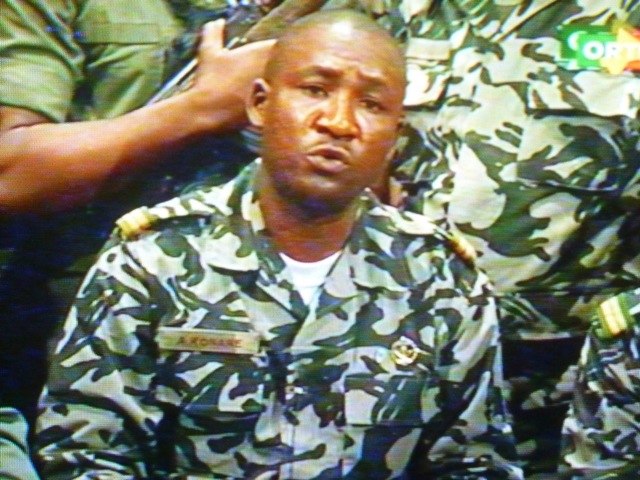
On state TV, Malian pop music videos are interspersed with a repeated short announcement by a group of soldiers calling themselves “Le Comité National pour le Redressement de la Démocratie et la Restauration de l’Etat” (National Committee for Recovering Democracy and Restoring the State or CNRDR). It shows about a dozen men in fatigues (mostly regular army, with some National Guard, plus at least one air force guy and one policeman) crowded into the studio. A lieutenant named Amadou Konaré reads a statement saying that the constitution has been suspended and a curfew is in effect. This is followed by a short statement by a gravelly-voiced captain named Sanogo, urging Malians to remain calm and reassuring them that the army will prevent looting.

CNRDRE leaders on TV: Lt. Konaré at left, Capt. Sanogo at right

The CNRDR is claiming it took power because of the incompetence of President Touré, and that it will hand over power to a democratically elected regime. It’s true that President Touré has never been more unpopular in Bamako than this year, and there will be some who will celebrate his apparent ouster. (Touré’s defense minister was on BBC radio this morning saying that the president is “in a safe place” — i.e., the coup leaders haven’t caught him yet.) But it remains to be seen how this coup will be received: even if many Malians don’t like the incumbent president, they see a military putsch as a huge step backward for the country. These sorts of things aren’t supposed to happen nowadays! And of course the reaction from abroad has been uniformly against the coup.

It strikes me that these coup leaders are fairly young, and many of them probably don’t remember the events of 1991 that ended years of single-party rule and brought about Mali’s transition to democracy. In other words they have grown up and come of age entirely within Mali’s democratic process — in no way are they holdovers from the bad old days.

9:00 a.m.: Someone knocks on our gate, which I’ve kept locked, and rings our doorbell. I go into the courtyard and call out “Who is it?” in Bamanan and nobody responds. Eventually we discover it’s just my brother-in-law Solo, who had his headphones on and didn’t hear me! A brief scare. Solo had ridden his motorcycle from the Badialan neighborhood, across town. He says the streets are pretty quiet, businesses and shops are all closed, and the soldiers have closed the petrol stations. The only firing now is troops firing into the air. He adds that a civilian in Bolibana, a neighborhood at the foot of the hill atop which the presidential palace is located, was killed by stray gunfire overnight.

Three SMS messages from the US Embassy just received: “continue to shelter in place,” and  “please prepare for possible service outages: water, electricity, internet”. Another announces that the airport has been closed.

10:30 a.m.: Gunfire seems to be growing more sparse. I speak to a friend who works at the US Embassy, where only essential staff are supposed to come to work today. He says convoys of American residents have been arriving at the embassy, which is mildly disconcerting since we’ve been instructed to “shelter in place” until further notice. [I later find out that these convoys were in fact bringing the embassy’s “essential staff” to work in armored embassy vans.]

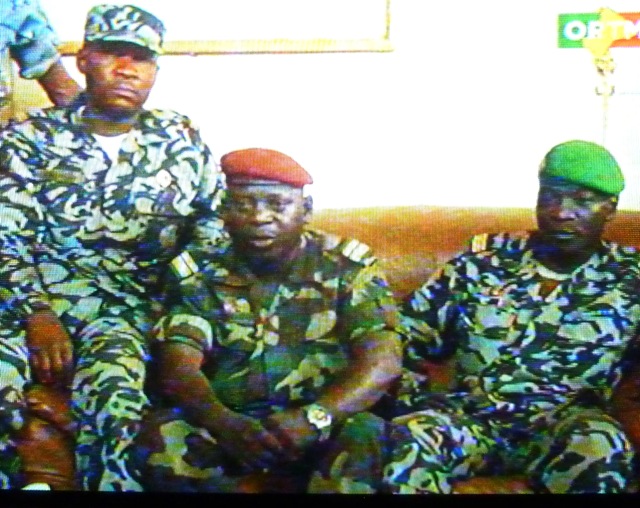
11:00 a.m.: The coup leaders (referring to themselves as the CNRDR) make another announcement on TV. The camera shows 15-20 young people in fatigues gathered around spokesman Lieutenant Amadou Konaré. He begins to read a prepared text but his microphone isn’t working, and it takes the crew several minutes to fix the problem before he can start over again. He calls on all his fellow soldiers to rally to the CNRDR, and to stop firing into the air (an act he describes as “an expression of joy”). He says that all Mali’s borders have been closed, and he invites government staff to return to work on Tuesday, March 27. (Monday the 26 is a holiday, so the only “extra” days off are today and tomorrow.)

CNRDR troops on ORTM, 11 a.m. Thursday

Lt. Amadou Konaré, CNRDR spokesman

Once again I’m struck by how young these folks are. The oldest of them might be in his mid-30s. Are these truly the leaders of a coup that seems to have toppled what had been one of West Africa’s most stable regimes? Or are there more senior figures somewhere pulling the strings? It’s also noteworthy that these troops are rank-and-file, not from special units like the parachute regiment or presidential guard. I wonder how and whether they will be able to command the loyalty of their peers in other military units.

2 p.m.: An article on Bloomberg Business News, citing the French publication La Lettre du Continent, claims that overthrown President Touré “sought refuge” in the US Embassy, but a trusted source of mine in the embassy says this is untrue.

4 p.m.: A friend of mine in Missira (northeast of downtown) says he hasn’t been out of his house all day — too much shooting going on. He mentions that at least one shop in his neighborhood was looted last night. Meanwhile, the BBC says troops have looted the presidential palace at Koulouba. Here in Badalabougou, though, the shots are increasingly few and far between. Perhaps the CNRDR’s call on soldiers to stop firing into the air is having some impact.

Nothing new lately from ORTM, which is still broadcasting music videos. But Africable TV has recently come back on air, playing (guess what?) music videos!

5 p.m.: This SMS from the embassy: “Mutineers declared curfew on Malian radio and television, 0600 March 22 to 0730 March 27. Airport and border crossings closed. All American citizens should shelter in place.” If this is in fact the curfew, it doesn’t seem to have been very effective — while downtown Bamako is nearly deserted, my residential neighborhood is eerily normal. I suspect the actual order applies just from 6 p.m. to 7:30 a.m. for the next five nights. [Later confirmation is that it’s a 6 p.m. to 6 a.m. curfew.]

5:30 p.m.: An announcement is read in Bamanan on Radio Kayira FM — the CNRDR has sent an emissary, Adjutant Souleymane Tounkara, to this station to explain their motivation in toppling the government, and to reiterate that Bamako residents must respect the curfew. Shortly thereafter, my aikido instructor calls me to warn me to stay home and not to go downtown; he thinks I’ll surely get robbed if I venture out into the city.

7:00 p.m.: BBC radio reports looting of the homes of several prominent politicians and businessmen. Malijet lists several arrested top government officials, including:

  • Gen. Kafoukouna Koné, Minister of Territorial Administration and Local Govt. (one of the most powerful figures in the overthrown regime)
  • Abdoul Wahab Berthé, Minister of the Civil Service
  • Soumeylou B. Maiga, Foreign Affairs Minister
  • Sidiki N’Fa Konaté, Minister of Communication and govt. spokesman
  • Agatham Ag Alhassane, Minister of Agriculture
  • Marafa Traoré, Minister of Justice
  • El Moctar, Minister of Tourism
  • Jeamille Bittar, Chairman of the Chamber of Commerce and presidential candidate
  • Adama Sangaré, Head Mayor of Bamako
  • Modibo Sidibé, former Prime minister and presidential candidate

8:00 p.m.: Africable TV airs a pre-recorded interview with Capt. Amadou Sanogo, leader of the CNRDR. The journalist asks him, what assurance can you offer that you won’t organize fraudulent elections and cling to power yourself? Sanogo responds by saying he is an honest, sincere man who knows what he wants. At several points his remarks elicit applause from the soldiers gathered around him. He reiterates his goal to preserve Malian national unity. I notice he wears a US Marines eagle, globe and anchor pin on his fatigues: has he undergone USMC training at some point? (He claims to have, according to a Reuters story.)

Asked what will become of overthrown president Touré, Sanogo replies in a roundabout way that the Malian people “know who is who, and who did what,” and that everyone must answer for what they have done. The final question concerns whether Sanogo is being manipulated by “certain members of the political class” — to this, Sanogo responds that he is so apolitical, he has never voted in his life.

8:30 p.m.: Now it’s the turn of ORTM to feature an interview with Capt. Sanogo, apparently recorded this morning. Sanogo claims he knows where President Touré is, that he is safe and in good shape. (But he doesn’t say that Touré is in custody.)

The Journal Télévisé starts over 30 minutes late, hosted by Aissata Ibrahim Maiga, and after the Sanogo interview it airs raw footage from Koulouba, with bullet-pocked walls and one room that appears to have been the scene of a fire. The palace looks like it is still intact, but many of the windows and fixtures have been damaged or looted. Next we see some more declarations by CNRDR spokesman Amadou Konaré, who is now referring to Capt. Sanogo as “son excellence.” Then some statements from political parties are read, expressing their support for the CNRDR and the army.

Posted in Uncategorized | Tagged , , , | 18 Comments

Gunfire across the Niger

Our first indication of trouble brewing comes around 1 p.m. Wednesday, when our son’s daycare phones to ask us to bring him home four hours early. They are closing up, they say, because of possible violence in downtown Bamako. Some of the children at this daycare have parents in high places in the Malian government, and they seem to know which way the wind is blowing.

A few minutes later I receive an SMS from the US Embassy’s security alert network, reading “Reports of gunfire in Kati. RSO recommends all personnel immediately limit unnecessary movement in Bamako due to the possibility of civil unrest.” Kati is a town 13 km outside Bamako, home to a sizable army garrison, and also the point of origin of a previous wave of rioting in early February. (“RSO” is the embassy’s Regional Security Officer.)

Troubling news, but not unprecedented. We pick our son up and bring him home. An hour later our daughter’s school calls asking us to get her early as well. Then at 4 p.m. I receive this SMS from the embassy: “RSO has received reports of gunfire in downtown Bamako and recommends that all personnel shelter in place.”

By this time early reports are starting to appear on the web that Malian troops in Kati mutinied following a confrontation with the minister of defense that morning. The mutineers soon left their base and took over the streets of Kati, from whence they intended to march on Koulouba, the presidential palace. Around this time a member of the Malilink e-mail forum posts a message saying he’s heard that the defense ministry was on fire. (This report is later denied and remains unconfirmed as of 11 p.m. Wednesday.)

By late afternoon we are hearing reports that the mutineers have taken over the national radio and TV broadcasting center in downtown Bamako, where I just had an appointment on Monday. State TV and radio have been off the air since around 4 p.m. I first hear gunfire coming from downtown, across the Niger River, around 5 p.m. — just sporadic pops and cracks, rifles firing probably into the air. I don’t hear any bursts answering other bursts. It sounds less like shots fired in anger, more like shots fired in frustration.

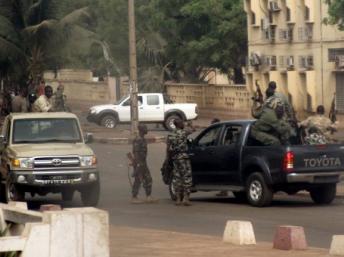
Army troops outside Malian Radio & TV, downtown Bamako (AFP photo)

What’s been surprising is how normal our neighborhood here on the south bank of the river has seemed, despite all this. Just like every evening, a small group of young men is clustered by the dry goods shop outside our compound wall, chatting and watching TV. People come and go. The gunfire doesn’t seem to intimidate here, perhaps because Bamako is normally such a peaceful place and people simply don’t know what to make of it — unlike Brazzaville, scene of repeated civil wars, where the sound of a truck backfiring would send people scurrying for cover.

With state TV and radio off the air, we turn to Africable TV for news. Their anchors describe having met some of the mutineers, who claim to be demanding only greater resources to fight the rebellion in northern Mali, and who say they are not trying to take over the government. Private radio stations are still broadcasting, but none of them seems to be airing any local news — perhaps fearing that troops will shut them down next? By 9 p.m. Africable TV too has gone dark.

Now we’re hearing that the action has shifted to Koulouba and the presidential palace, where mutineers may be confronting the presidential guard. Fortunately RFI (French radio) is still in business; around 10 p.m. it reports fighting and possibly flames in the vicinity of the palace. It’s unclear whether this is simply a “misunderstanding among brothers-in-arms,” as some of the mutineers earlier claimed, or an out-and-out coup attempt.

Sporadic sounds of shooting persist, still coming from north of the river. Still isolated short bursts of fire, automatic rifles and occasionally heavy machine guns. I did get concerned around 8 p.m. when, instead of the usual “bang bang/pop pop pop” I heard “CRUMP CRUMP CRUMP” — explosions, not shots. Fortunately I haven’t heard that sound since.

11 p.m.: ORTM (Malian television) is back on the air, but only playing archive recordings of Malian traditional musicians. If they start playing martial music, or for that matter anything by Banzoumana Sissoko, we’ll know something major is underway. Soon a title appears: “In a moment, a declaration by the soldiers.”

It’s looking like there will be no school on Thursday…. Anyone got any suggestions for things to do while “sheltering in place” with your kids?

Thursday, 12:30 a.m.: Still waiting for that declaration. ORTM has moved on from traditional music to Malian pop (Salif Keita, Mamou Sidibé, Askia Modibo). I’m kind of hoping for something Western-flavored like I used to hear on Radio Folona down in Kadiolo, like Rod Stewart, Phil Collins, the Scorpions or even Chickenshack. Hey, a guy can dream. Speaking of which, it’s way past my bedtime and I hope these soldiers will get moving.

12:35 a.m.: Malijet is reporting that an army officer, a certain Captain Sanogo, has mounted a coup d’etat and that his mutineers have vanquished the presidential guard protecting Koulouba. No word on the whereabouts of President Amadou Toumani Touré.

12:46 a.m.: An online rumor reports that President Touré is holed up in the Djicoroni paratrooper base, where he used to be the commanding officer. But I’m also hearing that he has denied via Twitter that a coup has taken place.

1:35 a.m.: Still no announcement. Going to bed. Oumou thinks they won’t announce anything until they’ve captured the president.

Posted in Uncategorized | Tagged , , | 8 Comments

This book will change your life

(A shameless plug, with some reflections thrown in)

This book is not about Bamako, my current home, although some of the field research for it was conducted here. Nor is it a book about Brazzaville, Congo, although most of the field research for it was conducted there. In fact it’s not really about anyplace, strictly speaking, and that’s just the point. As an anthropologist, I study people, and there’s only so much you can learn about people by studying places.

I didn’t always appreciate this fact. When I began the fieldwork that led to Migrants and Strangers in an African City a decade ago, my approach was centered on a specific, geographically situated community 160 km north of Bamako. I call this community “Togotala” in the book, using a pseudonym. A decade ago, I tended to think of human communities in terms of points on a map. It was the time I spent in Togotala and with Togotalan people elsewhere (in Bamako, in New York, and later in Brazzaville) that helped me realize just how misleading the place-bound concept of community can be.

Nowadays, most people who consider themselves Togotalan don’t actually live in Togotala. The town itself is officially home to a few thousand people, but there are many more Togotalans in Bamako at any given time than in Togotala. Observing Togotalans’ daily lives and seeing the importance of regular communication between distant members, I came to understand the community not as a place but as a network, an aggregation of social relations connecting people in multiple locations. Most of the people who call Togotala home experience it as a state of mind, a set of sentiments and loyalties, more than as a place. Think of Zach Braff’s line in the film “Garden State”:

Maybe that’s all family really is — a group of people that miss the same imaginary place.

There’s absolutely nothing empirical about home, belonging or identity; all require acts of imagination.

Something I struggled with while writing Migrants and Strangers, and with which I struggle in my current research in Bamako, is the problem of defining who is “in” and who is “out” of the study. In Brazzaville, my target population was people who came from elsewhere, specifically West Africans (and, more often than not, Malians); the book examines how they identify with distant homelands while living and working in places like Congo. This time around, to learn about marriage practices in Bamako, I’m trying to target people for whom Bamako is home, in a city where most people identify at least to a degree with someplace else. A man can live most of his life in Bamako, but if he remains active in the politics of his native village, regularly sends money to relatives there,  marries within his village community, and sends his children to grow up there, can we really consider him Bamakois?  Do his marriage practices reveal anything about marriage in Bamako?

Since the question of where someone belongs is inherently subjective, my interviews here begin with a subjective question: “Do you consider Bamako your home?” Even answering “no” to this question, however, doesn’t automatically disqualify someone from participation in my research. Any single criterion for inclusion — say, a minimum number of months or years spent in the city — is arbitrary. I’m still trying to define who should be in and who shouldn’t, but for the time being I’ve decided to cast a wide net.

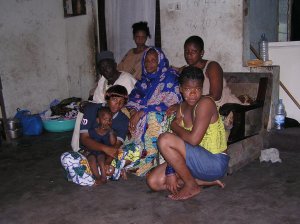
A Malian family in Brazzaville, 2005. In 2008 the elderly parents “retired” to Bamako, though they’re originally from the Sikasso region.

Very few of the migrants I knew in Brazzaville were from Bamako, and these had only formed a mutual aid/self-help association in 2004 — something their peers from rural Mali had done decades earlier. Yet Bamako figures prominently in the lives of Malians abroad. Even those who don’t come from the capital city often return to settle there at the end their migration careers. Many of the biggest homes in this town were and are funded with migrant remittances.

One final note about Migrants and Strangers in an African Society: for years, I had been using the working title “Exile Knows no Dignity,” which is a Bamanan proverb referring both to the humiliations migrants endure and to the place-bound nature of identity formation in contemporary African societies. I was attached to this title because it encapsulates so much of what the book is about. My editor at Indiana University Press prevailed on me to change it, however, arguing that the proverb was too cryptic to make a good book title. In the age of online search engines, the argument went, a title should clearly convey the subject matter within the first 42 characters. So we took my working subtitle — “Migrants and Strangers in an African City” — and made it the new title, while the old working title was distilled into the new subtitle. Not so poetic, but it gets the job done.

Posted in Uncategorized | 1 Comment

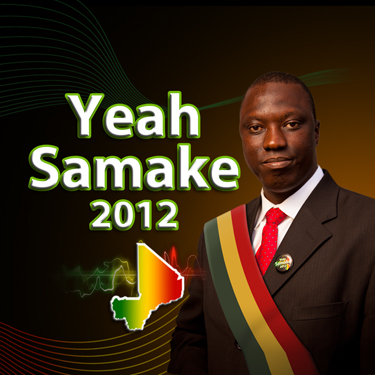
Who is Yeah Samaké, and what does he want?

From my lonely log cabin high atop Bamako’s Colline du Savoir, I’ve noticed a growing amount of media attention in recent months around a 43-year-old Malian man named Yeah Samaké. He’s the youngest contender for Mali’s presidency, and has been featured on PRI’s “The World” in January, and again in a February article in Slate Magazine. Both sources mention his status as a “frontrunner” in this country’s presidential elections, scheduled for next month.

Yeah Samaké (image from samake2012.com)

Niankoro Yeah Samaké hails from Ouélessébougou, a small town 80 km south of Bamako. According to his Wikipedia entry and his campaign website, he grew up poor in a large family, attended secondary and post-secondary schools in Bamako, then in 2000 he moved to Salt Lake City where he earned a masters degree in public policy from Brigham Young University. After graduation Samaké became executive director of the Mali Rising Foundation, an organization established by prominent Utah community and business leaders in 2004; the foundation’s mission includes school construction and teacher training, and it has so far built 12 schools in five southern Malian communities, including Samaké’s hometown of Ouélessébougou.

In 2009 Samaké went back to Ouélessébougou where he was subsequently elected mayor. His website reads:

At that time, the municipality was ranked 699 out of 703 in terms of economic development, transparency, and management, with a tax collection rate below 10%. Within one year, Ouélessébougou jumped to the top ten cities in Mali with a tax collection rate about 68%. Yeah accomplished this by increasing citizen participation through a tribal council system, and by challenging the culture of corruption. His successes earned him the respect of his peers and he was appointed to the post of vice president of the League of Mayors.”

Last spring he declared that he would contest presidential elections to be held in April 2012.

I have heard plenty of good things about Yeah Samaké, and I have no doubt that he could make Mali a better place. But I also have serious reservations about his candidacy, which I will group into the following five areas.

  • Malian grassroots vs. U.S. AstroTurf: Samaké’s campaign has made a point of not fundraising in Mali, ostensibly to avoid corrupting influences. Instead he is targeting donors in the U.S., not just Malians living there but Americans as well. (To get a sense of how thoroughly American-oriented his efforts are, consider that his campaign website is entirely in English, and includes an “About Mali” section.) By the Number One Law of the Universe — “There is No Such Thing as a Free Lunch” — his presidency would be beholden to foreign interests. The idea that any presidential candidate can raise all necessary funding outside the country he/she expects to serve raises all sorts of ethical concerns.
  • Media buzz (and the lack of it): In contrast to many of the other men who’ve announced their intention to run for Mali’s presidency, Samaké has generated relatively little coverage in the Malian press. A search on Maliweb, a site that posts articles from Malian newspapers, reveals just 19 mentions of the name “Yeah Samaké” since January 1st of this year. By comparison, during the same period there were 128 mentions of “Soumaila Cissé” (former prime minister and presidential candidate), 131 mentions of “IBK” (for Ibrahim Boubacar Keita, former prime minister and presidential candidate), and 196 mentions of “Dioncounda Traoré” (President of Mali’s National Assembly and presidential candidate). Tellingly, in addition to the PRI and Slate stories mentioned above, much of the media coverage of Samaké’s campaign has come from U.S.-based outlets like the Deseret News, Meridian Magazine, and the Daily Herald.

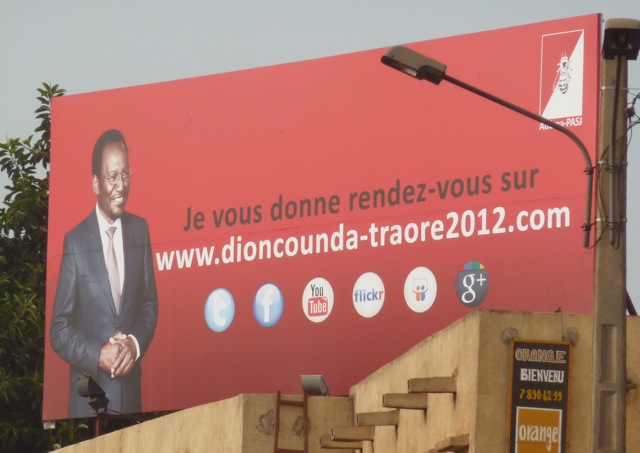
    He’s on Facebook, too: Bamako billboard for Dioncounda Traoré of the powerful ADEMA party

  • Name recognition (and the lack of it): As a consequence of his low media profile, coupled with his relative lack of experience on the national political stage, coupled with little traditional advertising (I have yet to see him on a billboard, unlike many of his rivals), Yeah Samaké is not exactly a household name, at least in Bamako. Most cab drivers I ask either haven’t heard of him or don’t know who he is and what he’s achieved. Last Friday, before beginning a lecture to my class of over 200 fourth-year sociology students at Bamako’s University of Letters and Human Sciences, I did an experiment,  asking the class to free-list their country’s declared presidential candidates. Students volunteered the names of 19 other candidates before someone finally mentioned Samaké’s name several minutes into the exercise. Only two more names came up after his, exhausting the field. But maybe fourth-year sociology students in Bamako just aren’t Samaké’s demographic.
  • “Marché nyini”: How can Samaké justify his claims to frontrunner status? With no opinion polls here, it’s impossible to know who’s in the lead. But given his lack of media coverage and name recognition, given the fact that his political experience is limited to three years as mayor of a provincial town, given the fact that he is up against major political figures (including at least five ex-prime ministers) backed by major national parties, let’s call Samaké’s presidential bid what it is: a long-shot. I will be very surprised if he garners more than 5 percent of the vote come April 29th. Does he truly think he can win? Or is he just engaging in what Bamakois call marché nyini, literally “looking for a market” — i.e., some kind of personal benefit? In other words, is he being sincere when he represents himself to U.S. donors as a leading candidate, or is he trying to pull the wool over their eyes? These questions may seem cynical, but politics in this part of the world is an unrelentingly cynical business.
  • Finally, The Mormon thing: He doesn’t exactly broadcast the fact over here, but Yeah Samaké is a convert to Mormonism. (Literally nobody I’ve asked in Bamako who’d heard of him has been aware of this fact.) In his PRI interview he claims that his faith in no way prejudices his countrymen against him. There was a time, 10 or 15 years ago, when I would have believed that it wouldn’t make any difference for his political prospects in Mali, where people have long espoused a tolerant and a-political approach to Islam. Alas, in recent years the social and political landscape has shifted: in 2009, for example, Bamako-based Islamic “civil society” groups organized massive protests against a bill that would have reformed women’s rights, claiming it was contrary to Islamic law; the demonstrations ultimately forced the Malian government to scuttle the reforms. If, by some miracle, Yeah Samaké does manage to make it into the second round of this year’s presidential election, it’s hard to believe the same forces — well organized, well funded and increasingly vocal in opposition to what they portray as foreign, anti-Islamic influences — wouldn’t unite around his opponent and crush Samaké’s Mormon/American-financed candidacy by whatever means necessary. If his faith hasn’t been an issue for him in politics so far, it may simply be because he hasn’t been taken seriously as a candidate for national office.

Whatever happens in the election, one thing is sure. It will take a lot more than one man — however dedicated and talented he may be — to change Mali’s political culture and root out the venality, waste and cynicism that characterize it. But just maybe Yeah Samaké’s run — if it’s genuine, and even moderately successful — will inspire other reformers to get into the game, and prove to be a harbinger of a more hopeful future.

Postscript (March 21, 2012): An article about the upcoming election on The Africa Report lists four candidates who “stand a real chance of being sworn in,” and Samaké isn’t among them.

Postscript 2 (May 2, 2013): Time correspondent Aryn Baker has written a new profile of Samaké and his continuing bid for the presidency.

Posted in Uncategorized | Tagged , , | 8 Comments

Riding the SOTRAMA

For getting around Bamako, you really have four options.

  1. Provide your own transportation. As I wrote in a previous post, more and more Bamakois can afford to do so, whether on two or four wheels. Still, most city residents don’t own cars or motorcycles.
  2. Take a taxicab. While cabs in Bamako may be battered, they are plentiful and, by the standards of any developed country, quite cheap. A 30-minute ride across town might cost 2000 francs if you don’t bargain much; that’s around US$4.00. 2000 francs being equal to many households’ daily budgets, however, cabs are still too pricey for most Bamakois to use very often.
  3. Hop on a bus. Buses in Mali are generally used for transport between cities rather than within them, but some buses do operate on a handful of fixed routes around Bamako. Since these routes only serve a few neighborhoods, most Bamakois have never ridden in one. Why not, therefore…
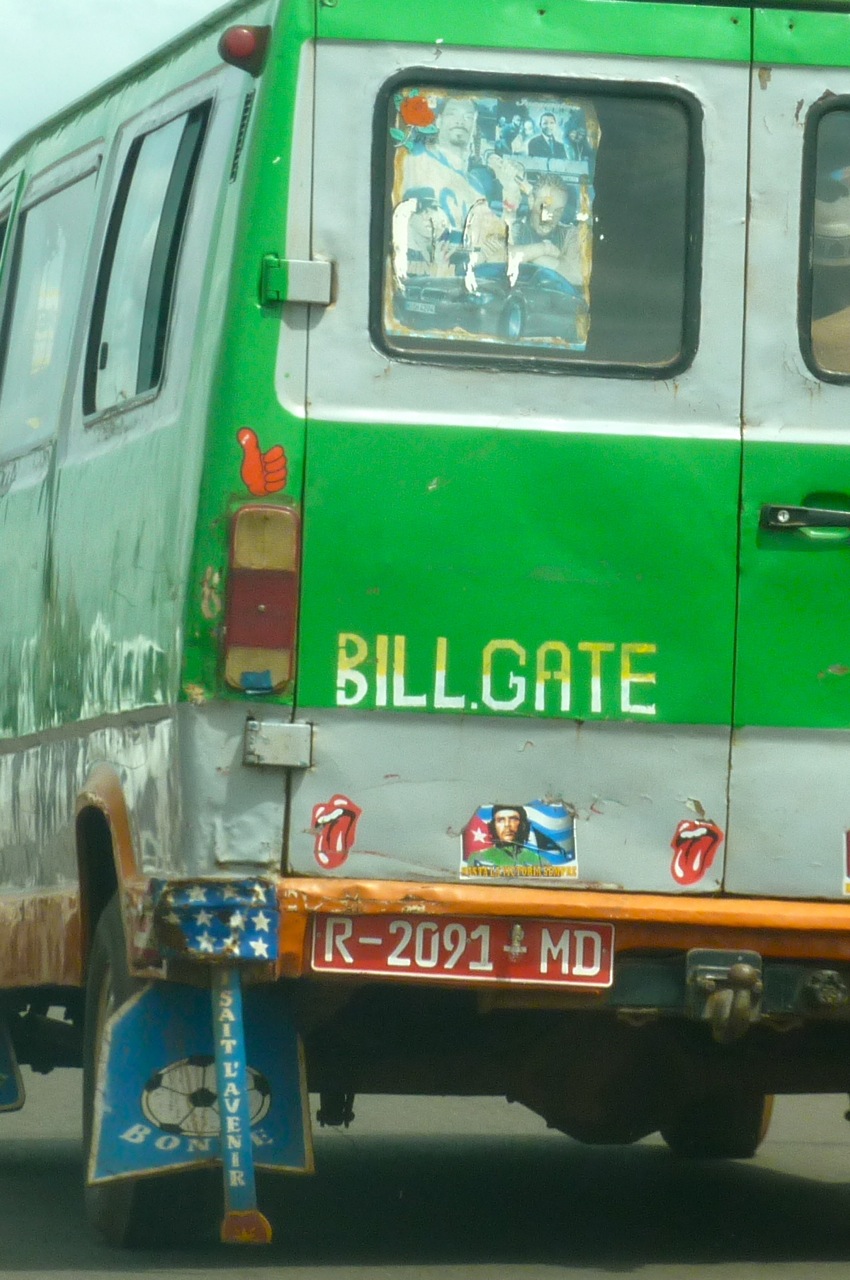
  4. Ride a SOTRAMA — this is the Bamako term for a van modified and licensed to carry paying passengers along a fixed route. And riding a SOTRAMA is an experience unto itself.

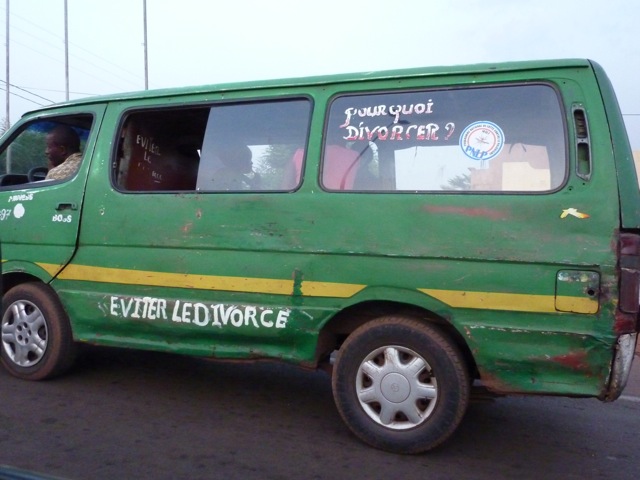
I wonder if this vehicle’s owner is a divorcé

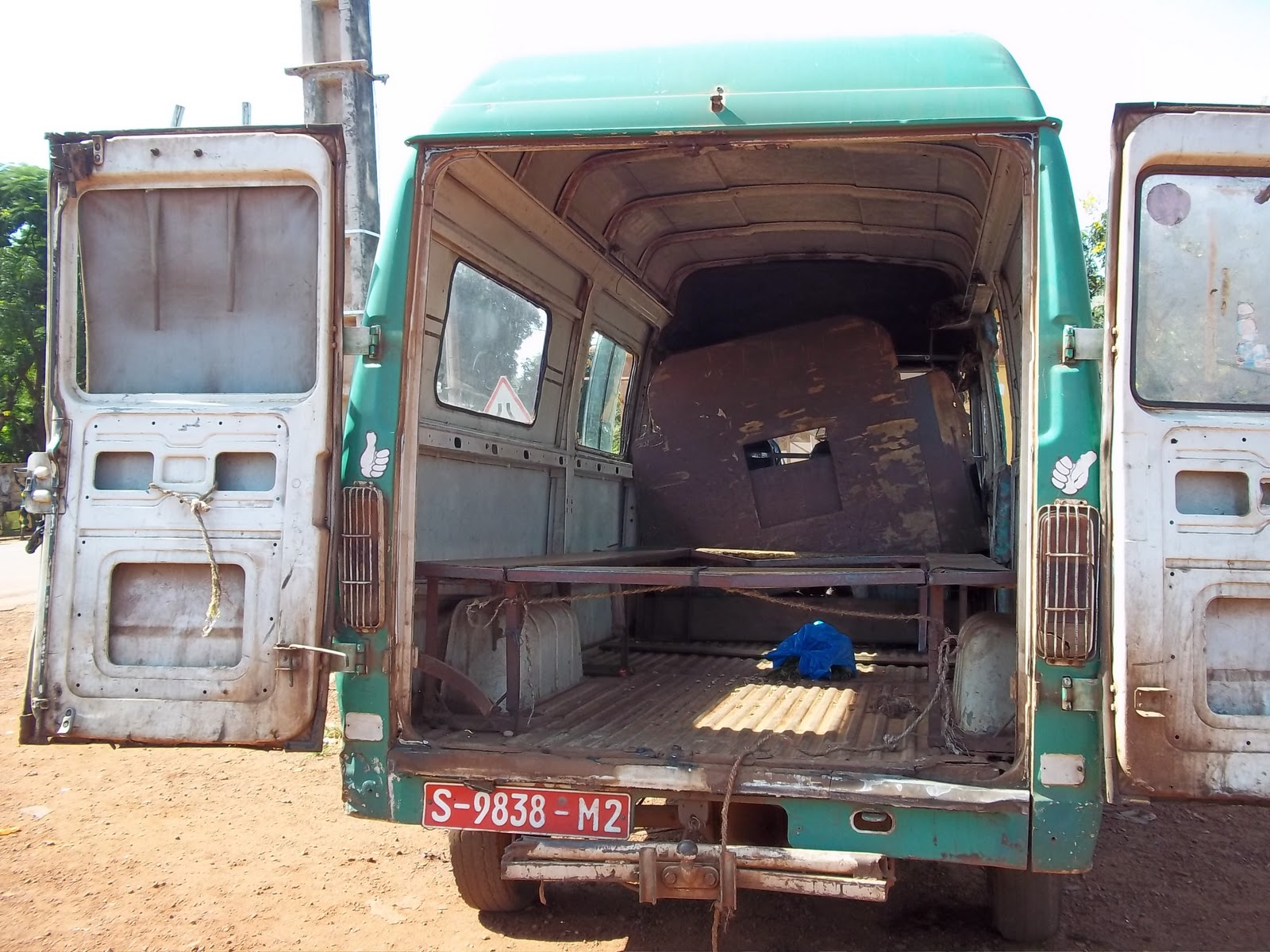
First a bit of background: the name “SOTRAMA” comes from the era when all these vehicles were run by a state company, La Société du Transport du Mali. For years now, though, they’ve all been in private hands: each SOTRAMA van belongs to somebody, who usually hires a driver from whom he/she receives a flat daily fee. Typically the driver must pay 15,000 francs (US$30) to the owner per day, plus an equivalent amount for diesel fuel. Maintenance costs are incumbent on the owner, but given the state of most of these vans, it’s clear they don’t receive much maintenance. A van is purchased used in Europe and brought to Mali, where the interior is stripped to bare metal, and some spartan wooden benches are bolted in place so as to allow any passenger to enter or exit through the side door without other passengers having to move.

Rear view of a SOTRAMA interior

SOTRAMAs are uncomfortable and slow. They don’t run on predictable schedules, and you can only learn where one goes by asking someone who knows. But they do have the advantage of being cheap. The most expensive SOTRAMA fare I know in Bamako is 225 francs, about US$0.45, while the typical fare ranges from 125 to 150 francs. (These fares rise along with the price of diesel, which is fixed by the Malian government these days at 605F/liter, around US$4.50 per gallon at the current exchange rate. Gasoline costs 14% more.)

SOTRAMAs are a highly social means of transportation, by necessity: climbing aboard, you find yourself in close proximity to 20 other passengers, in a vehicle that might carry half that many in any wealthy country. Over the years I have learned some tips for quality SOTRAMA riding.

  • Make sure it’s going where you’re going. SOTRAMA routes are never published, and are frequently changed. Moreover, some neighborhoods are served by multiple routes which may have similar names (e.g. “Magnambougou” vs. “Magnambougou Projet”; “Nafaji” vs. “Nafaji Féré”). When taking a route for the first time, always ask the driver or a fellow passenger if it will get you where you want to go.
  • Say hello. Each passenger greets fellow passengers immediately upon boarding. As in most Bamako milieus, Bambara-language greetings are best; “A ni tché” works as a blanket greeting at any time of day.
  • Watch your head. There’s precious little headroom in SOTRAMAs, particularly in the Toyota HiAce vans which are the most common model on many routes. Remember that the owners install overhead handrails; make sure not to bump into them. (In the headroom department, I much prefer my SOTRAMA to be in the Mercedes Benz MB100 series, like a 207D or 307D; I also appreciate a 312D. But the SOTRAMA passenger can rarely afford to discriminate.)
  • Don’t carry your fare in your trouser pockets. Once you squeeze into whatever gap is left on the bench, you most likely won’t be able to get to anything in those pockets until you stand up again. Shirt pockets are useful in this circumstance.
  • Exact change is appreciated. At some point you must pay your fare to the “prentikè,” a surly young dude riding by the side door. He may or may not be able to give you change — there are never enough coins in this town — so it’s advisable to pay as close to the exact fare as you can. If you have extra money, you can always pay the fare of a fellow passenger, e.g. a handicapped or elderly person. (Such individuals in Bamako are seen as inherently deserving of charity. Do not attempt to pay for a young, healthy passenger you don’t know!) Such an act of random kindness costs very little but can generate more goodwill than a million dollars of bilateral development assistance.
  • Don’t take the prentikè personally. Along with rustling up passengers (by shouting the SOTRAMA’s destination in an incessant slur of vowels) and collecting fares, rudeness is part the prentikè‘s job description. There are two other things you can expect from a prentikè anywhere in Africa. One, he will carry any paper currency he receives wadded up between his fingers. Two, he will only enter and exit the vehicle while it is in motion. These are part of his déontologie professionnelle; I suspect he receives job training in the various ways to diss passengers, wad up banknotes and leap from moving vehicles without losing his flip-flops. Bamakois realize that the prentikè‘s life is not an easy one, so they try not to be too harsh with him. (To learn more about the world of the prentikè, see this recent French-language “day in the life story” about a SOTRAMA prenti, including some of the prenti‘s unique jargon, from a Bamako newspaper.)
  • Signal your stop. The driver only pulls over his SOTRAMA when he knows someone wants to get on or off. Shortly before reaching her destination, a passenger must tell the prentikè; the prentikè then relays the message to the driver by banging loudly on the vehicle’s roof or side panels. (While passengers may be tempted to eliminate the middleman by rapping on the vehicle themselves, I advise against this; the prentikè sees it as an encroachment on his privileges.) After you’ve signaled your stop and the van pulls over, say goodbye (“k’an bè“), and remember to watch your head while disembarking.

One of the singular aspects of the SOTRAMA as social space is the degree of familiarity that obtains between complete strangers riding in it. A mother with a babe in arms may hand off her young charge to a passenger she’d never met before while stowing her bags beneath her feet. There is no segregation of the sexes: a male passenger may be wedged in tight next to a woman in a full-face veil. I’ve never seen anyone object.

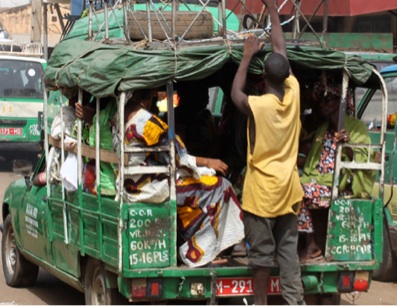
A final note: Bamako has long been home another interesting public transportation option, the bâché. This is a pickup truck with benches in the back, covered by a heavy tarp (la bâche, hence the vehicle is bâché). One can still ride them, but they’re limited to a couple of routes where they used to be all over town (see below).

POSTSCRIPT (May 2019): See Coleman Donaldson’s street interviews about Bamako’s Sotramas.

Posted in Uncategorized | Tagged , , | 9 Comments

Of wars and rumors of wars

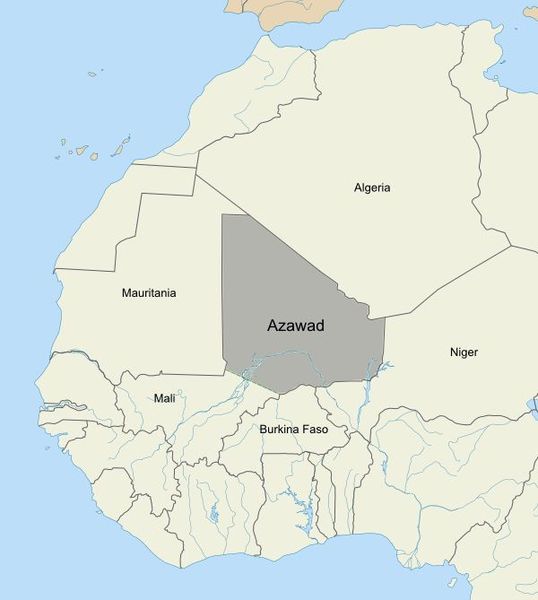
In case you’ve missed it, a violent rebellion has been gathering force over the last couple of months in the north of Mali. Since mid-January, Malian government posts in several northern towns have been attacked, with the attacks claimed by the Mouvement National pour la Liberation de l’Azawad or MNLA, a recently emerged Tuareg separatist group. “Azawad” is a Tamasheq-language term for the Tuareg homeland, which according to the map below right, taken from Wikipedia’s MNLA entry, encompasses the northern half of Mali, but which by most definitions also includes swathes of western Niger and southern Algeria. (A Google search for the MNLA finds, in addition to the homepages of several state nursery and landscape associations, one site possibly linked to the Tuareg movement in question, but when I try to load this page I always get a “network error.” I wonder if Malian ISPs have been instructed to block it.)

The security problems in northern Mali have prompted a lot of discussion in Bamako and  on internet discussion sites. Many southerners, including journalists, are wont to dismiss the attackers as “armed bandits” and terrorists rather than rebels. They may have a point: the Sahara Desert has long been a refuge for shady transnational networks engaged in criminal enterprise, including occasional kidnappings but mostly smuggling; Al Qaeda’s regional affiliate, Al Qaeda in the Islamic Maghreb or AQIM, has also been active in the region for several years now. In the zone that the MNLA is claiming as its territory, the lines between criminal activity, terrorism and rebellion have never been clear. While an MNLA spokesman has disavowed any connection between his group and AQIM, one account by a survivor of the January 18 attack on Aguel Hoc (printed in one of Mali’s more reliable newspapers) claims the attackers were Islamists who during their occupation of the town wore “Afghan-style” clothes, gave speeches advocating sharia law and encouraged civilian men to grow their beards long.

The true motives of the assailants is just one of many uncertainties. How many of them are there? What links do they have to Tuareg fighters repatriated last year from Libya? How many casualties have they taken, and caused, in their confrontations with government forces? If their attacks go unchecked, will national elections scheduled for April still be able to take place? In the absence of any real reporting from the afflicted region, nobody can answer these questions definitively. Photos are now circulating on social media of dead bodies, allegedly Malian soldiers executed by rebels. Are they genuine? How many soldiers have died? No one is saying, which frustrates a lot of people here in Bamako. So great were the tensions that unruly protests erupted here and in several southern cities last week, spearheaded by the wives and sons of army personnel demanding to know what’s really been happening in the north. The Malian government has not been especially forthcoming in this regard. (For a thorough English-language synopsis of local media coverage of these protests, see Alex Thurston’s Sahel Blog.)

Bamako residents’ responses to the situation in northern Mali reveal much about the state of Mali’s democracy. For one thing, some Malians apparently don’t cherish the institutions of that democracy, and instead long for an extra-constitutional solution to the ongoing problem. One Bamako paper has published a call for President Touré to surrender power to an undefined “Committee for the Defense of the Republic” that will rule the country until security can be restored and elections held. Judging from the responses posted online to this call, it seems many would support such action. [If, for any reason, Touré were to resign before his term ends in June, Mali’s constitution calls for him to be succeeded by the President of the National Assembly, not some ad-hoc group.]

The current crisis also reveals a readiness by some southerners to scapegoat northerners, especially light-skinned Tuareg and Arabs, for the rebels’ actions. During recent protests in Kati, just outside Bamako, businesses and homes belonging to Tuareg residents were set ablaze by angry mobs. Shortly thereafter, President Touré called on citizens to make a distinction between rebel fighters and loyal civilians.

It is not my place to comment on Malian government policy or on Mali’s security affairs. Indeed, as a Fulbright scholar whose stay in Mali is entirely funded by the U.S. government, I would be unwise to do so. What interests me here, as an anthropologist, is the rash of rumors concerning events in the north, and the local interpretations of the causes underlying these events, whether relayed in the Bamako press, on the web or by word of mouth. One thing you can guarantee in the absence of authoritative, verifiable information is that rumors will thrive.

One widespread rumor is that the president doesn’t want to give up power when his final term expires four months from now, and has manufactured the crisis to postpone elections and remain in office. (On a continent where so few heads of state have ever voluntarily stepped down, one can hardly blame Malians for their skepticism of their leader’s intentions. But let’s recall that Touré also was the first Malian president to do so, after initially holding office in 1991-1992.) Another rumor is that the pair of Frenchmen kidnapped from their hotel in northern Mali last November were in fact military advisers to the MNLA, sent by the French government to support the rebellion against the Malian government. The French are also accused of fomenting a coup plot over the last week. (The French are a perpetual bête noire in popular Malian imaginings of both local events and geopolitics; many here believe France to be aiding the rebels, and point to the fact that MNLA advocates have appeared on French television broadcasts.) Closer to home, I heard someone say that the clinic torched in Kati last week had been used to treat Tuareg rebel casualties. (Never mind that Bamako is 1000 km from the fighting, and is also among the last places any Tuareg rebel would try to seek refuge.)

Of course I don’t believe any of these rumors, and neither should you. But the fact that rational people accept and repeat them underscores the key role the media play in shaping Malian political culture. Mali has a vibrant independent press, but not one with the resources necessary to cover a conflict in a remote area. And with the international media not yet showing much interest in Mali’s northern crisis, we’ve all been left in the dark. The effects on this country’s young democracy have been anything but salutary.

[Postscript: Adam Nossiter, the New York Times‘ West Africa correspondent, filed a story from Bamako about the northern rebellion that highlights the post-Gaddafi arms connection. Perhaps next some serious journalists can actually get to the afflicted area and find out what’s really going on! Additionally, for an informed “long view” of Tuareg uprisings in northern Mali, see a recent piece by blogger Andy Morgan.]

Posted in Uncategorized | Tagged , , , , | 4 Comments

Too many women in this town?

My colleague, anthropologist Yaya Bamba, with male focus group participants

A key part of my current Bamako research is discussions with groups of 8 to 10 city residents, in which my research assistants and I ask questions pertaining to family and marriage. We organize each of these focus groups to be relatively homogeneous in certain respects (namely gender, marital status, and level of education), then balance this homogeneity through inter-group variation. For every discussion with unmarried, less-educated young women, for instance, we’ll have another with unmarried, less-educated young men, another with unmarried, more-educated young women, another with married, less-educated women, etc. We meet each group on their “turf” so to speak, ask each group the same questions, and the discussions last from 90 minutes to two hours. Focus groups aren’t very useful for learning about individuals’ experiences or beliefs — people don’t share many personal details in them — but they’re great for identifying normative views and showing how these views vary (or don’t) across demographics.

One question we ask is, “Do you think there are as many women as men in Bamako? Why or why not?” The responses generated are surprisingly uniform: young or old, male or female, non-literate or university-trained, Bamakois are very likely to say that more women than men live in their city. The issue here is not whether women outnumber men, but by how much. Some say the ratio is 60/40 in favor of women, others say 70/30, some even suggest 80/20 or 90/10.

My colleagues Djénéba Dembélé and Yaya Bamba with focus group participants

Whatever the ratio, the existence of a surplus female population is among the most commonsense, taken-for-granted ideas in Bamako, and in Mali as a whole. It’s just something that everyone knows. Many of our focus group participants point to anecdotal evidence from their daily lives: “Look at the passengers on the SOTRAMAs [minibuses] every day,” one woman said, “they’re mostly women.” Other participants refer to social scientific data, citing surveys or statistics they’ve heard of to back up the notion of female overpopulation and the corresponding notion that there aren’t enough men to go round.

There’s just one problem: it’s not true. Yes, as in most countries, the sex ratio in Mali (according to the country’s most recent Demographic and Health Survey) skews slightly toward females, who make up 50.5% of the nation’s population. But the ratio skews in the opposite direction for Bamako, where 50.2% of residents are males. Due to the large number of males who become rural-to-urban migrants, urban sex ratios in Africa tend to favor men, if only by a little, and Bamako is no exception.

The fact that females have a slight edge in national census figures must have something to do with the widespread perception of an excess of females in Bamako. But this is more than a simple misapprehension of available data. There’s a reason people here need to see too many women when they look around. And that reason is polygamy.

[Anthropological sidebar: Technically, I’m talking about polygyny, the form of polygamy where one male marries two or more females. But since the alternative form, polyandry, is basically unknown in Africa, I follow the example of my Malian hosts in using the blanket term “polygamy” to describe this practice.]

West Africa is home to the highest polygamy rates in the world. Roughly 40% of married women in Mali are in polygamous unions (this figure is 24% for Bamako); rates are even higher in neighboring Burkina Faso and Guinea. Such levels of polygamy are not found outside West Africa, even in other majority-Muslim countries. The polygamy rate in Mauritania, Mali’s predominantly Arab neighbor to the northwest, is about 12%, while in Yemen and Pakistan it’s only 7%. (I haven’t yet come across polygamy statistics for Saudi Arabia or several other countries of the Muslim world; the latest Demographic and Health Surveys for Egypt and Indonesia, incidentally, don’t even mention polygamy. But rates in these countries are likely to be closer to those in Pakistan or Yemen than those in Mali or Niger.) As the chart I’ve put together below indicates, Islam is not the only relevant factor here; being in a West African society correlates much more strongly with polygamous marriage than being in a Muslim society does.

“% Polygamous” denotes rate of married women in polygamous unions (source: Demographic & Health Surveys, http://www.measuredhs.com)

[A note on the chart: Countries in the left cluster, all of them West African, have polygamy rates of 35% or more; those in the middle cluster, in West and Central Africa, have rates of 10-30%; those in the right cluster, in North Africa and Asia, are between 5 and 10%.]

One might therefore conclude that polygamy is popular in Mali, and indeed it is. Yet our focus group data also reveal that people here see polygamy as a problematic institution, the cause of considerable domestic strife and intra-family conflicts. The Bamanan-language term for “rivalry,” fadenya, literally means “father-child-ness,” expressing the competition that prevails among children of the same father but different mothers; by contrast badenya, “mother-child-ness,” the condition of being full siblings, denotes solidarity. When we ask focus group participants to name the disadvantages of polygamy, men and women alike rattle off several: jealousy among co-wives, rivalry among half-siblings, problems between a polygamous husband and his wives, squabbles over inheritance, high economic costs… the list goes on and on.

When we ask what the advantages of polygamy are, people are slower to respond. They are most likely to say that without polygamy, many women would never find a husband — since “everyone knows” that women far outnumber men in this part of the world. Polygamy, in this view, is an institutional adaptation to Mali’s supposed female overpopulation problem.

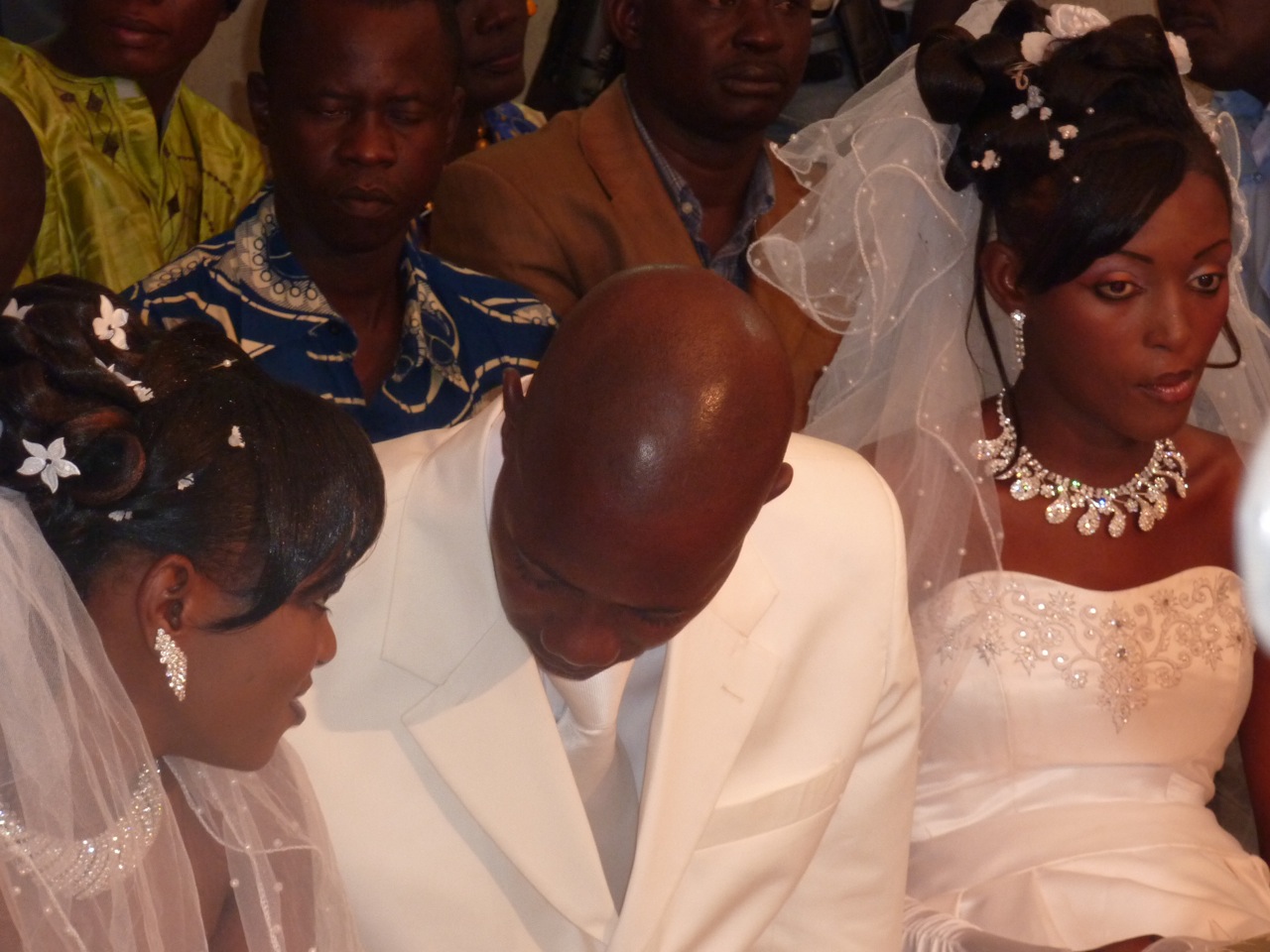
A husband for every bride? Bamako wedding ceremony, July 2010.

Furu ye wajibi ye, goes a Bamanan saying: Marriage is an obligation. While it holds for both sexes, the obligation is much stronger and begins much sooner for women. Young Bamakoises want to get married by age 25, after which point they’re seen as having passed their “sell-by” date. They worry that if they don’t find a husband by their mid-20s, they never will. (Bamako’s males, on the other hand, can wait until their 30s or even 40s, and indeed the average age at first marriage is about 9 years older for males than females here.)

The fact that essentially all men and women in Mali do marry — demographic surveys show no significant numbers of “old maids” or “confirmed bachelors” in the Malian population — does nothing to diminish many young women’s fears of being unable to marry. The myth of female overpopulation makes young women all the more anxious to find a husband, and all the more willing to settle for a polygamous one, while it also provides husbands a useful, even humanitarian justification for marrying multiple wives.

This is one of those myths that members of certain groups need to believe, and hence continue to believe in the absence of valid evidence. They simply fabricate evidence to fit the myth. (An example from my own society might be the myth of Barack Obama’s Kenyan birth, which no rational argument can persuade “birthers” to abandon.) Polygamy has been a part of Mali’s social fabric for so long, I don’t think most Malians can imagine their society without it — even those who would never consider polygamy themselves. As troublesome as polygamous unions may be, it’s easier for Malians to rationalize them through the myth of female overpopulation than to do away with them. And for this reason, I don’t expect to disabuse anyone here of this myth anytime soon.

[Postscript: Despite appearances, the wedding ceremony photo above does NOT show a wedding between one groom and two brides. I took it at a civil ceremony in July 2010, at the height of Mali’s pre-Ramadan wedding rush, where several couples were getting married simultaneously. The bride at right has no relationship with the groom in the middle!]

Posted in Uncategorized | Tagged , , , , | 8 Comments

Bamako, 1997 to 2012: What’s changed?

Niaréla, Jan. 2012

Fifteen years ago this month, I came to Bamako for the very first time. In those days I was a fresh-faced Peace Corps trainee, more eager to get out to my rural post than to experience the city. On the bus from the airport, I remember being saddened by the sight of open sewers and corrugated metal roofs.

When I returned to Bamako several months later, I saw it with new eyes. Rather than comparing it to the American cities I knew, I compared it to the rural Malian communities I knew, where corrugated metal roofs are a sign of prosperity (they last longer than thatch), and sewers of any kind simply don’t exist, so seasonal rains cause flooding and erosion. At least Bamako had sewers, not to mention electricity — even if neither worked properly much of the time. And the city boasted other amenities, such as restaurants and spaces for leisure, that I came to appreciate more over time.

Northeast Bamako from Point G, Jan. 2012

Since my Peace Corps service ended in 2000 I’ve returned to Bamako every couple of years, and have been struck by the city’s transformation. I’ve come to see Bamako as a kind of urbanization laboratory. In some ways life for Bamakois today seems better than before; in other ways it’s more difficult. Here I’ll use the occasion of this 15-year anniversary to reflect on several changes the city of Bamako has seen since the close of the 20th century.

Demographic growth: By any measure, Bamako’s population has been expanding at breakneck speed. According to the City Mayors Foundation, Bamako’s annual growth rate is 4.45%, which makes it the sixth-fastest-growing city in the world, and the fastest on the African continent. The city’s population attained the one million mark only in 1998, and by 2010 it had exceeded two million.

Kalaban-Coro Heremakono, in southwest Bamako, Nov. 2011

The city’s expansion is also spatial — largely horizontal rather than vertical. The ACI 2000 neighborhood, allotted twelve years ago on the former site of a military air base just west of downtown, now houses many of Bamako’s government offices and embassies.  And whole new neighborhoods are springing up on the edge of town, in places like Kalaban-Coro Heremakono, Boulkassoumbougou and Doumanzana, where five or six years ago you could only find mango groves and scrub brush. Today they’re home to thousands of cinder-block homes, most of them unfinished but nonetheless occupied.

Approaching the King Fahd Bridge, Dec. 2011

Traffic jams: As the city grows, and as increasing numbers of its residents can afford cars and motorcycles, more and more people occupy Bamako’s road-ways. In the 1990s, heavy traffic was rare in Bamako, and there were just two or three areas downtown where the sheer volume of vehicles caused delays. Now embouteillages are nearly constant from the Route de Koulikoro to Niaréla to the Grand Marché to Lafiabougou. The two main bridges across the Niger River are major choke points seven days a week. “Nowhere near as bad as the ‘go-slows’ in Lagos,” Nigerians might say, but really, this is hardly something to boast about.

Mobile telephony: In 1997 there was no cellular service anywhere in Mali. By 2000, a few wealthy Bamakois had cell phones. Now, 91% of Bamako households own at least one cell phone, according to the ELIM survey published by the Malian government last year. It would be difficult to overstate the impact of this technology on urban social life. In the old days, if you wanted to meet people, you often had to go to their home or office and hope they’d be in. Land-line phones were expensive and unreliable. Now, with your cell phone, you can coordinate with almost anyone, at almost any time, via voice or SMS (that’s “text messages” to you ignorant Yanks).

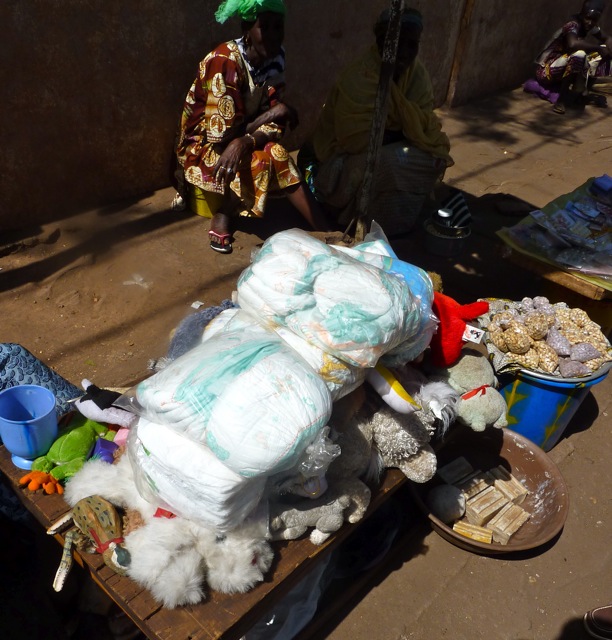
Kushitigi: Sidewalk diaper stand, Badalabougou, Jan. 2012

An emerging consumer class: Wherever you look, there’s evidence of the growing number of Bamakois who have risen to middle-class status. They drive more, watch more TV (and more channels: Bamako has four broadcast channels now, compared to two in 2000). They spend an increasing amount on leisure, as demonstrated by the host of extravagant New Years soirées advertised on TV, for which tickets cost from 25,000 to 50,000 CFA francs (US$50-$100!). And they buy consumer goods they never used to buy. One example is disposable diapers: until recently, these were hugely expensive and purchased exclusively in fancy supermarkets by expat parents. Nowadays, cheap diapers are sold by market women and street hawkers to a local clientele. Then you’ve got new forms of conspicuous consumption: throughout Africa, for instance, a German firm is marketing an energy drink known as “Bizz’up” made from hibiscus flowers. This name, familiar to those who’ve been to West Africa, is ripped off from bissap, a hibiscus drink that’s locally made. Why would Malians want to drink an expensive imported version of something produced cheaply right here at home? Because they can. (But I still think it’s both silly and deeply wrong.)

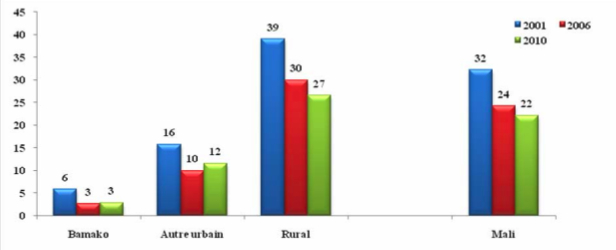
Development: The most recent ELIM survey is full of interesting figures, most of them encouraging, about social and economic development in Mali and in Bamako. If you believe these government figures, in 2010, for instance, 98% of Bamako households had access to potable water, and 70% had electricity (this latter figure had nearly doubled since 2001). Three-quarters of children in Bamako attended primary school, up from 58% in 2001. Moreover, the proportion of Bamakois living in poverty had dropped from 17.6% in 2001 to 9.6% in 2010, while the proportion of those living in extreme poverty was cut in half, from 6% to 3% over the same period. Has Bamako achieved that elusive goal, pro-poor economic growth?

Maybe. But this report also provides several discouraging signs. Many of the gains of the first decade of the 21st century were concentrated in the first five years, with stagnation or even regression from 2006 to 2010 in areas like poverty reduction (see chart below). Bamako saw no improvement in access to electricity, for example, after 2006; more disturbingly, the school enrollment figure actually dropped 10% from 2006 to 2010. Which brings us to what’s probably the most significant negative change of the last fifteen years.

From progress to stagnation: extreme poverty figures from latest ELIM survey

The political mood: In the late 1990s, Mali was brimming with optimism. The country had recently emerged from decades of military dictatorship and had managed a transition to democratic rule that was hailed as a model for Africa. One sensed that Malians saw brighter days ahead, that while their country was extremely poor, at last it was headed in the right direction. I don’t get this sense here so much these days. Despite all the gains described above, I’m more likely to hear Malians voice frustration and disgust with inept public administration, rampant corruption, and a lack of leadership from their government.

University students queue for their stipend payments, Oct. 2011

Probably the most troubling area is the state of Malian public education. Remember that 10% drop in Bamako’s primary school enrollments from 2006 to 2010? Public schools have been so plagued by strikes and shut-downs that some families don’t see the point of sending their children to school anymore. This problem exists at all levels of the education apparatus, right up to the Universities of Bamako, where I’m supposed to be teaching. The whole university system has been closed since last July, pending organizational restructuring, and there’s been no word on when it will reopen. Thanks to Bamako’s increasing population — which owes as much to high fertility as to rural-to-urban migration — the strain on the city’s public schools is growing worse every year. Many Bamakois will tell you their political leaders simply aren’t interested in improving public education, since they all send their children to private schools.

At the core of the matter, of course, is politics: lots of Malians think the country’s politicians are sacrificing future generations for their own selfish interests. Americans may be cynical about their government, but at least U.S. public schools are open for business, and we trust the police to do their jobs. A growing number of Bamakois have lost faith in their government’s ability to do anything, from keeping the schools open to keeping criminals off the street. Some have begun dispensing mob justice to suspected thieves instead of turning them over to the police. And nothing’s likely to improve before elections are held in April.

What’s the upshot? Two words: fundamentally ambiguous. We may be encouraged by the progress made, but we should also be worried about the shortfalls. While Bamakois can take pride in their collective achievements of the last 15 years, pressing problems — many of them linked to explosive demographic growth — threaten those achievements and have already reversed some of the improvements of the early 2000s. Mali’s status as a role model of democratic transition mustn’t blind us to simmering discontent with the country’s democratic process, which more and more Malians associate with gridlock and anarchy.

What will the next 15 years bring? All I can say at this point is that most Malians aren’t expecting that the road ahead will become much smoother for them. At least for the next few years, the signs suggest the road will get rockier and steeper. And they will continue to toil onward, in spite of everything.

Posted in Uncategorized | Tagged , , , , | 14 Comments