Six steps to fix a broken Mali

It’s too soon to declare Operation Serval a success, and there are already concerns about its eventual end, but the French-led military intervention in Mali has at least brought the country back from the brink of disaster, and opened up a space in which Malians can finally begin to chart a way forward for their nation. If I were advising the people who hold Mali’s fate in their hands — not only Mali’s interim president, but members of influential donor governments in North America and Europe — here’s what I’d recommend: six steps to reform the Malian state, settle conflicts and restore stability.

  1. Take the time to organize proper elections. According to Mali’s interim government, nationwide elections (originally meant to be held in April 2012) are now scheduled for July. The U.S. government, bound by legislation barring aid to any regime that ousted a democratically elected predecessor, has long insisted on a new vote, even while half of Mali was under rebel occupation. The U.S. Embassy in Bamako strongly supports the July date for elections. But premature elections could well create another crisis within a matter of months. Voter lists were already in disarray long before the country’s political-military crisis flared up a year ago, displacing half a million northerners. As journalist Cheick Tandina put it, “Mali doesn’t need hasty elections which might get botched and would confer no legitimacy to those voted in.” Mark Quarterman, Director of Research for the Enough Project, has also warned Mali against succumbing to the “election fetish”:  “elections, under the current system, could solidify the hold of the current ruling group,” he wrote last month, referring to the discredited parties and politicians whom many Malians blame for causing the current mess. Elections in Mali must take place, but according to Mali’s timetable, not that of donor governments.
  2. Hold an inclusive national dialogue to forge a political system with popular legitimacy. This dialogue must precede elections. Only leaders with a solid mandate will be in any position to negotiate with disaffected communities in northern Mali (see item 5 below). Mali desperately needs a legitimate government, and while foreign powers can aid the process, the only people who can create it are Malians themselves. Prominent voices in Bamako are calling for a national dialogue like the 1991 conférence nationale that paved the way for a new constitution and elections the following year. But the current rush to elections may take that option off the table.
  3. Reintroduce foreign aid very carefully. Misspent aid money was part of the problem under the old regime, and more misspent aid will only make matters worse. The chart below shows the vertiginous rise in official development aid to Mali in the first decade of the 21st century, from under half a billion dollars to over one billion dollars annually.
    Mali aid

    Official development assistance received in Mali (Source: World Bank Databank; figures in constant 2010 US$); thanks to Nate Allen at Princeton for this chart

    Not only did this money not make Mali better governed, it very likely contributed to its destabilization. Experts like Jonathan Glennie, Paul Collier and William Easterly have made trenchant critiques of development aid, most notably its tendency to absolve recipient governments of the responsibility of actually governing. At minimum, Mali’s donors must make every effort to ensure that their taxpayers’ funds are properly spent and don’t undermine the effectiveness of the very state they are supposed to reinforce. (See a recent op-ed and a brief on aid and governance in Mali, both by political scientist Isaline Bergamaschi.)

  4. Reform the Malian armed forces from the ground up. The European Union has launched a new mission to train the Malian military, but lack of training is only the tip of the iceberg. Northern Malians don’t trust the Malian army, which continues to face accusations of killing civilians. It’s unclear whether the Malian government will take punitive action: its chief prosecutor claims he has yet to be informed of any abuses committed by the army.
    Sanogo screenshot

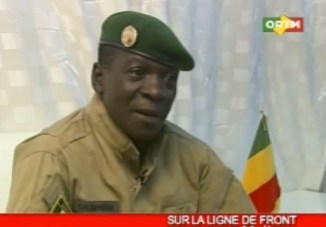
    Capt. Sanogo: on TV, again

    Meanwhile, Captain Amadou Sanogo, who led the coup a year ago, still appears regularly on state television, which even last week broadcast friendly interviews with him in French and in Bambara. Boukary Daou, the newspaper editor arrested 12 days ago after publishing an open letter criticizing Sanogo’s high salary, remains in custody. It’s apparent that Sanogo and his military backers hold a great deal of political power in Bamako, and that the military has yet to be insulated from the political process and vice-versa. Mali’s army is simply a reflection of the dilapidated state apparatus, and requires more than a few EU trainers to fix.

  5. Hold talks to address northern grievances. Mali’s interim officials have expressed willingness to meet with separatist MNLA leaders, provided they disarm and drop their demand for sovereignty. But it’s not obvious what the rebels would gain from such talks: according to a statement by Mali’s prime minister, federalism is off the table, and many politicians in Bamako are eager to make the point that “rebellion doesn’t pay.” Up north, the Tuareg-dominated MNLA is now consolidating control over the territory it controls, issuing documents stamped with the name of the “Azawad Republic” they declared last year. Thus far the MNLA and the Malian government have engaged in a “dialogue of the deaf,” with the rebels accusing Bamako of orchestrating a “genocide,” and self-appointed “youth leaders” in the south labeling the MNLA a terrorist organization, “enemy number one” of the Malian people. (To get a feel for the difficulty of having a fruitful discussion on the place of Tuareg people in Mali, consider some of the comments on my post about Mali’s “Tuareg problem” last month, many of which interpreted that post as “anti-Tuareg propaganda,” others of which actually articulated anti-Tuareg invective.) Whoever should represent northerners, and however difficult such talks may be, they must take place.
  6. Support the truth and reconciliation process. Earlier this month, at the insistence of donors, Interim President Dioncounda Traoré announced the creation of a “dialogue and reconciliation” commission. Some Malians are skeptical of this idea, which they see as alien to their own traditions of negotiation and conflict resolution. But this is one instance where — my anthropological proclivities notwithstanding — I think donor priorities are well founded. Since independence, the government’s failure to address the legacy of violence has only contributed to an escalating cycle of bloodshed in northern Mali, between the army and Tuareg civilians as well as between Tuareg and Songhai militias. In the words of Malian anthropologist Isaie Dougnon,

    “after every crisis, Mali passes a general ‘amnesty’ law, which closes the records of those who are accountable to the people and those who have committed the worst crimes against the interests of the people, without putting in place a framework for understanding and reconciliation. This is what was done after the coup of 22 March 2012. It granted amnesty to coup supporters and civilians before the process of political transition was even begun.”

    One way or another, Malians must confront the injustices of the past. Doing so openly  runs counter to a strong tendency to suppress painful memories in the interest of preserving social harmony. Yet this tendency only prevents the long-term resolution of sensitive issues. Either everyone must be held accountable for their misdeeds — a process that demands a much more robust justice system than Mali possesses — or some form of truth and reconciliation process must take place.

Of course the devil is always in the details, and I’m aware that for certain readers the above list probably seems rather like the Monty Python sketch in which an “expert” explains how to rid the world of all known diseases. I’m also aware that these six steps, while necessary for Mali’s future stability, may not be sufficient to produce it.

Yet over the past month as I’ve joined colleagues both in and out of academia for discussions about Mali’s current crisis and how it developed, I’ve been struck by how many experts don’t even see some of these steps as necessary. Some believe speedy elections and some vague form of regional autonomy for the Tuareg will be sufficient to solve the problem. I think this is deeply misguided. Peace in Mali rests as much on events in Bamako and Kati as in the Adrar des Ifoghas, in Gao, or in Kidal.

[Author’s note: Greg Mann and I recently co-authored a shorter opinion piece making some of these same points. This blog post represents my own views and does not necessarily coincide with Greg’s.]
Posted in Uncategorized | Tagged , , | 9 Comments

The north, the army, and the junta

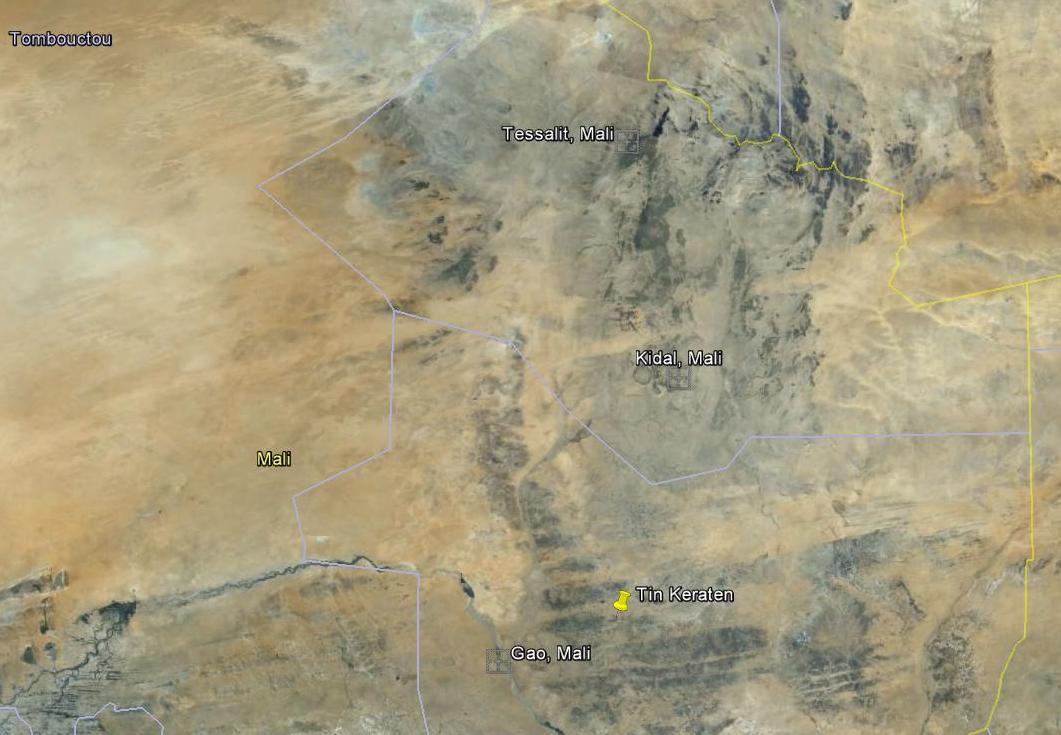
The Chadian government’s announcement of the deaths of two top commanders of Al Qaeda in the Islamic Maghreb, Abou Zeid and Mokhtar Belmokhtar, made headlines in the last week — although the French and Malian governments have so far given no explicit confirmation of these deaths, and the Algerian press is skeptical. The heaviest fighting has occurred in the Adrar des Ifoghas mountains north of Kidal. Earlier today, a fourth French soldier was killed in action, this time in a skirmish near the village of Tin Keraten, 100 km outside of the city of Gao.

Adrar des Ifoghas mapAnother story has all but escaped the notice of the international media: Mali’s armed forces have been almost shut out of military operations in the northern-most combat zone. Since late January Malian troops, alongside counterparts from France, Niger and Chad, have occupied Gao, Timbuktu and other towns along the Niger River; Malian soldiers were patrolling jointly with French counterparts near Tin Keraten, according to the Associated Press. But further north, in the region of Kidal (birthplace of many rebellions over the years), the fight against Islamist rebels is being waged by troops from France and Chad, who have now been present there for more than a month. The Chadians have taken heavy casualties, with at least 27 dead thus far. Occupying Kidal alongside these forces are fighters of the Mouvement National pour la Liberation de l’Azawad (MNLA), the Tuareg separatist rebels who a year ago were allied with the Islamists. But the Malian army is not there, at least not in force. (A handful of Malian troops are reportedly in the area: last week Malian Army Col. El Hadj Ag Gamou told the French newspaper L’Humanité that 19 of his men, all Tuareg, are there acting as guides for the French and Chadians.)

“It’s the lack of means that explains the absence of the Malian armed forces in Kidal. If they give us the means, we’ll go beyond Kidal,” the deputy director of Mali’s armed forces public information bureau told a press conference in Bamako. Public reactions among Malians have been skeptical of this claim; army spokesmen have little credibility with the Malian people these days.

The truth is that France and the MNLA don’t want Malian troops in Kidal. Given the army’s track record over the last several weeks — torture and summary execution of prisoners, plus recriminations against alleged “collaborators” — Tuareg residents there have every reason to fear a massacre. The army, no doubt under pressure from France, recently arrested some of its own soldiers suspected of carrying out abuses against Arab civilians. The Malian armed forces may lack the means to send their troops to Kidal, but more importantly, they lack discipline and a credible command structure to keep their men in line.

Still, the Malian army’s absence from Kidal rankles some Malians, who see it as an affront to national sovereignty. Bamako newspapers routinely cast the MNLA as an unreformed terrorist organization. “The MNLA’s presence today in Kidal not only contradicts the principal of Mali’s territorial integrity, but also calls into question the reconquest of northern Mali,” wrote an editorialist in today’s Le Flambeau. “And from this endorsement flows, on the one hand, the MNLA’s legitimacy in Kidal, and on the other the Malian state’s disinterest toward this part of its territory.” Other papers have accused the MNLA of continued collaboration with Islamist groups.

Army Colonel Ag Gamou, for his part, dismissed the MNLA as bent on “political banditry,” and having no more legitimacy than any of the Islamist groups now targeted by French and Chadian troops. “The MNLA is nothing but an aircraft carrier for all the jihadists,” he told L’Humanité. Such warnings against the MNLA’s “rehabilitation” will complicate prospects for serious national political dialogue.

Col. Ag Gamou with some of his troops near Gao

Another complicating factor is renewed dissension within the Malian army’s ranks. In an open letter published in today’s Le Républicain, a junior officer complained about what he sees as unfair benefits given to Captain Amadou Sanogo, the ex-CNRDRE junta leader who last month was sworn in to head a military reform committee. The letter reads,

Dear Mr. President:

We have learned, as we are dying in the grand desert, that Captain Sanogo, for having mounted a coup d’etat, and put the country in its present situation, will receive a salary of four million [CFA francs, approx. US$8000 per month]. And the others in his group, which is to say, his clan, who refuse to come fight, also receive the same treatment. We do not understand this and demand of you, we other soldiers of the Malian army, a clear explanation. We want to know if mounting a coup d’etat to be compensated and recognized as a good soldier [sic]? We will never accept this. If this decision is not annulled within two weeks, we will cease, that is to say me and my men, to fight and we are ready to accept all the consequences.

Capt. TOURE, Gao, March 1, 2013

Touré’s use of the term “clan” to describe the group of soldiers loyal to Sanogo is reminiscent of the way critics described ousted president ATT, whose corrupt entourage was one of the Malian public’s primary complaints against him (see, for example, the 2007 book ATT-cratie: La promotion d’un homme et de son clan). Such language clearly troubles the powers that be in Bamako, including the junta whose members retain control of the security services: only hours after this letter was published, according to a statement on the paper’s website, Malian state security agents arrested the publication director of Le Républicain, one of Bamako’s most respected newspapers.

This episode illustrates the many challenges Mali now faces. The question of who’s really in charge in Bamako, and what influence the junta’s members have in the political process, must be settled definitively. The military must be reorganized and kept on a tight leash. And Malian political leaders, while avoiding the appearance of caving in to illegitimate groups, must engage in open discussions with representatives of disaffected northern populations, including the Tuareg, whose grievances are both legitimate and long-standing. Accomplishing these tasks will make killing a few hardened Islamist leaders in the desert look easy.

Correction: An earlier version of this post stated that it was Adam Thiam, editor in chief of Le Républicain, who was arrested earlier today.  Information subsequently posted on Maliweb indicates that it was Boukary Daou, not Thiam, who was taken into custody.

Postscript, 10 March: Malian soldiers posted in Diabaly have reportedly left their positions and headed south toward Segou, firing into the air to protest not having received combat pay, according to a report by the AFP.

Recommended viewing: Reuters photographer Joe Penney’s set of portraits of young women in Gao wearing headdresses that had been banned under Islamist rule.

Posted in Uncategorized | Tagged , , , , , | 11 Comments

Corruption is for everyone! (Part 2)

Last May I wrote about the ways the phenomenon of corruption in Mali is not restricted to the political elite, as one could conclude from the voluminous public criticism Malians make of their leaders on Mali news websites. Now comes this comment posted to a recent news item about Mali’s political class, ostensibly by a Malian named Kassin in response to compatriots. His critique gets to the heart of the matter far better than I ever could, and I thought it worth translating in its entirety.

Kassin: “When I read these comments, I fall down laughing, Malians are so dishonest!

“You attack the politicians as if they were the only thieves in the country.

“They embezzle from their state offices and from development projects to win candidacies in elections, to traffic in real estate, build houses, buy apartments overseas, send their children to study or show off, their wives to give birth or show off overseas….

“Yes, they are big-time thieves. But they’re far from being the only thieves in Mali, otherwise the country wouldn’t have collapsed like it did in 2012.

“There’s the SOTRAMA apprentice who rips off the driver who rips off the owner who rips off the state through the vehicle’s customs and insurance fees.

Overloaded SOTRAMA (philintheblank.net)

“There’s the traffic cop who takes 1000 francs to let the vehicle go on its way, even though it has no spare tire, doesn’t meet regulations, has no windshield wiper, no safety belts, it’s overloaded, and 15 meters down the road there will be carnage with 10 dead and 15 gravely wounded.

Gabriel Touré Hospital, Bamako

“In Gabriel Touré Hospital [one of Bamako’s big public hospitals], doctors’ first concern is to treat the best-off among the wounded, neglecting the others… if, that is, [the doctors] haven’t already gone off to private clinics (Farako, Pasteur), the better to sell their services to sick people in good shape, even though they’re paid by the state for a full-time job, and nobody complains.

“There’s the nurses who try to sell the medications they swiped from other sick patients.

“There’s the school principals and public school teachers who charge their students registration fees (300,000 to 500,000 francs), trade exam grades or exam answers for sex or money, and nobody complains.

“Placement in civil service recruitment competitions for Customs, the Tax Office, theTreasury, the Kati military school, the Koulikoro military academy, the National Police, the Gendarmerie, are all sold to candidates for millions of francs, and nobody complains.

“Scholarships for students and interns, generously offered by donor countries, are illegally haggled over in the Ministry of Higher Education like commodities, often sold to foreigners who don’t even have Malian passports but who for a few hundred thousand francs will take the place to study abroad of a young Malian who deserved it.

“Study fees paid by students for the public treasury are embezzled by their schools’ accountants, who lend the diverted money to traders to enable them to get their shipping containers out of Customs to make an illegal windfall, and nobody complains.

“There’s the traders who prefer to pay a few thousand francs to the Customs agent building his multistory house rather than pay the official duties for their vehicles, so the money never goes into state coffers.

“There’s the senior army officers who bicker over fuel allocation for operations or for UN peacekeeping missions.

“There’s the mayors and municipal advisers who sell off the same plots to 5 different people.

“There’s the lawyers and judges who settle their cases among them before trial, having sold the verdict to the highest bidder, and nobody complains.

“Those who win government contracts systematically kick back 10% to the ones who award them, then build defective projects that are nevertheless approved by the public works agency.

“There’s the state electricity workers who take 5000 francs to reconnect service to a subscriber who’s never paid his bills, or help him bypass the electrical meter.

“There’s the civil servant who shows up for work at 10 a.m. and goes home at 2, even though the workday begins at 8 or 9 and ends at 4, and who takes 10,000 francs from anyone who wants to collect an official document, and nobody complains.

“There’s the emigrant abroad who sends money to his brothers, parents and friends to buy a plot or build a house and who is systematically robbed of half his money — and that’s if he’s lucky, otherwise it might be all of it, and nobody complains.

“In short, when we talk about corruption in Mali, 98% of the population does it, so to blame only the ones who go into politics is to lie to oneself and won’t help the country move forward.

“We have to get to the root of the Malian problem by putting justice at the center of our preoccupations.

“If those in the legal system won’t budge, it’s the the conscious young people who must force them to change, otherwise this country will never get back on its feet.”

My own comment: To fix this broken state, it won’t be enough simply to change Mali’s leaders, nor to find more patriotic politicians. The rule of law must be established, and institutions of the state (meaning, the people who work for them) must be made capable of resisting the pressures from society to bend or break the rules.

So, how to do that? I don’t share Kassin’s view that “nobody complains.” In point of fact, Malians complain incessantly about all this these instances of corruption in their lives. But they generally go along with them, because when the rules are not enforced (or selectively enforced to aid those in power*), only a sucker plays by the rules. And until that changes, it doesn’t matter who’s at the top, or how disaffected the people are; Mali’s culture of corruption will go on.

* I recently heard an apparently popular saying among the Brazilian ruling classes: “For my friends, anything. For my enemies, the law.” Do Malians have their own version of this saying, I wonder?

Postscript, 6 June: Malian singer Rokia Traoré said something in a recent interview with Jeune Afrique which touches on the same theme as this post.

In this country, when you run a company, your relatives won’t understand it if your niece doesn’t get a job there. When you’re a civil servant and you offer Tabaski sheep [an expensive end-of-Ramadan gift] to everyone, nobody wonders where you got the financial means to do it. A leader doesn’t fall from the sky, he comes from the people; he reflects the environment in which he grew up. And if embezzling money has become almost normal, how can you expect him to be more concerned with the public good than with his personal comfort?

Posted in Uncategorized | Tagged | 23 Comments

Understanding Mali’s “Tuareg problem”

Last week I took part in a “teach-in” organized by Michigan State University devoted to the ongoing crisis in Mali. A half-dozen Africanist scholars joined a pair of retired U.S. ambassadors to discuss the origins and consequences of that country’s state collapse, ethnic tensions, the rebel takeover and French military intervention. The audience, mostly MSU students and faculty, included several Malians. One recurring subject was the Tuareg people and their place in the Malian nation. Various non-Malian participants spoke of the need to grant the Tuareg some kind of autonomy, while Malians in the room rejected such an arrangement. At one point a Malian graduate student in attendance stated flatly, “There is no ‘Tuareg problem’ in Mali.”

This remark reminded me that listening to Tuareg and non-Tuareg Malians talk about their intertwined history can be like listening to Israelis and Palestinians talk about theirs: the two groups’ respective visions of the past they share are fundamentally divergent, with each group casting itself as victim.

Plenty of analyses by Western officials and journalists these days are structured around simple binaries dividing Mali’s population into north and south, white and black, North African and sub-Saharan, good guys and bad guys. Such crude dualisms need to be dispensed with. Below are a few facts about northern Mali generally, and the Tuareg specifically, that can help in this regard.

  • Even in northern Mali, the people we call “the Tuareg” are a minority.

    Map by National Geographic (click on image for larger version)

    It’s notoriously difficult to count nomads, so we cannot know precisely how many Tuareg live in Mali, or anywhere for that matter. The CIA World Factbook estimates that the “Tuareg and Moor” account for 10 percent of Mali’s population. The Malian government doesn’t collect statistics on its citizens’ ethnic affiliations, but it does sometimes ask what languages they speak. Figures from the 2009 census suggest that about 3.5 percent of Malians speak Tamasheq, the language of the Tuareg, as their mother tongue; in the country’s three northern regions (Timbuktu, Gao and Kidal), Tamasheq speakers account for about 32 percent. They probably constitute a majority in the Kidal region, which in 2009 had a population just shy of 70,000 people — the size of a modest Bamako neighborhood. But the Songhay, a sedentary, phenotypically “black” population, are the biggest group in northern Mali. (Arabs or “Moors” make up about four percent of the population in those three regions, and one percent nationally.)

  • Most of the people we call “the Tuareg” are black. Tamasheq speakers are divided into racial categories determined not only by skin color but by lineage. Dark-skinned descendants of slaves held by high-status Tuareg are known as eklan in Tamasheq, or Bella in Songhay, and they are more numerous than the light-skinned descendants of slave owners. (See Bruce Hall’s A History of Race in Muslim West Africa on the evolution of racial categorization in this region.) Historically they have little interest in Tuareg nationalism. Dark-skinned Tamasheq speakers were among the first victims of war crimes — including looting, rape and murder — committed by rebels of the Mouvement National pour la Liberation de l’Azawad (MNLA) last year. “For the MNLA, dark-skinned Tuareg are fit only for enslavement or death,” a dark-skinned, Tamasheq-speaking woman recently told Sky News. Maybe there’s no such thing as a dark-skinned Tuareg. In Sikasso I used to frequent a Tamasheq-speaking family of blacksmiths, all of them of dark complexion, who had moved there from Gourma-Rharous (southern Timbuktu region) in the 1980s. Later in Bamako I met a light-skinned, turbaned Targui (the singular form of “Tuareg”) who knew them, but he objected to my assimilating them with his own ethnic category. “They are not Tuareg,” he scoffed. In his eyes, no member of a servile sub-group qualified as Tuareg.
  • The people we call “the Tuareg” are not united on anything, least of all separatism. In addition to race, Tamasheq speakers are divided into multiple categories of tribe, clan, and hereditary status. The MNLA — the group that, in the eyes of many Malians, north and south, brought this current tragedy upon the country — has no legitimate claim to speak for “the Tuareg,” still less the Texas-sized chunk of territory which it declared sovereign last year, in which Tamasheq speakers constituted less than a third of the population. An online petition now circulating among Tuareg Malians disavows the MNLA and its separatist aims. “We have been, remain, and will always be full-fledged Malians,” the text claims. Those who seek an independent state for the Tuareg are a “minority within a minority,” as the Bamako press likes to point out.
  • The people we call “the Tuareg” have not been excluded from Mali’s government. Following the Tuareg rebellion of the early 1990s, thousands of Tuareg fighters were integrated into the Malian army, and Tuareg leaders have long held prominent roles in the Malian state. President Amadou Toumani Touré’s first prime minister (2002-2004), and two ministers in Mali’s current government, are among the many Tuareg officials who have served the Malian state. It would be foolish to argue that Tuareg Malians have been underrepresented, let alone shut out, of the political process in Bamako. Like Malians everywhere, they may not have been well represented, but they have been represented.
  • Innocent civilians identified as “Tuareg” have been abused and murdered. 

    Bodies in a well in Sévaré: Who are they? Who dumped them there? (Photo: Jerome Delay, AP)

    Far too often, Malians who point out the above facts downplay or deny the systemic violence against light-skinned Tuareg in Mali. Their claim that the MNLA and other rebel groups have carried out far more crimes against Malians is probably correct: several MNLA leaders are now under international arrest warrants for war crimes. But surely the Malian state must be held to a higher standard, and reports of its troops killing civilians in northern Mali have grown too numerous to ignore. (The MNLA is keeping a list of reported abuses by Malian forces and claims to have filed suit against the Malian government in the International Criminal Court.) The recent statement by Dioncounda Traoré, Mali’s interim president, that “the Malian army has not committed any exaction,” failed to convince even his own partisans. Since French and Malian forces took Timbuktu last month, Arab civilians too have been “disappeared” after being taken into custody by Malian troops (see a heartbreaking report by France24 including footage of an Arab woman finding her husband’s body in a shallow grave outside town). The French are growing uneasy amidst mounting evidence that their own allies are committing war crimes. Remember that Tuareg civilians in Kati and Bamako were already the targets of mob violence in early 2012. Harsh repression by the Malian army of earlier Tuareg uprisings dates back to the 1960s. And yet…

  • The label of historically oppressed minority does not easily fit the people we call “the Tuareg.” Despite all the abuses just described, it’s inappropriate to cast southern, “black” Malians as aggressors and northern, “white” Tuareg as victims in any uniform sense. Generations of enslavement, raiding and domination by light-skinned Tuareg over their dark-skinned neighbors has left an indelible mark on inter-group relations (again, see Bruce Hall’s book on that sordid history). Due to this legacy, some non-Tuareg Malians just cannot perceive “the Tuareg” as victims of oppression. They perceive them, instead, as racists who refuse to accept black majority rule (see Greg Mann’s commentary on the racial politics of Tuareg nationalism from last year).

This last point was brought home to me after I was interviewed on NPR last month about Mali’s Tuareg population. My remarks included the statement that “even in Libya, the Tuareg were still subject to discrimination.” Amadou, a Fulani Malian with whom I’ve  exchanged friendly e-mails, wrote on an online forum, “With ‘even’ and ‘still’ one may wonder if in Bruce’s mind Tuareg are ‘subject to discrimination’ in their places of origin.” I responded that indeed they were. His prickly retort read, in part, “You know very well that attacks on Tuaregs [sic] were just reactions of misguided people who were acting out of frustration rather than inherent or systematic prejudices against a group of people.” For Amadou, the burning of Tuareg-owned homes and businesses wasn’t discrimination, it was a misunderstanding. Perhaps the MSU student who thinks Mali has no “Tuareg problem” feels the same way.

I’m no expert on the Tuareg or northern Mali in general, and I don’t claim to offer any solutions. But I know three things. One, whatever the “Tuareg problem” is, an independent or autonomous state for “the Tuareg” is unlikely to solve it. Two, simplistic categories used to describe these people and their relations with neighboring groups actually keep us from understanding, let alone preventing, the race-based injustices that have occurred in Mali and throughout the region. And three, until Malians of all backgrounds can meet for open dialogue about the crimes they have endured — and carried out — they will continue talking past each other, and their divergent views of their common history will only grow further apart.

Posted in Uncategorized | Tagged , | 160 Comments

What threat from Mali’s Islamist groups?

Last month British Prime Minister David Cameron said Islamist terrorist groups in North Africa pose a significant threat to global stability. The Islamist presence in Algeria and Mali, he said, is “linked to al-Qaeda, it wants to destroy our way of life, it believes in killing as many people as it can. We need to work with others to defeat the terrorists and to close down the ungoverned spaces where they thrive with all the means that we have.” British pundits were quick to heap scorn on Cameron’s assessment. Simon Jenkins in The Guardian wrote that

the so-called al-Qaida menace appears to be a ragtag coalition of Tuaregs, gangsters and dissidents, armed with weapons mostly released by Nato’s regime change in Libya. They managed to grab a barely accessible Saharan base, but have melted away at the first sign of serious opposition.

Tom Stevenson on the website of the UK monthly Prospect claims these groups pose no “existential threat” to the West and its interests. British former diplomat Carne Ross states that while the armed Islamist groups across Africa may be collaborating, there is “no evidence of a coordinated network with international terrorist ambitions.” Unlike real terrorists who fight for global jihad, Ross claims, Africa’s jihadist groups have strictly local origins and local agendas. Such skepticism has also been voiced in official circles in Washington. The French government, by contrast, has taken the Saharan terror threat very seriously for some time. According to the French weekly Le Nouvel Observateur, members of the departing Sarkozy administration in May 2012 informed François Hollande’s defense staff that “the French people don’t know it, but the risk of [terrorist] attacks coming from this region are very high.” Since 2009, these sources claim, French intelligence services thwarted three planned attacks on French soil and five attempts to infiltrate jihadist fighters.

Today, after a week or two of calm in most of Mali, it’s apparent that reports of violent jihadism’s demise in the country were greatly exaggerated. Over the weekend, the northern city of Gao was the scene of Mali’s first-ever suicide bombings: two separate bombs exploded, one involving a jihadist on a motorbike, the other a jihadist on a donkey. Malian security forces carried out arrests on Saturday, then on Sunday engaged in fierce firefights with Islamist rebels; news footage from France2 (below) shows French armor and helicopter gunships coming to the aid of Malian troops in the city. The Movement for Oneness and Jihad in West Africa, an offshoot of Al Qaeda in the Islamic Maghreb (AQIM), has claimed responsibility. There’s a tendency among some analysts to dismiss AQIM as a primarily criminal enterprise, more concerned with its lucrative smuggling and kidnapping activities than with jihad.

I used to think this way, but now I’m not so sure. For those who want to learn more about AQIM, I recommend two books. The first, published in French last year, is Al-Qaida du Maghreb Islamique : L’industrie de l’enlèvement, by the Franco-Beninois journalist Serge Daniel. Daniel, the veteran West Africa reporter for Agence France Press and Radio France International, spent over two years interviewing the region’s security officials, political leaders, and even detained radicals. His book minutely details AQIM’s origins in the Algerian civil war and its decade-long history of kidnapping Westerners for ransom, a strategy that has netted the organization up to €100 million by some sources. (In this regard, the supposed bombshell revelation by a former U.S. ambassador to Mali that France had paid ransoms to AQIM came as no surprise.) Somewhat less thoroughly, the book also outlines AQIM’s Algerian-dominated command structure, its involvement in drug smuggling, its finances, its ideology, and its recruiting methods. (The AQIM fighter’s average age, Daniel says, is 16 years; reports of child soldiers in the Islamists’ ranks have been legion both in Malian and Western media). The book portrays the group’s members as driven first and foremost by intolerant dogma and virulent anti-Western zeal.

The second book is A Season in Hell: My 130 Days in the Sahara with Al Qaeda by Robert Fowler. This is an account by a senior Canadian diplomat who was himself kidnapped by AQIM during a mission to Niger in December 2008. He and another Canadian hostage were held in the unimaginably remote wastes of Mali’s Kidal region for four months before being set free (at the price, according to Daniel’s book, of the release of AQIM members from Mauritanian custody). “I have never met a more single-minded and committed set of individuals than the AQIM katiba [unit] that held us,” writes Fowler, who describes at length his erstwhile captors’ operational prowess, their austere lives, their harsh environment, their fervent faith and their many (unsuccessful) attempts to persuade and harangue their hostages into converting to Islam. His portrait of Mokhtar Belmokhtar, the AQIM leader who coordinated last month’s hostage drama in Algeria, is especially telling: the man may have a reputation as a smuggler of stolen cars and cigarettes (he’s been branded “Mister Marlboro” in the Western media), but in these pages Belmokhtar appears so puritanical he’s visibly ashamed to inform his Canadian hostages that some of his fighters ate part of a package of cookies meant for them after it broke open en route. Fowler characterizes the question of whether AQIM is “really Al Qaeda” as “startlingly moot: if they think like Al Qaeda, are motivated by and want to achieve the same things as Al Qaeda, behave like Al Qaeda, fight, kill, and die like Al Qaeda, and say they are Al Qaeda, then, quite simply, they are.” [Fowler has recently returned to the public eye in Canada through his outspoken advocacy of a larger Canadian role in international military intervention in Mali.]
At the onset of Operation Serval last month, AQIM was estimated to have up to 1000 fighters. (Its allies had a few thousand more; some have reportedly turned up in Darfur, others in Libya, while still others have no doubt sought safer careers since French airstrikes began.) The organization seeks to “internationalize the conflict as best as they can,” according to an EU adviser quoted in The Washington Post. In addition to its role in orchestrating January’s In Amenas attack, AQIM brought fighters from Nigeria’s Boko Haram to train for several months in Timbuktu.

Al Qaeda in the Islamic Maghreb and its partners in the region may not have held their ground against the French army and air force last month, but they are by no means vanquished. Reports indicate that they carried out an orderly withdrawal to their desert stronghold, where they will be exceedingly difficult to find and kill. They are ideologically driven and flush with cash. They have the desire and growing capacity to sow terror and instability throughout West Africa and the Sahara. In light of the renewed violence in Gao this weekend, it would be prudent to expect them to put up a determined, bitter fight  lasting not weeks, not months, but years. If they are not eliminated or effectively contained, and if what Daniel and Fowler have written about them is at all accurate, there’s no reason to believe they’ll be content to remain in the Saharan sands and leave the rest of the world alone.

Postscript, 14 February: A description of life under Islamist rule in Timbuktu, based on Arabic-language court documents discovered in that city, appears on the website of Foreign Policy. Rukmini Callimachi of the Associated Press describes an AQIM “manifesto” left behind in Timbuktu.

Posted in Uncategorized | Tagged | 8 Comments

Intoxication by information: fighting over facts in Mali

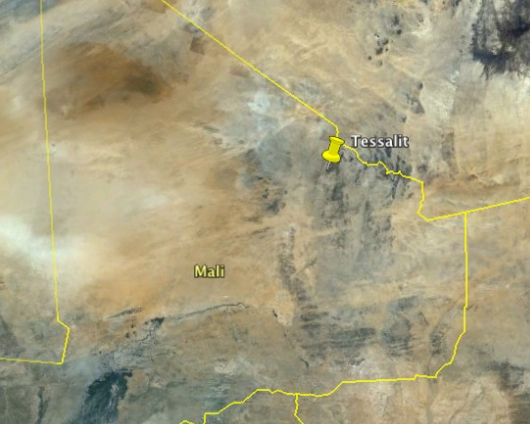
The remote village of Tessalit, way up in northern Mali close to Algeria, holds the key to the Tessalitfuture of the Saharan region. Anyone in Mali will tell you this. The Guardian‘s Afua Hirsch spoke to a few of them before writing about Tessalit’s “geostrategic importance” this week. According to one of her sources, in fact, Tessalit is among the top three most important locations on the planet.

Set aside for a moment that the source in question was a tour guide. Last month I discussed the misuse of the term “strategic” in recent writing about Mali. To recap: a location is strategic irrespective of the events swirling around it. The bridge over the Niger River at Markala is, by definition, strategic:  to drive a truck or tank across that river anywhere between Bamako and Gao (a span of over 1000 km), Markala is the only way to go. Places like Diabaly and Konna, on the other hand, happened to be the sites of early confrontations between Islamist and Malian government forces in January, but lack inherent strategic value: the battles could just as easily have taken place somewhere else. Once the Islamists left, these towns were no longer important to the security of government-held territory.

French armored vehicles cross the Markala bridge, Jan. 2013

In Mali it’s said that Tessalit has long been coveted by Mali’s neighbors and by the great world powers. During the Tuareg rebellion early last year, the press in Bamako was rife with speculation that Sarkozy incited the rebellion because President Amadou Touré had refused to grant France a permanent base there. Tessalit’s vital importance is one of those things people in Mali simply know to be true.

Another thing they simply know to be true is that their country’s population has twice as many women as men. (Opinions vary: some say three times as many.) Another is that Mali’s King Aboubakar II led a fleet of canoes from West Africa to the New World, more than a century before Columbus. Yet another is that the U.S. has 52 states. It doesn’t matter that there’s no evidence for any of these things; people like Hirsch’s tour guide nonetheless accept them as fact.

Maybe Tessalit has “geostrategic” value, maybe it doesn’t. The problem is that, as with so much pertaining to Mali these days, it’s impossible to say for sure. There’s simply no way to verify many of the claims being made about events in the country, no way to know which are accurate, which are exaggerations, which are erroneous, and which are downright deceitful.

Has the emirate of Qatar been supporting Islamist rebels? This is another charge taken as gospel truth in the Bamako press; similar allegations have appeared on Algerian websites.

Was there a plan under the Touré regime to sell off part of the city of Kidal to the Algerian government, as the Bamako newspaper Le Combat recently claimed, citing a former cabinet minister? (Not according to the same former minister’s article in Le Républicain.)

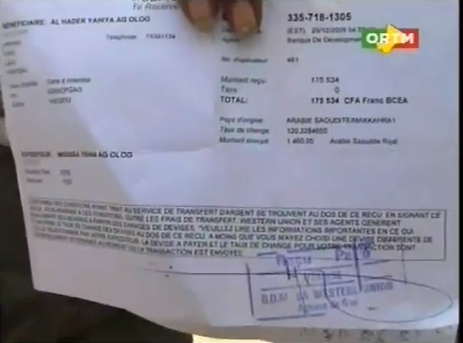
Did Malian soldiers in the recently liberated city of Gao indeed find “drug money” and proof of Gulf Arab states’ financial assistance for the rebels? Consider this video from a recent news broadcast on state television.

“This is proof that the combatants were paid,” a soldier announces, holding up a sheet printed in French. Yet it’s hard to know from the footage exactly what was found. A close inspection of a still image (below) shows the sheet to be a Western Union money transfer receipt from a BDM banWU 1k branch, received before the Islamist takeover (the banks in northern Mali all closed after the Malian army was expelled in early 2012). We are also shown images of handwritten Arabic documents, which the newscaster tells us record the Islamists’ payroll and financial transactions. But is this “proof” convincing?

Have Malian troops committed human rights abuses against civilians, as foreign watchdog groups maintain? Absolutely not, according to one Malian rights organization, which accuses Human Rights Watch and Amnesty International of mounting a disinformation campaign to discredit the Malian government.

Did the Malian armed forces in fact spearhead the counter-offensive against Islamist rebels last month, making French military intervention unnecessary? This is what Dr. Rokia Sanogo, a leader of the MP22 political movement, has recently claimed. She and her boss Oumar Mariko have been railing against foreign intervention ever since the coup last March, and the popularity of Operation Serval notwithstanding, they’re sticking to their line that the Malian army never needed anyone’s help to restore the country’s territorial integrity. Forget about that negative coverage in the Western media describing Mali’s army as a shambles, clearly part of an imperialist plot to undermine the country’s sovereignty. (Forget, for that matter, about a candid video showing coup leader Captain Amadou Sanogo lambasting his troops on 12 January for their indiscipline and cowardice during the Islamist assault on Konna.) These days you can believe whatever you want and find reporting to back you up.

French-speakers like to draw a rhetorical contrast between “info” and “intox,” i.e. truthful claims and disinformation. What I’m noticing more and more is the impossibility of distinguishing between these two categories. Mali’s vibrantly free press and the rising (though still small) numbers of internet users have not fostered an informed populace. If anything, new media technology has only muddied the waters, turning the country into a fact-free zone.

For Mali-watchers in the “reality-based community,” sorting truth from fiction has become an ever-more frustrating task. Maybe the U.S. and France actually do want to set up secret military bases in Tessalit. Maybe President Touré actually did take kickbacks from drug smugglers and kidnappers. Maybe foreign mercenaries actually did take part in the failed “counter-coup” on 30 April last year. My concern is that, amid the flood of innuendo, speculation and distortion, we’re not seeing hard evidence for these claims. People like to say that time will tell, but in Mali time has a way of keeping its secrets buried.

********************************

TO READ: For anyone tired of premature declarations of victory in Mali, I recommend this piece of careful reporting from McClatchy’s Alan Boswell: “Islamist retreat in Mali was orderly, witnesses say, suggesting force will return to fight again.”

Postscript, 20 June: Rumors of US and French interest in setting up a military base in Tessalit have resurfaced on the website Saharamedias.net.

Posted in Uncategorized | Tagged , , , , | 17 Comments

What’s to love about Mali? Four things.

Several days ago, an American living in Bamako wrote the following account on his blog:

I was in a SOTRAMA (Mali’s take on the minibus, a green shell ringed with wooden benches, infinite division of space, unlimited passengers) the other day and I watched a guy scoop up a baby from the arms of a mother who was burdened with several bags and a large plastic bowl overflowing with toothbrushes and tubes of toothpaste.

After she climbed into the SOTRAMA and arranged her merchandise, she did not ask for her baby back. Her baby remained in the arms of a stranger, who was now smiling and laughing with the woman’s daughter on his lap.

Two other women – strangers to each other – began a conversation that ended with reciprocal benedictions when they parted ways.

Everyone sucked their teeth in unison when a policeman stopped the SOTRAMA and asked to see IDs. But everyone quickly laughed when the prentike [the driver’s apprentice] mocked the policeman and then dodged the outstretched hand intending to give him a playful slap on the head.

A Bamako SOTRAMA

At a time when Mali has become unjustly branded around the world as a den of violence, religious zealotry and ethnic strife, this anecdote helped me remember what it is about Mali that made me fall in love with the place years ago, and what it is that keeps me going back. I want to highlight four of what I consider the most admirable qualities of Malian society and culture, and reflect on how, if properly harnessed, they might help the country cope with the challenges now before it.

(Although I use terms from the dominant Bambara language, having lived in Senoufo and Soninke communities in Mali, I know the Bambara have no exclusive claim to these qualities, and that equivalent concepts exist in other Malian languages.)

1. Mɔgɔya. This is what’s evident in the SOTRAMA story above — a spontaneous familiarity found even among strangers, an eagerness to engage with other people socially in almost any situation. The Bambara word mɔgɔ means “person,” and you could translate mɔgɔya as “personhood,” but that wouldn’t tell the whole story. In Mali, as in much of Africa, the person is not reducible to the individual; mɔgɔya is expressed through social relations, which exist prior to the person. “It is only by means of social ties that one can achieve personhood,” writes anthropologist Saskia Brand in her ethnography of Bamako, Mediating Means and Fate. An individual human being does not necessarily qualify as a person because, as Brand notes, someone who is anti-social may not be considered a mɔgɔ.

I think of mɔgɔya as a parallel of social capital, something that constitutes a public good, and the decline of which in American society has been noted by social scientists like Robert Putnam. Whatever you call it, Mali has it in spades. For outsiders like me, everyday displays of mɔgɔya can lift the spirits. For Malians, mɔgɔya is what holds society together.

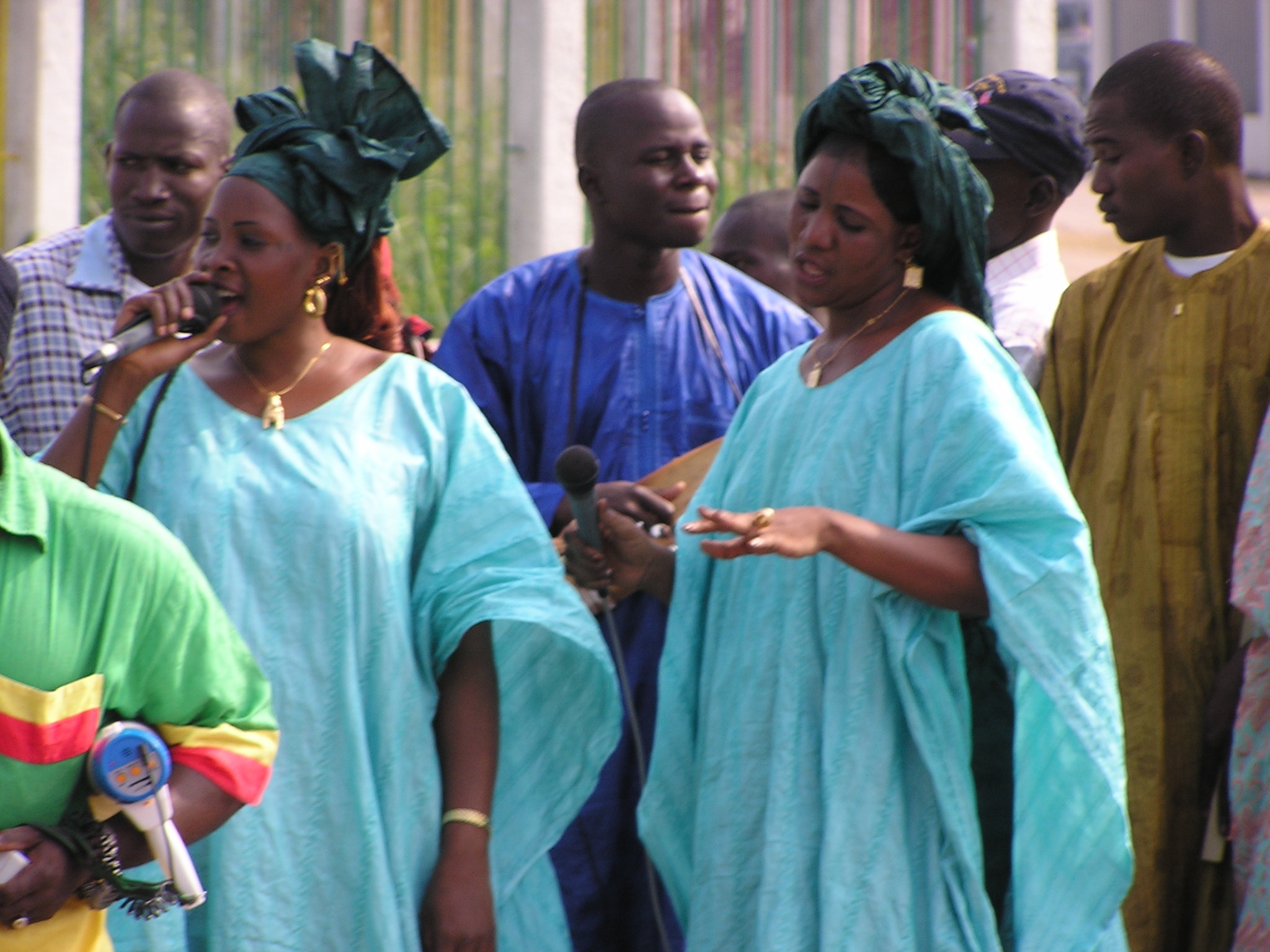
2. Danbe. This term can be equated with dignity, honor, and reputation. Danbe stems in large part from what anthropologists call “ascribed status” — that part of one’s reputation one inherits from one’s ancestors, closely linked to one’s place of origin, as described in my own book. Malians take great pride in their history, both at the level of the family and of the nation. A whole category of people (known as jeliw or “griots”) make their living reminding other people of their danbe. They make sure the memory of illustrious forebears, of legendary heroes and great leaders from Mali’s precolonial history stays fresh in the public mind.

Malian jeli women at work

Malian jeli women at work

Malians consequently tend to have a solid sense of who they are and where they came from. They exhibit comparatively little desire to mimic outsiders, whether it’s the French, the Americans or the Saudis. They have their own ideals to emulate, rooted in centuries of oral tradition and in their own understanding of their faith. “For us, danbe is at the center of everything,” a Malian man once told me. “It’s like water, you cannot live without it.”

3. Faso kanu. This term literally means “love of father’s house,” but a better translation would be “patriotism.” People unfamiliar with Mali might be tempted to dismiss the country as another African basket case built around arbitrary European-drawn borders  lumping together ethnic groups that ought to be separate. But all borders are arbitrary, and overall Malians coexist quite well within the borders they inherited (I’ll address a notable exception below). They relate to their nation-state in a way many other Africans don’t, in part because of the danbe complex of dignity, honor and historical memory that goes back to the 13th-century founding of the Mali Empire. Watching recent news footage from Timbuktu and elsewhere in newly liberated zones, I’ve been struck by the scenes of jubilant crowds greeting the troops and journalists, and by hordes of children chanting “MALI! MALI! MALI!” Even as the country has been at war, Malians have been transfixed by their national soccer team, les Aigles, who on Saturday battled their way past South Africa to reach the semi-finals in the African Cup of Nations. Don’t tell them their national identity is a meaningless colonial-era construction; they’ll think you’re stupid or crazy.

4. Senenkunya. Definitely the most idiosyncratic of the four, senenkunya is a system of joking relations that cross-cuts distinctions of ethnicity, caste, and clan. When two strangers in Mali meet, the first thing they do is ask each others’ jaamu or clan name. If for example one’s a Traoré and the other’s a Diarra, or one’s a Coulibaly and the other’s a Keita, or one’s a Fulani cattle herder and the other is a blacksmith (both statuses readily revealed by clan name), the second thing they will do is ritually insult one another. They will belittle each others’ intelligence, ancestry, and diet, often accusing each other of flatulence. And then they will get along like old friends.

Bizarre as it may appear, senenkunya is about a lot more than ritual insults (see a recent BBC article). It lays out a shared cultural blueprint to help people from all walks of life relate to one another. If two people in conflict learn that they are “joking cousins,” the conflict is immediately ended. Senenkunya is a system of alliances, some characterized by joking, others by deep respect and even avoidance. Like danbe, its origins can be traced to the earliest period of Mali’s precolonial history. If mɔgɔya is the glue that holds Malian society together, senenkunya is the grease that facilitates social relations and exchange.

(A couple of my colleagues in France, Etienne Smith and Cécile Canut, have questioned the utility of senenkunya and other African systems of joking relations, describing analyses like mine as outmoded functionalist irenicism. While I don’t know what irenicism is, I do consider their argument a fitting contribution from two dim-witted, flatulent eaters of donkey meat.)

Mali’s combination of strong social capital, concern for dignity, national identity, and joking relations described above can, I believe, help the country survive the conflict that now engulfs it. To paraphrase Bill Clinton, there’s nothing that’s wrong with Mali that can’t be fixed by what’s right with Mali. But Mali’s history since independence also suggests that these cultural assets have not extended evenly to all parts of the country. While the Tuareg are joking cousins with the Songhay, this fact has not prevented conflict among these groups, and one Malian has even told me that Songhay-Tuareg cousinage is “non-binding.”  The “Tuareg problem” in the north is the one ethnic divide in contemporary Mali with political salience, and groups on both sides of this divide consider themselves the historical victims. Light-skinned Tuareg point to a history of periodic repression by the Malian state and its associated ethnic militias, while their darker-skinned neighbors point to a history of being enslaved and attacked by the Tuareg. Recent recriminations against Tuareg and Arabs in Timbuktu are rooted in this history.

For Mali to break the decades-long cycle of conflict in the north, two things must happen. One, Tuareg leaders must face up to the legacy of slavery and racism that marks their people’s relations with black Africans. Two, officials of the central government must face up to the pattern of neglect and abuse that marks their relations with the Tuareg. At a juncture when even some Europeans are calling for an independent Tuareg state, perhaps we should think instead about how Tuareg and non-Tuareg can forge new bonds of peace with each other. The inclusiveness of Malian society simply needs to be taken a step further. It is not so far-fetched to imagine that all citizens of Mali, regardless of ethnicity or skin tone, might someday soon unite behind a common national identity.

Allez les Aigles!

https://i0.wp.com/news.abidjan.net/photos/photos/Mali-Afrique-sud8.jpg

Posted in Uncategorized | Tagged , , , | 57 Comments

Next, the hard bit

According to Al Jazeera, French forces have captured the airport a couple of kilometers outside Timbuktu. Footage from the network also shows a French column advancing northward near Niafunké being welcomed along the way.

But the Ahmed Baba Institute has apparently been burned: see video from Sky News.

320 kilometers to the east, the city of Gao was the scene of jubilation as French and Malian army vehicles rolled through the streets. Video from Channel 4 News and France24 shows public celebration as Malian troops entered the city.

Anecdotal evidence suggests that the Malian people are generally behind the French-led intervention. Add to the boisterous celebrations described above, and the fact that it’s now cooler to be French than American in Bamako (as reported by Peter Tinti), and a string of gushing editorials and comments in Malian state media, the recent proposal by a Malian politician (albeit a marginal one) to name one of the country’s military bases after French President François Hollande. Such pro-French expressions would have been unimaginable just a few weeks ago.

I have yet to see data from opinion surveys carried out in Mali since Operation Serval began on 11 January, but newly released data (gathered well before the operation) show that most Malians have long been in favor of international military action to drive rebels out of northern Mali. Last week the research firm ORB International published results of a poll, conducted between late November and early December 2012 in all six regions of Mali not under rebel occupation, that asked about 1500 Malians for their views on foreign responses to Mali’s situation. (See a summary or view the complete response table.)

  • Asked “Do you support or oppose foreign countries using force to target AQIM in Northern Mali?“, 78% of respondents said they supported such action. The rate was nearly 90% in the Mopti region.
  • Asked “Concerning the situation in Mali which do you think should be the biggest focus for the international community right now?“, 67% chose Mali’s territorial integrity, ahead of the country’s humanitarian and political crises.

These results come on the heels of survey research conducted earlier in 2012 by political scientists Jaimie Bleck and Kristen Michelitch, in a rural part of the Mopti region then located in a no-man’s land between rebel and government lines. This research showed significant support for a military solution long before hostilities resumed this month.

  • Asked, “Is armed conflict worth it to reunify the country, or is it better to peacefully separate? “, 78% said it was worth the fight, 9% wanted to peacefully separate, and 23% were undecided.
  • When asked “What type of intervention should be launched?”, 50% of respondents mentioned negotiations, while 60% cited military intervention as important to restore territorial integrity.
  • Most respondents who felt that military intervention was necessary preferred exclusively domestic involvement by the Malian military (43% of all respondents).  Of those citing the need for foreign intervention, the US was the most popular of the potential allies (23% of respondents favored US intervention), followed by France (18%) and then ECOWAS (15%).

Of course France still has many Malian critics, even if their message is somewhat muted these days. SADI party leader Oumar Mariko, a vocal opponent of international military intervention, has blamed the international community’s response to the March coup (i.e., sanctions and threats) for weakening Mali’s armed forces, while also insisting that it is the Malian army, not the French, that has been bringing the fight to the rebels. He has also suggested that the French are hiding the ugly realities of their military campaign, telling Al Jazeera: “Their version of events is all that anyone will hear. But when this is over, Malians will talk to each other and quickly learn the truth.”

(Some Malian reporters complain of not getting access to the front lines, alleging that only journalists traveling with French troops have been able to cover recent developments in the north.)

In a sense, however, Operation Serval’s current popularity among Malians may not matter, because the greatest military and political challenges lie ahead. Practicing classic guerrilla tactics, the Islamist forces have withdrawn as their enemy advanced. They have now fallen back to remote desert strongholds. As Luke Harding of The Guardian writes, “it is uncertain whether France’s giddy military advance will deliver any kind of lasting peace. So far the ‘war’ in Mali has involved little fighting. Instead Islamist rebels have simply melted back into the civilian population, or disappeared. Refugees who fled the rebels’ advance believe it is only a matter of time before the jihadists come creeping back.” (See video from Harding in Sévaré.)

The only major town the Franco-Malian advance has not yet taken in northern Mali is Kidal, about 300 kilometers northeast of Gao. Kidal was the target of French airstrikes in recent days. Today secular nationalist Tuareg rebels belonging to the MNLA (Mouvement National pour la Liberation de l’Azawad) claim to have ousted their Islamist rivals from the town. Over the weekend one report suggested that Kidal was the scene of a pro-MNLA demonstration.

Retaking Kidal may prove much more complicated than retaking Gao and Timbuktu. But even if it’s quick and easy, the fact remains that the Islamists have yet to be militarily defeated. How long will the French be willing to help the weak central government maintain its presence in Mali’s far north, a zone where its control has always been tenuous? Can Malian security forces, already accused in both the Malian press and foreign media of engaging in “reprisals” against civilians, manage not to alienate the population of that zone?

“Destroying a couple of AQIM bases and driving the rebels from Mali’s northern cities is the easy bit,” writes Luke Harding. “The challenge will be holding on to the territory against a nebulous and cunning foe and, perhaps, somehow incorporating the rebels into a lasting political solution.”

Mali’s conflict must be resolved not only in the wastes of northern Mali but in the corridors of power in Bamako. The country’s political leaders must now get down to the difficult business of working out how Malians will coexist in a single republic, under a democracy worthy of the name. Recent history may be discouraging, but one hopes Malians will rise to the occasion.

Posted in Uncategorized | Tagged , , , | 4 Comments

Lessons from Diabaly

After several days of contradictory reports, it’s now certain that the armed Islamist fighters who had taken over the town of Diabaly, in Mali’s central region of Segou, have departed. Events in Diabaly over the last two weeks offer useful clues about the abilities and qualities of the three armed forces involved — Islamist, Malian government, and French.

Charred pickup trucks destroyed by French airstrikes are seen in Diabaly, Mali, January 21, 2013. The town of Diabaly was retaken by French and Malian forces after al Qaeda-linked rebels took over the town a week ago. (REUTERS-Joe Penney)

This small town, population approximately 15,000, is located on the vast plain north of the Niger River, amid rice fields and irrigation canals dug during the French colonial era. Before dawn on January 14, as reported by Alan Boswell of McClatchy Newspapers, a column of several dozen Islamist vehicles moved toward Diabaly, entering not by the northern main road where Malian troops were waiting, but from the south, flanking the town and catching its defenders by surprise.

The Malian army collapsed quickly, some of its soldiers taking off their uniforms and running once the battle began. Their poor performance, in Diabaly as in Konna a few days prior, has cost the armed forces the confidence of the Malian people, according to a report from the Los Angeles Times. Footage from France24 taken in the nearby town of Niono shows an army of exceedingly modest means, unable to feed itself and unprepared for the fierce determination of the Islamists.

Once the army was defeated, as many as 120 Islamist pickup trucks (the AP reports 30-40) occupied Diabaly, where they were parked under mango trees to conceal them from French aircraft. Under the command of an Algerian Arab known as Abou Zeid, the Islamist fighters occupied private homes, sometimes setting up gun emplacements on the roofs. Their ranks included some English-speaking Africans as well as others who “looked like Europeans,” according to witness accounts. They took no prisoners, executing the Malian soldiers left behind. Although some civilians were executed, in general the Islamists did not deal harshly with civilians, even seeking to win them over according to the Wall Street Journal. They even offered to pay rent to the owners of the homes they occupied. (The “hearts and minds” campaign carried out by these groups in northern Mali has been documented by Al Jazeera.) While they did try to keep women from going outside with their heads uncovered, they did not immediately attempt to impose the harsh interpretation of Islamic law that they had instituted in northern towns, where they had enacted it over a period of several weeks.

Islamist fighters laid mines outside homes in Diabaly, according to the WSJ and The Independent. They also vandalized the Sacre Coeur Catholic church, breaking the crucifix (see video from francetv) and beating up Christians. Note that, as elsewhere in Mali, Muslims in Diabaly always got along well with members of the town’s small Christian community in the past. These abuses were committed by outsiders, not town residents.

“I am angry at them. I studied Islam — so I know everything they know. Not one of the rebels came to my home or to the mosque to see me,” Diabaly’s chief imam told NPR’s Orfiebea Quist-Arcton. “If they were true Muslims, they should have looked for me, because I am the religious leader here.”

The French seem to have acquitted themselves rather well in their effort to drive the Islamists out of Diabaly. Over a week, they targeted enemy vehicles from the air, ultimately forcing the occupiers to flee the town on foot. Some reports suggest they headed east; most of them seem to have melted away. The town’s civilian population was apparently spared: the only report of civilian casualties I have seen so far is of one child wounded by French shrapnel, reported by the BBC. The people of Diabaly, by all accounts, welcomed the Islamists’ departure.

“The only thing that prevented the French planes from annihilating these people is that they were hiding in our homes. The French did everything to avoid civilian casualties,” a resident told Rukmini Callimachi of the Associated Press. “That’s why it took so long to liberate Diabaly.”

Yet the Malian army has warned of difficulties caused by enemy sympathizers. “The war against the Islamists is not at all easy and there’s a very small part of the population which is helping their cause,” Col. Seydou Sogoba, the Malian commander in the Niono, told the Associated Press. “That is what is making the fight against them tough.”

What does all this augur for the next phase of Mali’s armed conflict? The Islamists easily overpowered their Malian army adversaries, who were not expecting the enemy to be so heavily armed. Some commentators think the Islamists’ cunning has been exaggerated: David Blair of the Daily Telegraph, for instance, casts doubt on the Islamists’ strategic thinking, arguing that they made a terrible mistake by trying to push into southern Mali earlier this month. But Andy Morgan contends they’ve still got plenty up their sleeve, and will be much harder to fight in the desert, their home turf.

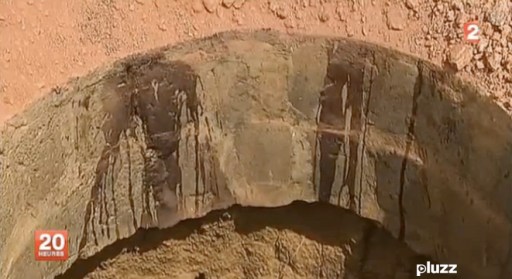
Perhaps the most pressing concern for the Malian military pertains to human rights violations. Members of Mali’s security forces have allegedly committed atrocities against Tuareg and Arab civilians elsewhere (see also a report from The Guardian). France2 television reported on 22 January that 10 to 20 suspected Islamists had been executed by Malian soldiers near the town of Mopti, their bodies dumped in a well. The FIDH claims army troops have engaged in a pattern of abuses against civilians in the Segou and Mopti regions.

Well

Screencap of 22 Jan. news broadcast on France2, showing a bloodstained well in the town of Sévaré where the bodies of civilians executed by Malian security forces were allegedly buried

The Malian army’s Chief of Staff Gen. Ibrahima Dahirou, in an interview with RFI, denied his troops had committed any wrongdoing and said their training had stressed protecting the rights of civilians. Yet such allegations appear to have touched a nerve. Mali’s prime minister’s office today felt compelled to issue a communique: “The government reiterates the instructions given by the Interim President of the Republic to the security forces regarding strict respect for human rights. The army must be above reproach and there can be no question of us tolerating acts we decry from the terrorists,” it read in part. The entire statement was read on state TV’s evening news on 23 January, followed by a statement from the army chief of staff emphasizing his forces’ commitment to protecting civilians and “scrupulously respecting” all relevant human rights conventions.

Malian troops are not only the weakest link in the French-led military campaign, they may prove to be its greatest liability. Their lack of discipline and apparent willingness to carry out harsh “reprisals” against unarmed civilians will surely complicate the Malian government’s efforts to win back the territory it lost last year. Various civilian militias formed by the Malian government have a history of targeting Tuareg and Arab civilians. In the weeks and months to come, French military commanders may find that they must protect the people of northern Mali not only against Islamists, who are all too willing to use them as human shields, but against members of Mali’s own armed forces.

Postscript, Jan. 26: See an LA Times story on Diabaly, focusing on the way Abou Zeid’s Islamists interacted with the local populace.

Posted in Uncategorized | Tagged , , | 13 Comments

Malian voices united (mostly)

For outsiders, among the most remarkable aspects of life in Mali is the music, the first of many things I fell in love with while living there in the late 1990s. Western journalists writing about the country’s worsening conflict this month have sometimes gone out of their way to mention the country’s world-renowned musicians. And it’s true that these artists, especially the jeliw — members of the caste generally known in Western languages as “griots” — occupy a special place in Malian society.

Barely two weeks before the French military intervention began in Mali, reggae singer Tiken Jah Fakoly released a single urging Malians to mobilize against the rebel threat. A few days later, rapper Master Soumy released a song along similar lines entitled “Sini ye kɛlɛ ye” (tomorrow is a fight). More recently, both these artists joined several well-known Malian musicians under the name Voices United for Mali to record a song “Mali-ko” responding to the country’s conflict. These musicians hail from every part of Mali, and sing (or rap) in a broad range of styles. The “Mali-ko” video below is followed by my translation of and commentary on the lyrics, the message of which is less straightforward than may first appear.

Ensemble: It’s time to speak up about Mali / Artists must speak up about what’s happening to Mali

Khaïra Harby (from Timbuktu): Men and women of Mali, let’s stand together, our country is not warlike

Fatoumata Diawara (from Bougouni): What’s happening in Mali? People are in conflict, betraying each other, the fighting doesn’t end / We’re all of the same blood, the same mother / Let’s stand together to make Africa stronger

Amkoullel (from Mopti): Let’s unite, Malians, and stand strong / Once we do, Maliba [greater Mali], nobody can touch you

Doussou Bakayoko (from Bougouni): Mali doesn’t belong to those people / The great fatherland will never crumble

Kasse Mady Diabaté (from Kita): Let’s show the whole world that Maliba is not a country of war / We all share the same father, the same mother

Sadio Sidibé (from Wassoulou): Mali, Maliba my beautiful country, what’s become of you?

Baba Salah (from Gao): You were the sun lighting the four corners of the world / Our Mali, dry your tears, we love you

Soumaila Kanouté (from Kayes): I’ve never seen such a shocking, catastrophic situation / They want to take what doesn’t belong to them / Go tell them that Mali is indivisible, unchangeable

Master Soumy (from Kayes): Yesterday Mali was like a cigarette butt to be tossed away / We all cried, we all worried / Each day we watch shocking news, it’s unacceptable / We Malians must react or we’ll be the laughingstock of the world

M’baou Tounkara (from Kita): Mali used to be a sweet country / Since the conflict began, Malians have suffered so

Oumou Sangaré (from Wassoulou): Listen well! If we don’t get ready, our grandchildren will be ashamed tomorrow / They will suffer tomorrow

Koko Dembélé (from Mopti): As long as there’s life, there’s hope / Children of Mali, rise up!

Babani Koné (from Segou): […] What future will the women and children have in this country? I’m worried, afraid / Let’s not kill one another, we share the same blood

Afel Bocoum (from Timbuktu): The only way out of this crisis is the path of understanding

Iba One (from Mopti): Malians let’s unite, that’s how our country will advance / War cannot resolve anything […]

Tiken Jah (from Côte d’Ivoire): Mali all united, Mali indivisible / Peace is priceless

Fati Kouyaté (from Kayes): War doesn’t distinguish between men, women and children / War only knows regret / We are not accustomed to war

Kisto Dem (from Bamako): Who could have imagined our fatherland Mali turning out this way? Just when Malians were getting it together, others brought us war / In the north, the children are hungry and thirsty, our women have become chattel / Living under the rule of force / Now it’s just about survival

Mamadou Diabaté a.k.a. « 21 DG » (from Kayes): Maliba, as our ancestors called you, don’t stay on your knees, rise up and fight to honor your ancestors

Mariam Doumbia (from Bougouni): If we stand together, enemies can’t hurt us, other countries won’t laugh at us

Ahmed Ag Kaedi (from Kidal): Mali is like a great tree, there’s room for all of us in its shade

Oumou Sangaré: If we don’t get ready we’ll lose our country / If we don’t get it together we will live in shame / I’m talking to our politicians, to our soldiers

Habib Koité (from Kayes): Malians, unity makes us strong! / We can’t let our great land slip away from us / This land of great men

Djeneba Seck (from Bamako): Africa, Europe, Mali / Let’s unite, have mercy on one another, act in unison / That is what is best about Maliba

Vieux Farka Touré (from Timbuktu): Wake up! We’re one family, let’s stand together

Mylmo (from Nioro du Sahel): We’re so respected around the world, why fight amongst ourselves in front of everyone? / Sunjata Keita and our country’s heroes left us their values, we mustn’t abandon them

Amadou Bagayoko and Mariam Doumbia (from Bougouni): Let’s work together, war is bad, conflict is an ugly thing / If we stand together, life will be better, friendship will be better / Let’s help each other out

Nahawa Doumbia (from Bougouni): We want peace, peace / Peace in Mali / Peace in Africa / In the whole world, peace

(Most of the above lyrics are sung in the Bambara language, but those by Arby, Salah, and Vieux Farka are in Sonrai, while Diabaté speaks in Soninké and Ag Keidi sings in Tamachek. Le Nouvel Observateur has written about the project and posted a French version of these lyrics, from which I translated the non-Bambara verses, but that version contains important omissions.)

Fatoumata Diawara at the Voices United for Mali press conference on Thursday, 17 January 2013. Photograph by Moustapha Diallo, from the website of The Guardian [UK])

On the surface, this looks like an anti-war song. The lyrics repeat the notion that Malians constitute one family, sharing the same blood, the same mother and father. Kinship is the strongest idiom governing social relations in Mali, and rhetorical appeals to kinship have great power to end conflict.

Yet this song also carries a message of defiance. Even as some artists decry war (as Kouyaté points out, Malians really aren’t used to it), others exhort their audience to set aside their differences and mobilize in defense of the fatherland (faso). Tiken Jah and Master Soumy are not alone in urging Malians to get ready for war. Ethnomusicologist Ryan Skinner of Ohio State University tells me the verse by griot singer Babani Koné begins with

a dramatic “sow wèlè,” or “calling of the horses.” This staple form of the griot verbal art… connotes the gathering of forces in preparation for conflict, for war. [Koné] calls on the horses (“sow“) and their “great warrior princes” (“sukèlèmansadenw“) to converge. This suggests that the Malians she calls on (literally) may not like war, but they are not unprepared for it.

A bit later, Oumou Sangaré sings “N’an m’an cɛ siri Maliba bɛ bɔ an bɔlɔ dɛ,” which I translate above as “If we don’t get ready, Maliba will slip away from us.” The verb k’i cɛ siri literally means to tie one’s waist —  like girding one’s loins to prepare for a fight. When they sing about standing together, I suspect the message is directed more at Bamako’s still-divided political class than at their rebellious northern compatriots. These Malians want the world to know that while they hate war, they’re now facing an enemy that does not share their disposition to dialogue and compromise. They will do what’s necessary to defend their country.

The multiethnic, multilingual display of artistry in “Mali-ko” is an inspiring reminder of another thing I’ve come to love about Malian society: its long history of peaceful conflict resolution and inter-group harmony. Yet the absence of the country’s best-known Tuareg musicians from this project is conspicuous. The project’s lone participant of Tuareg ethnicity is Ahmed Ag Kaedi, leader of the group Amanar. I can’t avoid wondering if he was only pressed into service after Mali’s more famous Tuareg artists (Tinariwen, Tartit, Takamba Super Onze) either espoused the separatist cause or had to flee Mali fearing for their safety. Many Tuareg viewing this video are probably wondering the same thing.

Nonetheless, the most important message from the artists behind “Mali-ko” is that the Malian people are ready and willing to stand up to the threat before them. The Malian armed forces, still reeling from a string of battlefield defeats, badly need to hear this message. Mali is a place where words can conjure victory even in the darkest hour.


Posted in Uncategorized | Tagged , , | 32 Comments