Situation report for Friday, 18 January

Today’s post offers no analysis, just some pointers and recommendations for more reading into the most recent developments in Mali. The English-language press having stepped up its coverage, most of the links below are from anglophone sources.

  • The International Criminal Court in the Hague has opened an investigation into war crimes committed in Mali since the beginning of 2012.
  • On Thursday, Malian troops were said to have deployed to the Banamba area, some 150 km by road northeast of Bamako, to counter a possible incursion of Islamists from Diabaly. The Malian press reported on Friday that this was a false alarm, but I’ve heard an unconfirmed report that three men were arrested there for attempting to bribe a soldier to let them pass through a checkpoint. The fear is that they were they gathering intelligence for the Islamists.
  • In the Segou region, unconfirmed reports carried by the BBC and AFP claim that French and Malian troops have retaken the small town of Diabaly, occupied by Islamist forces since Monday. These reports have been contradicted by the French defense minister. For an insight into Islamist tactics, I strongly advise reading Alan Boswell’s reporting on how the Islamists took Diabaly in the first place. Camilla Toulmin’s reflections on her time near Diabaly over the years offer an historical counterpoint.
  • Andy Morgan analyzes historical tensions in northern Mali on CNN.com, and has posted an excerpt of his forthcoming book, entitled “Guns, cigarettes & Salafi dreams: the roots of AQIM,” to his blog.
  • What do Malians living in the contested territory between Islamist and government forces think about how their country should be governed? Political scientists Jaimie Bleck and Kristin Michelitch provide fascinating answers in the results of their survey in the Mopti region, conducted both before and after last year’s military coup (the most recent data were collected in July 2012).
  • Looking Ahead in Mali,” by Scott Straus and Leif Brottem, is among the best reflections I’ve yet seen in print about how Mali got to this point and how it might get out.

The graphic below is from the website of The Atlantic, adapted from one created by France24 on 16 January.

Posted in Uncategorized | 11 Comments

Behind Mali’s conflict: myths, realities & unknowns

Since the French military intervention in Mali, known as Operation Serval, began last week, the internet has been buzzing with talk about its motives. Is France really only trying to contain a terrorist threat, as it claims? Or do major world powers have other, more sinister interests at stake? At its root, what is the conflict in Mali about?

This discourse, generated largely by journalists, analysts and activists unfamiliar with Mali, has been far too speculative for my tastes. Let’s consider what we do and don’t know about the causes and effects of international interest in Mali.

1. Mineral rights

Many sources say that the main reason France, and Western countries more broadly, are getting involved in Mali is that these major world powers covet the country’s mineral resources. The website globalresearch.ca expresses this view bluntly: “the goal of this new war is no other than stripping yet another country of its natural resources by securing the access of international corporations to do it.” Mali’s subsoil has been reported to contain abundant precious metals, oil and gas. But the truth of Mali’s “mineral riches” is rather murky.

Where oil and gas are concerned, talk of Mali’s “oil wealth” is premature: while Mali has potential reserves, it has zero proven reserves, and despite its government allocating 700,000 square kilometers for drilling since 2005, no wells have been drilled yet (see Jeune Afrique and Benjamin Augé). No major multinational energy companies have even bought drilling rights in Mali: the only companies who have are Italy’s ENI, Algeria’s SONATRACH, Canada’s Selier Energy, and a few other minor players with high risk tolerance. Even before the present conflict began a year ago, the Malian Sahara’s remoteness and chronic insecurity made it a no-go zone for most investors. Military intervention will not change that for the better.

As for uranium in Mali, the only current mining operation of which I’m aware is in Falea, close to the country’s southwestern border with Guinea, carried out by the Canadian company Rockland. This operation has had its own social and environmental problems, but it’s nowhere near the conflict zone. Despite rumors of uranium in northern Mali, no evidence has been made public, so we cannot take it as a given that the area is “uranium rich.”
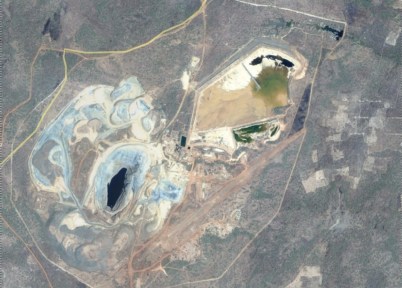
Aerial view of the Syama gold mine in southern Mali

Mali is among Africa’s top gold producers, exporting between 36 and 60 metric tons annually over the last decade; gold is a key source of revenue for the Malian government. Mining operations are carried out in southern and western Mali by a handful of multinational companies (Randgold, AngloGold Ashanti, and Iamgold among others).

Given what we don’t know about what lies beneath Malian soil, we can’t rule out the possibility that natural resources are a factor behind foreign intervention. But starting a war is hardly necessary to get cheap access to Mali’s gold or other minerals. Successive Malian governments, aware that they lack the capital and human resources to develop these deposits themselves, have cut very generous deals with mining companies and imposed minimal regulations on their activities. What’s the point of carrying out a risky jewelry store heist when the owners are practically giving away their merchandise?

2. Blowback from US military training

A primary reason for the defeat of Malian government forces at the hands of northern rebels last year, writes Barry Lando in the Huffington Post, was “the defection to the rebels of several key Malian officers, who had been trained by the Americans.” This unintended consequence of the US military’s ill-advised training program in the Sahel region helped turn the tide in the rebels’ favor, this argument goes.

This would make sense if most of the US-trained officers in Mali’s armed forces had defected to the rebels. But that’s not the case: Pentagon-sponsored training was provided to a broad cross-section of officers and NCOs in the Malian military, of which the defectors (most of them Tuareg) made up a minority. US-trained personnel fought on both sides of the conflict: at best the effects of their training were canceled out, at worst they were negligible. The problem with the US military’s training program wasn’t that it benefited the wrong people, it’s that it didn’t work. Following exercises in 2009, detailed in Wikileaks, even one of the Malian army’s most elite units got poor evaluations despite lengthy collaboration with US trainers. Whatever “advantage” such collaboration may have provided, it was the last thing the Tuareg — experienced desert fighters — needed to defeat Malian government forces.

(The “Democracy Now” television news program yesterday managed to combine the  blowback and uranium fallacies in a single headline: “Admin Aids French Bombing of Mali After U.S.-Trained Forces Join Rebels in Uranium-Rich Region.“)

3. Neocolonialism

By sending troops and jets to Mali, is France merely reasserting its bygone role as the country’s colonial master? Yes, says the World Federation of Trade Unions, which claims that “France continues to use the military bases it maintains in Africa in order to strengthen its role in the inter-imperialist competition and to serve the interests of its monopoly groups who are plundering the wealth-producing resources (gold, uranium etc.).” One Russian analyst argues that Operation Serval represents an attempt to “recolonize Africa.” Despite Malians’ warm reception for the French, similar interpretations continue to appear in the Malian press.

It would be difficult to prove or disprove allegations of neocolonial or imperialist motivations in French foreign policy. Surely a great many French citizens and leaders harbor paternalistic sentiments toward their former African colonies, and surely there are economic interests at stake. But we do know that for over a year, the French government (under Presidents Sarkozy and Hollande) was extremely reluctant to intervene in Mali’s conflict, preferring instead to lend logistic and financial support to a West African regional operation. The imminent collapse of the Malian military last week at the hands of Islamist forces in the Mopti region rendered that option moot. “La Françafrique” isn’t dead, but times have changed: by all indications, Operation Serval was a last resort, whereas a few years ago it would have been the default option.

4. Mali’s “strategic importance”

All of a sudden the word “strategic” keeps cropping up with reference to Mali. When you see the word associated with dusty hamlets like Konna or Diabaly, you know something’s amiss.

How about this claim by a U.S.-based activist group: “Mali is strategically located between the Arab African north and the Black African south. This largely Muslim country borders seven other countries…. This makes Mali of interest to the U.S., which seeks to counter the growing Chinese economic presence in Africa.”

A process of reverse reasoning appears to be at work here: If a conflict involving Western military forces is occurring somewhere, that somewhere must, by definition, be “strategic.” But let’s be honest: in and of itself, Mali has no strategic value. Discussing the fallout of intervention in Libya, Ross Douthat got it right last July when he wrote, “Mali is neither oil-rich nor strategically important. It is the kind of place whose politics is covered briefly in the back pages of foreign policy magazines, in between capsule book reviews and want ads for Kissinger Associates.” It is the recent successes of armed Islamist groups on its soil that have made Mali matter to the rest of the world.

5. Islam and Mali
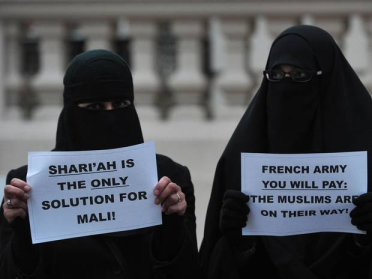
Protestors in London, 12 Jan. (AFP)

Protestors in London, 12 Jan. (AFP)

Proponents of the “clash of civilizations” thesis (a group that includes both neo-conservatives and radical jihadists, believe it or not) see Mali as the new front line in the war between Islam and the West. But at least 9 out of 10 Malians are Muslim, they are grateful for the French intervention, and they want no part of the intolerant, totalitarian project reserved for them by the coalition of Islamist groups now controlling Mali’s north. At its core, the conflict in Mali is not between Muslims and non-Muslims; it’s between Muslims with different visions of Islam, and religion is by no means the most important issue at stake. One of the reasons the French government was so hesitant to get involved, and now insists that it’s fighting “terrorists, not Islamists” (sparking accusations in the French media of  “political correctness”), is that it doesn’t want to play into the hands of those who portray what’s happening in Mali as “Islam vs. the West.”

Moreover, I’m not sure how accurate it is to call the forces fighting against the French “Malian rebels” or to describe the conflict as a “civil war“–the command structures of AQIM and MOJWA in particular are dominated by Algerians and Mauritanians. Malians widely perceive these groups as foreign invaders, motivated by racism and greed as well as a perverted, even ignorant view of their faith.

We cannot say that the war in Mali is primarily about natural resources, Western meddling, or religion. We can say, however, that it is a direct consequence of state failure, which as I have argued elsewhere came about largely due to factors internal to Mali. My experience as an anthropologist has made me suspicious of reductionist theories and grand narratives of history, from Marxism to dependency theory to modernization theory. The notion that what’s today playing out in Mali is the product of a “great game” between major powers ignores the realities on the ground there. Those are precisely the realities that anthropology has trained me to appreciate.

*********************************

FROM THE NEW YORK TIMES:

For years I’ve been trying to persuade the Times to adopt an “all Mali, all the time” format. They’re finally listening.

And one from Peter Tinti:France gets deeper in Mali war: Are they ready?Christian Science Monitor, Jan. 16

Postscript (Jan. 23): The training blowback fallacy is still getting traction in the Huffington Post, while minerals feature in speculation about Western interests in Mali by Seumas Milne in The Guardian.

Postscript (Feb. 25): An activist with EarthFirst! claims that what’s really behind Operation Serval is Mali’s abundant irrigated rice fields, which the French want to control to maintain food security for Libya (?).

Posted in Uncategorized | Tagged | 90 Comments

Merci François !

The military intervention launched in Mali by French President François Hollande, known as Operation Serval, began Thursday, 10 January. Its stated mission is to push back the advance of Islamist forces and assure the security of France’s 6000 citizens in the country. On Sunday 13 January, French planes struck Islamist militia targets in Gao and Léré, as well as a fuel and arms depot in Aghabo, 50 km from Kidal (see map below). Maliweb has reported that Islamist forces are withdrawing from all major towns formerly under their control, and regrouping near Tessalit, in Mali’s far north near the Algerian border. But the facts remain extremely uncertain and are likely to remain so for some time yet.

Source: Lefigaro.fr

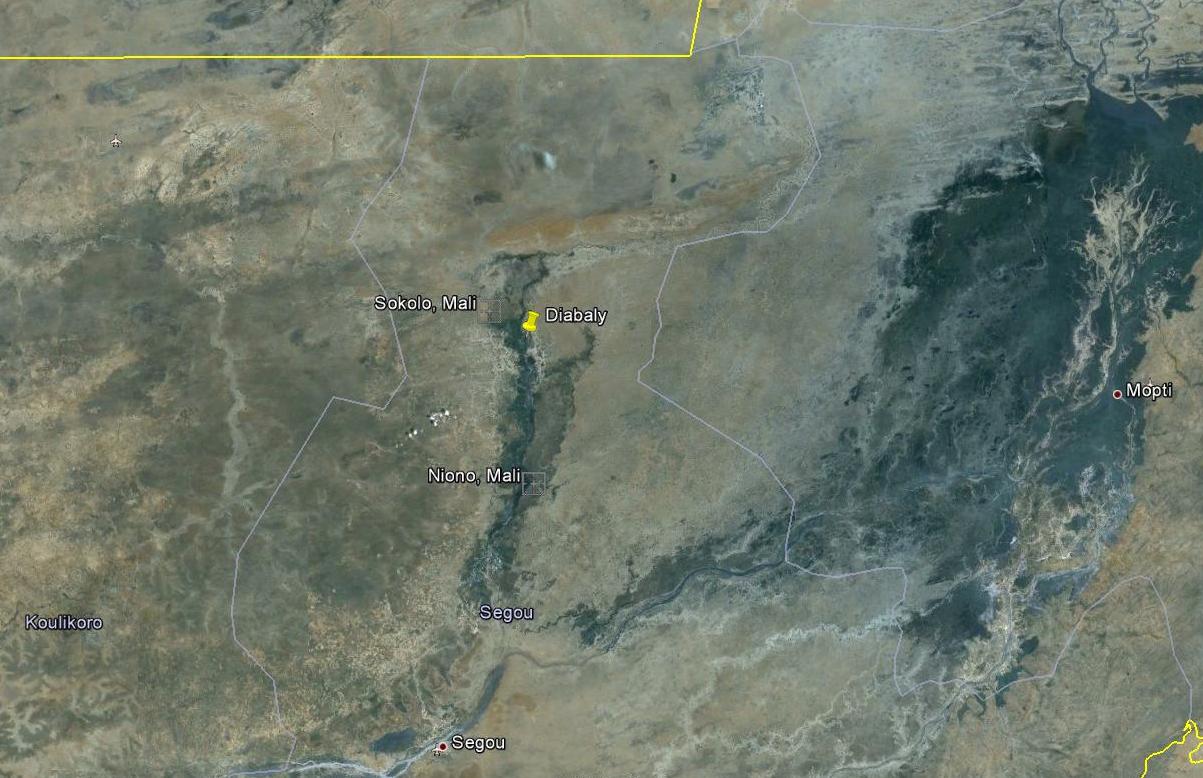
But some Islamists forces continue pushing south. In the Segou region, north of the Niger River, they have taken the small town of Diabaly, located in the Segou region, about 80 km south of the Mauritanian border and 30 km north of Niono (see below).

Segou region, showing Diabaly

Segou region, showing Diabaly

In Mopti, a city stricken by panic during last week’s Islamist offensive, calm has been restored and people are going about their daily routines, according to the regional governor interviewed by phone on state television (ORTM) Sunday.

Most of the French troops (400 of the 550 in Mali, according to the New York Times) are being deployed to Bamako, ostensibly to protect French citizens there, but probably also to safeguard Mali’s weak state apparatus against terrorist threats. Bamako is full of soft targets since security precautions, even at key government installations, are often lax. ORTM’s Saturday broadcast showed footage of the arrival of French forces at the Bamako airport, as well as the arrival of a delegation of Nigerian officers who will command an incoming multinational West African force. The government of Interim President Dioncounda Traoré declared a state of emergency on Friday, 11 January. This condition gives Mali’s military and police additional powers, including the ability to detain suspects without charge and ban public demonstrations. No curfew has yet been announced.

The state of emergency comes on the heels of protests in Bamako and Kati on 9 January,  fomented by the radical opposition coalition MP22, which (as it’s been doing since the coup last March) is demanding a sovereign national conference, known as les concertations nationales, to establish a new system of government. In response to these demonstrations, schools in Bamako and Kati were ordered closed. MP22 is still demanding immediate concertations nationales (as reported Saturday by ORTM). Nonetheless, on Saturday the government announced that schools would reopen Monday.

In a televised address to the nation on Saturday (below), Dioncounda appeared to address his MP22 critics when he called upon “every Malian to renounce petty quarrels and put away their personal agendas, which uselessly weaken us, and confront in a patriotic manner the war that our enemies are imposing upon us.” He stated emphatically that every Malian must now consider him/herself “un soldat de la patrie” (a soldier of the fatherland).

Not all reactions to French military engagement in Mali have been positive. The Algerian press is particularly critical, and plenty of conspiracy theories have circulated, both in France and in Mali, about the French government’s “neocolonial” motives. French naysayers include a few prominent figures, most notably former foreign minister Dominique de Villepin. Nonetheless, Le Point reports broad political support at home for Hollande’s step.

In Bamako, the public’s reaction thus far has been overwhelmingly positive (see Jeune Afrique of 12 January, or Le Figaro or ORTM of 13 January). Newspaper editor Adam Thiam, under normal circumstances no fan of French policy, has published a gushing editorial in Le Républicain entitled “Hollande le Malien.” On state TV Sunday, one Bamako resident described Serval as France’s repayment of the sacrifices made by African colonial troops during the Second World War. Malians online express heartfelt gratitude to Hollande (still well liked in Mali’s capital for having ousted Nicolas Sarkozy, probably the least popular head of state among Bamakois in recent memory). Some are even taking up a collection to benefit the family of the French helicopter pilot killed in action on Friday.

The false air of normalcy that had prevailed for months in Bamako seems finally to have lifted. On Tuesday, 8 January, as battles raged in and around Konna, an astonished Bamako resident wrote on Malilink, “Since 6 p.m. I’ve been listening to Channel 2 [state radio]; they’re playing R&B and love songs while the country’s at war!” Following the state of emergency, however, government media have sought to mobilize the public, even urging Malians to wire money to a government bank account set up to accept private donations to the armed forces. After a blood drive was announced, ORTM reported on Sunday that over 1000 people showed up at one Bamako health center to donate. Such mass mobilizations, however, have exposed the incapacity of the Malian state: the national blood bank apparently could accommodate just 113 donors per day.

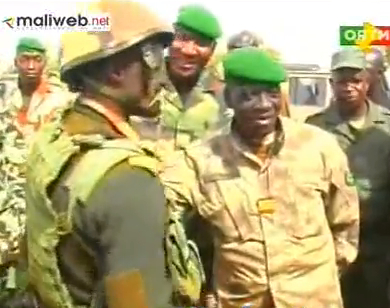
Capt. Amadou Haya Sanogo (right) greets the troops in Sévaré, 12 January

Capt. Sanogo (right) greets the troops in Sévaré, 12 January

Captain Amadou Haya Sanogo, head of Mali’s military reform commission but more importantly leader of the still-powerful junta, was shown on state TV over the weekend visiting wounded soldiers in hospitals in Bamako and Kati (the Malian military says its forces suffered 11 dead and 60 wounded during last week’s fighting), and reviewing the troops in Sévaré. The captain is still carrying his magic baton (and is that mudcloth beneath his combat blouse?), but has added a new fashion accessory — an automatic pistol strapped to his thigh. Sunday’s TV news showed him dispensing battlefield promotions, not usually the prerogative of a junior officer. Given the captain’s obdurate opposition to any foreign military presence in Mali, his compatriots’ warm embrace of Operation Serval puts him in a delicate position. Sanogo has expressed thanks to France but, as Thomas Hofnung recently wrote in Libération, he would have loved to get credit for ousting the Islamists with his own men, so the arrival of French and West African forces on Malian soil complicates his political ambitions.

Given the disaster that Hollande’s initiative managed to avert this past week, it’s hard not to be swept up by the wave of relief and optimism in Bamako. Yet many dangers lie ahead as foreign military forces step up their campaign in Mali. As Dominique de Villepin warns in an op-ed,

Wars never build up a solid and democratic state; on the contrary, they foster separatism, failed states, and the iron law of armed militias. Wars never offer a means to wipe out the terrorists swarming the region; on the contrary, they legitimize the most radical. Wars never bring about regional peace; on the contrary, western intervention enables everyone to discard their responsibilities.

One decade ago, de Villepin pointed out the risks and likely ill effects of George W. Bush’s proposed invasion of Iraq. That war solved one problem, only to create a thousand new ones. What’s the end game? What’s the exit strategy? How will mission success be defined? How can a stable state emerge from this process? Recent international military actions (Iraq, Afghanistan, Libya, Somalia) offer few encouraging answers to such questions. Here’s hoping the international community’s latest war somehow bucks this grim trend.

Further recommended reading:

Posted in Uncategorized | Tagged , , , | 11 Comments

Barbarians at the gates

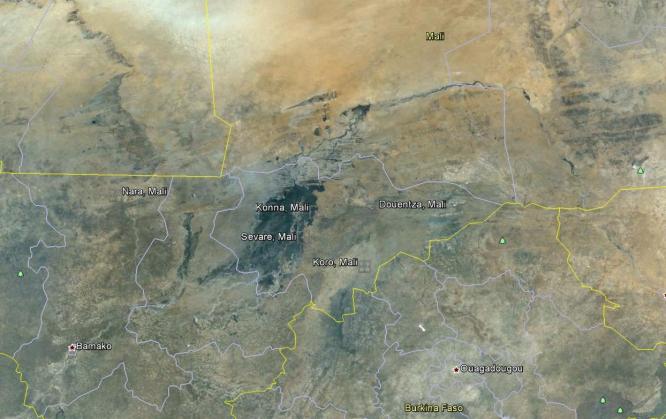
Mali has been swirling with rumors of an Islamist offensive since Sunday 6 January, when panicked posts on Facebook reported dozens of pickups full of heavily armed militants advancing on the town of Mopti, and contended that nearby Sévaré (home of the Malian army’s forward HQ) was being “quietly encircled” and infiltrated. The next day a Malian newspaper claimed that Islamists were also threatening the towns of Koro, Diabaly and Nara. Let’s recall that similar panics have occurred in Mopti before and proved to be unwarranted. This much is sure: Islamist forces are reinforcing at least some of their positions over a front line stretching nearly 500 km, from the Mauritanian border to the border with Burkina.

Some limited skirmishes also have taken place. Various international news outlets have reported that the Malian army from its outpost in Konna (60 km from Mopti) fired artillery toward rebel positions (described as “warning shots”) near a village called Gnimignama, 30 km away. (For folks in broadcast journalism, please note that latter name is pronounced “Nyee-mee-nya-ma.”) Today Malijet reported that the Malian army has launched a counter-offensive toward the town of Douentza, and Al Jazeera claimed that rebels captured a dozen Malian troops near Konna. Neither of these last two accounts has been confirmed as of Tuesday afternoon, and the Defense Ministry in Bamako has issued a communique denying that any of its forces were captured.

In light of these developments, I want to reflect on what these Islamists represent to the West, and how we Westerners talk about them. Mali has garnered considerable attention from the U.S. media lately, particularly regarding the application of harsh “Sharia” punishments in the Islamist-controlled north. And it seems like the only adjective we can think of to describe these punishments is “barbaric.” In the course of her 35-minute interview with The New York Times‘ Adam Nossiter about the situation in Mali, broadcast on 3 January, “Fresh Air” host Terry Gross used the word “barbaric” six times, according to NPR’s transcript. (It was seven times if you include the show’s lead-in, which wasn’t transcribed.) Nossiter had recently written about these punishments, although he did not use the term “barbaric” either in that article or during his “Fresh Air” interview.

Stoning and amputation as forms of punishment have been condemned around the world, and the vast majority of Malians (including their most prominent Islamic leaders) are opposed to such brutal measures. But I have to sound a note of caution regarding the preeminence of this term “barbaric” in recent journalism about Mali (a Google search for the terms “Mali” and “barbaric” yields nearly 360,000 results), given the adjective’s long and problematic history. The English word “Barbarian” goes back to ancient Greece, where its root signified the opposite of a citizen. Romans and later Arabs adopted the term to designate anyone outside the limits of their respective empires. In fact, this is how the Berbers of North Africa got their name (though they prefer to call themselves Amazigh). Fast-forward two millennia and we’re still using “barbaric” to describe people in that part of the world — many of whom happen to be Berbers.

The trouble with this adjective is that it precludes analysis. Once you label something as barbaric, you make it clear that you require no further understanding or context on the matter. Yet confronting the application in northern Mali of what are known in Arabic as hudud punishments demands both. The close association between these punishments and the word “barbaric” raises the question of why other brutal acts — such as the killing of 15 unarmed preachers by Malian troops, or the routine practice of lynching suspected thieves in Bamako — don’t generate similar international attention and outrage. Could it be because they’re not perpetrated in the name of Islam? (Given a choice between facing accusations of theft in government-held Bamako or in Islamist-held Gao, I’d take Gao, thank you very much.)

And the “barbarian” blade cuts both ways. Canadian diplomat Robert Fowler, shortly after being kidnapped by Al Qaeda in the Islamic Maghreb in December 2008, was subjected to jihadist propaganda videos (shown on a laptop computer perched atop a stack of spare tires at a remote desert camp). For Fowler and fellow captive Louis Guay, the worst part of viewing them was not their footage of the 9/11 attacks, or of US troops being shot and blown up in Iraq and Afghanistan. In fact, Fowler writes in his 2011 memoir A Season in Hell,

the scenes that elicited the strongest emotion were the all too familiar images of the black-hooded, orange-clad figures, chained hand and foot, shuffling around those tiny cages in Guantanamo…. [This] was the intimate and almost palpable proof of our side’s methodically applied, officially sanctioned, and so casually administered barbarity, parsed into the bureaucratic banalities and legal niceties of officially sanctioned abuse and torture, that was hard to absorb. (pp. 56-67)

Later, his Al Qaeda captors challenged his notions of justice: “How, they would ask, over and over again, could we find the reasonable application of the Shari’a-sanctioned punishment (stonings and amputations) so barbaric compared to the atrocities and indignities that occurred in bloated Western prisons?” (p. 156). [The above underlining is mine.]

Notably, these are the only two occurrences in Fowler’s 360-page text of any word in the “barbaric” family. Yet nobody who’s read the book can accuse Fowler of having latent sympathies for his kidnappers, or of being “soft on Islam.” (His selected bibliography includes works by Nonie Darwish and Robert Spencer, both of whom I place in the category of frothing-at-the-mouth Islamophobes.) What his account shows is that the perceived barbarity of the West is a primary motivating factor among hardcore Islamists today. Let’s keep that in mind as we contemplate the next chapter in what used to be called the “global war on terror.” (In today’s Globe and Mail, Fowler himself advocates Canadian participation in a military intervention in Mali; Prime Minister Stephen Harper is having none of it. Meanwhile, African Union chairman Boni Yayi is calling for NATO intervention; NATO says such an operation is not on its agenda.)

As an anthropologist, I’m guided by a professional stance of cultural relativism — the principle that we must seek to understand another culture on its own terms, not our own.  When it comes to taking a moral or ethical position on a question, I can do that on my own time, but my job is to inform and explain, not to pass judgment. I’m starting to wonder whether the same applies to many journalists covering Mali these days.

Postscript, June 2017: More than four years on, frenzies over jihadis’ allegedly “barbaric” punishments exacted in Mali continue to surface in the Western media. See this excellent analysis of “The Stoning that Didn’t Happen” by three specialists.

Posted in Uncategorized | Tagged | 15 Comments

An ka wili

Tiken Jah Fakoly, a well-known reggae artist who’s been based in Bamako’s Niamakoro neighborhood for the past several years, just released a single entitled “An ka wili” or “Let us rise up,” urging Malians to unite against the Islamists who have taken over the north of their country.

True to form, Tiken Jah grounds his call to action in Mali’s precolonial history. Below is my own translation of the lyrics to “An ka wili”:

Mali will slip away from us [Mali bè na taa k’an to] / Kidal will slip away from us / Timbuktu will slip away from us

Chorus: Let us rise up, let us rise up, if we don’t rise up, Mali will slip away from us

Where have the descendants of Tieba gone? / Where have the descendants of Samory gone?

Where have the descendants of Sunjata gone? Where have the descendants of Da Monzon gone?

Let the descendants of Sumaoro rise up! Let the descendants of Sunjata rise up! Let the descendants of Sonni Ali Ber rise up!

We cannot tell our children, “Kidal once was ours”

We cannot tell our children, “Timbuktu once was ours”

What will we tell our children, that Gao once was ours?

What will we tell our children, that Timbuktu once was ours?

Sonni Ali Ber, died in 1492, the greatest hero and legend of the Songhai empire / A brilliant strategist, authentic military genius / He led 32 wars over 26 years, and won them all, Mali!

Samory Touré, great African warrior, synonymous with resistance against the colonizers, Mali!

Sunjata Keita, King of Mandé, who brought the peoples together, founder of the Mandé empire, Mali!

Babemba, fierce opponent of colonization, Mali!

Rise up! The day has come!

Tiken Jah Fakoly, Pan-Africanist icon

There’s nothing unusual about these lyrics’ heavy historical content: in my previous post, and in a recent scholarly article, I’ve referred to the role that Mali’s legendary precolonial rulers and heroes continue to play in the nation’s political imagination. What may appear unusual, at least to outsiders, is that Tiken Jah is not Malian: he was born and raised in Odienné, in northwestern Côte d’Ivoire. He only left his native country in 2003, after his outspoken criticism of the nativist doctrine called ivoirité earned him death threats from the supporters of then-president Laurent Gbagbo.

In other settings it would probably be strange to see a non-citizen leading calls for nationalist mobilization. (Could “God Bless the USA” have been recorded by Michael Bublé or Celine Dion? Could “The Rising” have been written by Bruce Cockburn instead of Bruce Springsteen?) But the collective sentiments to which Tiken Jah’s lyrics appeal don’t correspond neatly to the modern Malian nation-state: they cite the names of kings and warriors — Sunjata, Samory, Sumaoro and others — who ruled over territories  encompassing much of present-day Mali, Côte d’Ivoire, Guinea, and Burkina Faso; notably, they also cite Sonni Ali, who conquered areas stretching from Senegal to northern Nigeria, and whose capital was Gao, the largest city occupied by Islamist militias today.

(Bamakois have embraced Tiken Jah as one of their own, but his activism on behalf of Mali’s national unity only gives ammunition to his critics in Côte d’Ivoire, who claim he’s not a true Ivoirian anyway. As Sasha Newell demonstrates in his new book about “nouchi” youth culture in Abidjan, a large number of urban Ivoirians regard anyone wearing a boubou as unfit for citizenship in their country.)

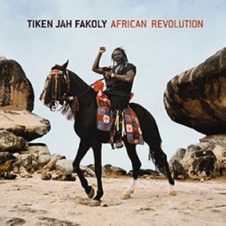
Another reference to bygone heroes: the cover of Tiken Jah’s 2010 release “African Revolution”

When Tiken Jah sings “Let us rise up,” he’s primarily addressing citizens of modern Mali; his video was produced in Bamako, after all, and it is Malian people of various walks of life (laborers, soldiers, seamstresses, civil servants, youths, street vendors) who appear in it. But the singer is also framing himself as a descendant of those illustrious forebears who united the populations of many ethnicities and localities, and who led opposition to foreign domination. (Note that in Bamako, the Islamists are widely perceived to be non-Malians, and indeed many of the leaders of Al Qaeda in the Islamic Maghreb and its offshoot MUJAO are from Algeria and Mauritania.)

Tiken Jah’s secondary audience might be citizens of neighboring countries who take their inspiration from some of the same founding figures, and whose governments could support a multinational military offensive to take back the Malian regions now under Islamist control. The “An ka wili” video is also replete with Pan-Africanist symbolism, from the red, green and gold colors to the outline of the continent. It speaks to a broad range of loyalties to unite listeners in opposition to the Islamist threat.

“I’m calling for a general mobilization,” the singer told the AFP. “Mali has known great men, great empires and it is unimaginable to leave the country divided as it is today. Malians must count first on their own strengths.”

Tiken Jah’s message is in line with the public mood in Bamako (on which I reported in my previous post), where people are fed up with waiting for outside assistance to reunify their country. I doubt that any attempt to mobilize the Malian people can succeed without making reference to the kinds of historical imagery presented in “An ka wili.” Interim President Dioncounda Traoré and his speechwriters should take note.

*********

Following the example of journalist and fellow Mali RPCV Peter Tinti, below I suggest a few notable English-language press items on the situation in Mali:

Also, the National Public Radio show “Fresh Air with Terry Gross” devoted its Thursday, 3 January broadcast to the crisis in northern Mali, with Adam Nossiter as guest. And I was hoping Terry would invite me….

Postscript, Jan. 12: Bamako Hebdo features a write-up on Tiken Jah’s song.

Postscript, Jan. 19: A group of Malian artists calling themselves “Voices United for Mali” has released a song “Mali-ko/Peace” (see the video). The group includes Tiken Jah, Fatoumata Diawara, Amadou and Mariam, Oumou Sangaré, Bassekou Kouyaté, Vieux Farka Touré, Djelimady Tounkara, Toumani Diabaté, Khaira Arby, Kassé Mady Diabaté, Baba Salah, Afel Bocoum, Amkoullel and Habib Koité among many others. Meanwhile, Bamako Hebdo features a write-up on a new single by rapper Master Soumy, of Sofas de la Republique fame, entitled “Sini  yé kêléyé” (Tomorrow is a fight), which he calls “a song dedicated to the Malian army, dedicated to mobilizing the people behind their army.”

Posted in Uncategorized | Tagged , , , | 10 Comments

Impatient for action

The growing consensus regarding international military intervention to address the emergency in Mali is that it is now inevitable. But that doesn’t mean it’s imminent.  Hervé Ladsous, the UN’s Under-Secretary-General for Peacekeeping and Romano Prodi, the UN’s Special Envoy to the Sahel, have both described an internationally sanctioned operation as unlikely before September 2013. That’s right — nine months from now, and a full 18 months since the scope of Mali’s troubles first gained global media attention.

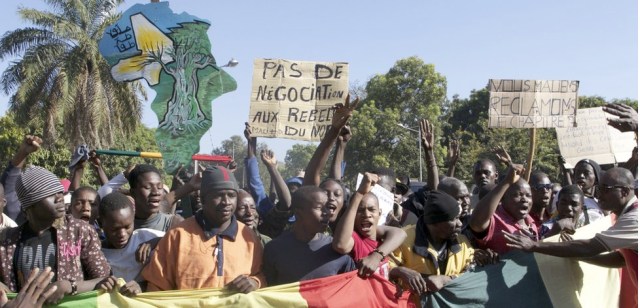
Demonstrators in Bamako call for UN intervention, Dec. 8; the sign at upper left reads "Mali cannot be divided."

Demonstrators in Bamako call for UN intervention, Dec. 8; the sign at upper left reads “Mali cannot be divided.” The sign at right demands Chapter 7 or peace enforcement under the UN Charter. (Photo: AFP)

There are voices pressing for a swifter approach. France and the African Union are advocating a mission that can begin in early 2013. But there are reservations: U.S. Ambassador to the UN Susan Rice recently characterized the French/AU plan as “crap.” The U.S. government wants to see an elected government in Bamako before any effort to retake Mali’s Islamist-held north can begin. Important regional powers, most notably Algeria, are still reluctant to commit to any action.

What do people in Bamako want? A poll conducted last month of 384 Bamako residents (funded by the Friedrich Ebert Foundation, linked to Germany’s Social Democratic Party) found that 92% want elections only after the “liberation of the north.” And there’s evidence that a growing number of Bamakois don’t want to wait for September. Among the signs of impatience: 2000 demonstrators recently rallied to call for immediate military action, according to the AP (although the AFP put the figure at only 1000). Recent TV5 reportage also suggests public opinion in Bamako supports action to retake the north sooner, not later. “We want war, very much,” a female displaced northerner tells the camera. The same video, however, also features some voices of those in favor of negotiation.

What does the Malian army want? For months army representatives (particularly Captain Sanogo) have been claiming that they have sufficient men, skills and morale to take on the Islamists; all they lacked was equipment. They have been demanding that the government of Guinea release a shipment of weapons, ordered by the Malian government before the March coup and shipped from Bulgaria, which had been seized (apparently under ECOWAS orders) at the port of Conakry. Earlier this month, that shipment finally arrived in Kati (the garrison town where political power these days truly lies).

Sanogo says the army won’t wait for next September, and that with or without international assistance, they will act soon. He claims that Mali’s army is ready to launch its liberation war.

But there is some skepticism among Malians that their troops are willing to fight. Last week I discovered what I suspect to be the first-ever “Downfall parody” video dealing with the Mali crisis. (For those unfamiliar, this parody genre, which inserts new subtitles into a scene from the 2004 German film “Downfall,” is a meme unto itself; the genre even has a dedicated YouTube channel.)

“They all fled dèèè,” an officer tells Hitler, seemingly briefing him on events in northern Mali last March. “Sanogo even left his shoes behind.” “The Malian army, fleeing like women!” Hitler responds, before beginning a rant that lambastes the Islamists, Mali’s interim leaders, its soldiers and even soldiers’ wives. “And what bugs me most,” the dictator fumes, “is that Sanogo has tasted money, and once a soldier gets a taste of money he will never return to the battlefield…. He just comes and shoots everywhere, scaring civilians, when he should be up north fighting the MNLA!” I don’t know who wrote this skewering of the army’s alleged incompetence and cowardice, but judging from the wording and its street-wise mix of French and Bambara (call it framanankan), it can only be the work of a Malian.

The army was recently called out from a different source: a couple of months ago, a pop-music singer who goes by “Roberto Magic Sapeur” (real name Harouna Sylla), released a song chastising every branch of the security forces (army, air force, gendarmes, police, customs officers, even firemen and game wardens) for “running away” from the enemy.  The singer has subsequently faced threats and accusations that he’d accepted money to sully the reputation of the Malian army. But he defends his musical intervention as more of a pep talk than an insult. His lyrics exhort Mali’s soldiers that there is no shame in death, and he recites the names of great military leaders from Mali’s history. “In Segou, Da Monzon didn’t run away,” he sings. “In Sikasso, Tieba didn’t run away. The Mande emperor Sunjata didn’t run away.”

Abroad, there are doubts that Mali’s armed forces have what it takes to reunify the country. American government sources I’ve spoken with believe the Malian army is still too weak. Consider the France5 news footage below. A few minutes into the video,  troops on maneuvers near Sévaré apparently lack the ammunition for live-fire exercises, so they pretend to fire their weapons and provide their own sound effects. Members of the Ganda Iso militia in Sevare are subsequently shown: they have no equipment and are fed just once per day. Logistics and air support capacities are almost nonexistent.

The last several months have brought disturbing signs that Mali’s army is broken, undisciplined and increasingly brutal. In July Amnesty International issued a report alleging a pattern of enforced disappearances, torture and extrajudicial killings carried out by the Kati-based junta; a video of torture committed by troops in Kati has even been posted on the web. September saw the massacre of 16 unarmed civilians by soldiers outside the town of Diabaly; despite thorough, courageous reporting on this incident by the AP’s Rukmini Callimachi, the crime remains unpunished, and authorities in Bamako have completely hushed it up.

Is the army up to the task ahead of it? Will deteriorating conditions on the ground force the international community to intervene before it’s ready? Will the tenuous political alliances in the south or the north break apart, leading to chaos? The BBC has posted an excellent analysis of possible scenarios for Mali in 2013. I doubt anyone can predict which way this thing will break. But we know that the status quo can’t hold indefinitely. Mali’s economy is far too weak, and state coffers, deprived of foreign aid, are depleting rapidly.

I suspect we will all be hearing a lot more about Mali in the months to come. And I’m afraid the news won’t be good. Here’s what I’ve been asking myself a lot lately. Is Bamako today in a situation like that of Freetown in 1999, with tough days but a brighter long-term ahead? Or is it more like Mogadishu in 1991, at the beginning of a long downward spiral that may never be fully reversed?

Posted in Uncategorized | Tagged , , , | 9 Comments

The captain’s back

After several months of lying low, Captain Amadou Haya Sanogo returned to the limelight this week — in a big way. On Monday evening, December 11, some 20 soldiers acting under Sanogo’s orders went to the home of Prime Minister Cheikh Modibo Diarra in Bamako. They forced open the door, arrested Diarra, and transported him to their barracks in Kati, where he had an entretien with Sanogo. Shortly thereafter, Diarra recorded a brief statement announcing his resignation; this statement was broadcast on ORTM state TV early Tuesday morning.

Tuesday evening, Sanogo himself appeared on the ORTM evening news; a caption identified him by his official title, chairman of the Military Committee for Reform of the Armed Forces.

[You can also view a version in Bambara]

In his remarks (see the write-up from Thursday’s issue of Le Républicain), he accuses Mali’s former head of government of many things: failing to respect the Malian people; failing to heed the head of state’s authority; traveling too much; blocking government progress; micromanaging hiring decisions; pursuing his own selfish agenda; paying peaceful citizens to take part in protests; failing to support the armed forces; and endangering Mali’s security.

Responding to a journalist’s question, Sanogo says he did not force Diarra to resign, but merely “facilitated” his decision to do so. He denies that there was anything untoward in the PM’s departure; after all, he says, prime ministers resign all the time, and in any case Diarra was never elected to office, but selected by the junta. Sanogo adds that, contrary to some reports, he and his “team” are by no means opposed to international military intervention to help the Malian government regain rebel-held territory.

For more than eight months now, civilian leaders have officially been back in charge. But if anyone doubted that ultimate political authority still lies with the soldiers in Kati, those doubts have now been effectively put to rest. Nothing happens in Mali — at least, outside of rebel-held zones — without Sanogo’s approval.

The captain is still talking tough against potential enemies, especially unnamed politicians who only look out for themselves. “Even beyond the prime minister’s case,” he remarks, “if someone should venture, for excessive personal ambition, to burden the system or stop it, I will not hesitate one single second to help the president of the republic to see to it that this person will not become a bottleneck for Mali.”

Back in May, Sanogo seemed to be a candidate for president. Now he claims to be working closely with Mali’s current interim president, Dioncounda Traoré, whom he has blamed for bringing the country to its knees. Don’t be fooled: as I argued in an article published last month, Sanogo sees himself in heroic terms and has an over-sized sense of his own destiny — this is, after all, the same guy who has repeatedly compared himself to Charles de Gaulle. He wants to be the sole arbiter of political change in Mali. (Talk about excessive ambition….)

So it’s no surprise that Sanogo continues to leave the door open to perhaps playing a different role, and to point out that he’ll be available should “the people” call upon him. In the Tuesday evening broadcast he says, “If tomorrow the Malian people, I say the Malian people, for whom we made all these concessions, the Malian people for whom we let go of so many things, decide that I should play a role other than as chairman of the Military Committee, I will assume my responsibilities.”

Yes, the captain is back. But then, he never really went away.

Postscript, Dec. 30: The AFP reports that ex-PM Modibo Diarra is unable to leave Mali to seek medical treatment for a possible tumor, citing a relative who says that Captain Sanogo has barred Diarra from leaving the country. Sanogo’s spokesman denied the report.

Posted in Uncategorized | Tagged , , , , | 15 Comments

Living on their feet

A young girl walks by balancing an enamel basin filled with mangoes on her head. A few minutes later, it’s a teenage boy with a huge rack of sunglasses. Next a mother, with infant daughter strapped to her back, walking beneath a towering basket of medicines. Then a middle-aged man with a foam mattress tied in a bundle. They are all trying to earn a living on the streets, and rather than wait for shoppers to come to them, they carry their wares through the city streets in hopes of finding buyers.

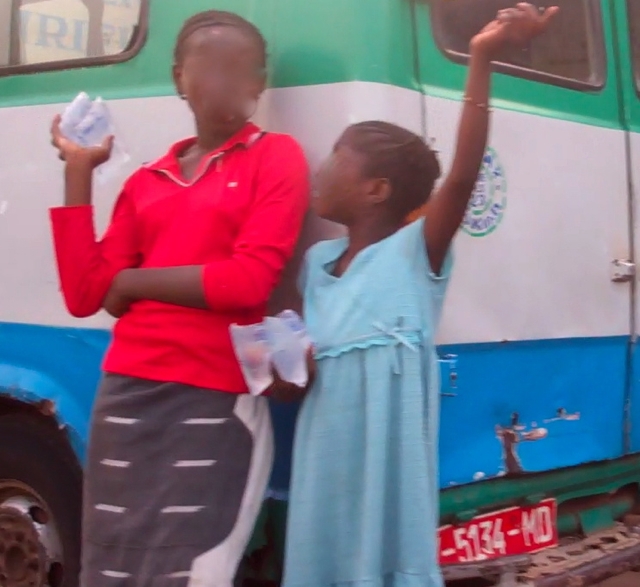
Ambulant vendors are an omnipresent feature of the landscape in urban Africa. They’re literally everywhere in Bamako, and have been since well before I first went there in 1997. You could see them wherever buses had to stop, hawking snacks, fresh produce, drinking water. I vividly recall seeing a girl of perhaps six years with her bucket full of plastic bags of drinking water, trying to attract passengers’ notice and shouting “Dji bè, dji sumalen bè” in her small, piercing voice.

Most of us who grew up in the “First World” probably aren’t used to ambulant vendors. In Mali I saw them as a curiosity at first, but I appreciated being able to stay in one place and have goods come to me. After a few months I virtually stopped noticing the vendors anymore.

Drinking water is sold in plastic bags, for 10 to 50 francs depending on the size and quality. The vendors are usually young girls. I blurred these vendors’ faces, out of respect for their privacy and sutura (see my previous post).

It wasn’t until my latest round of fieldwork in Bamako that I began thinking about them again. Perhaps it’s because there are so many in the city now; selling on the street has become the most common survival strategy. The luckiest vendors have places to sell from, maybe a market stall or a table under a shady tree. The rest wind up walking all day carrying their merchandise.

The goods fall into every category imaginable: food, beverages, clothing, prepaid cell phone cards, chewing gum, health products, insecticides, portable electronics. Then there are the mobile services: shoe shines, shoe repair, tailoring, manicures.

Some categories of vendors have signature sounds they make to announce themselves. Tailors tend to strike their scissors together, ting ting ting ting, to advertise their passage. (Many go by bicycle, with a hand-powered sewing machine strapped to the rear cargo rack.) In Brazzaville the manicurists would clink empty bottles of nail polish on their fingertips, making a singular sort of doing-doing-doing. I have yet to hear that sound in Bamako, come to think of it….

My daughter took this one from the window of a van while on a school trip

It occurred to me one day that I did not know these people; I had no friends who were ambulant vendors, and I knew nothing of their lives. Why do they do what they do? What are their days like? What challenges do they face? I decided to learn a little about them. As usual, I found it was best to go through people close to me, who already knew some vendors and could provide introductions.

After making the acquaintance of a few street sellers, I hoped to get a first-hand glimpse into their work. I did this with the aid of a Flip HD camera, which is small, relatively cheap and requires no training to operate. I approached three vendors and asked if they’d be willing to have someone shadow them for a day with the video camera, resulting in a short web documentary. They could designate their own camera person, a friend or trusted associate, to follow them around. They would pick up the camera in the morning from a friend of mine in the marketplace and return with the footage at the end of the day. I compensated both the vendor and the camera person with a good day’s wages. Then, using the hour or two of footage the vendor had brought, I edited a short video clip. I did a follow-up interview with each, asking questions about their work and their lives. I used their responses to put together voice-over narrations for their clips. I showed a rough cut to the vendor before finishing it, to give them the opportunity to cut out any scenes they didn’t want to appear in the final product. (Nobody actually asked me to cut anything out.) When each clip was finished, I burned a copy to DVD and gave it to the vendor.

The first person I recruited for this project was Mamadou, an 18-year-old guy who sold imported packets of cookies downtown. He arranged to video his friend, another cookie vendor, but the footage wasn’t great. I asked him to gather a second day of footage, this time with him as the subject, and it came together nicely. The camera work can be pretty jumpy, and the sound isn’t wonderful, but you get a window into a world you otherwise might never see.

Mamadou then served as the cameraman filming the second subject, a woman named Fanta who sold pharmaceutical products (various cold remedies, pills, tablets and patent medicines) on a daily route from Sogoniko to Dar Salam to Dibida and back, a circuit of at least 10 miles. Mamadou got great footage of her workday, and I was quite pleased with the final product.

I gave Fanta her copy of the video (in Bamako, even poor families like hers usually have a cheap videodisc player), but a few days later when I saw her in the marketplace she told me she’d hidden the disc for fear that her husband wouldn’t approve of her having participated in the video project. I realized that although she’d agreed to take part, and despite my best efforts to explain what the project was about, Fanta hadn’t given what researchers call “informed consent” — never having gone to school, she didn’t know what the internet was and had no idea what the consequences of her participation might be. Therefore I couldn’t post her video or any other images of her to the web. I’m obligated to protect my subjects against any potential risk from associating with me and my work; as I wrote in my previous post, I also try to be sensitive to their expectations of sutura, not to lose face in public, not to be humiliated.

My third subject was Brehima, an affable fellow who sells yugu-yugu or used clothing. He had his friend Sekou, a fellow used clothing vendor, follow him with the Flip camera through the streets of Badalabougou.

There were many more such videos I wanted to make. I wanted to do one of the wotorotigiw, the young men who push handcarts of goods around all day. I wanted to do one of the boys who walk around with shoeshine kits, charging 50 francs (10 cents) a shine. I wanted to do one of the guys who sell phone cards at busy intersections. Unfortunately time didn’t permit, and my fieldwork came to an end before I could undertake any of these. But I do think the Flip documentary project model is a worthwhile one with enormous potential for research and teaching, and I hope to try it again at the next opportunity. I’d be interested to know of similar efforts by other researchers, to get an idea of what’s worked and what hasn’t.

Of course I cannot generalize from my tiny sample of vendors. Based on what I’ve seen, however, I doubt many people go into this line of work except as a last resort. It is tiring and minimally profitable. Many are on the margins of the law: Fanta, the medicine vendor, faced the daily threat of having her merchandise confiscated by the police. All the vendors I spoke to said they would happily do something else if they could find another job. Yet some of them also derived clear satisfaction from selling (this was the case for both Mamadou and Brehima whose videos appear above). Given their druthers, I’m sure they would be vendors — but in a nice shop where they could  sit down every once in a while, and not have to carry their goods around all day under the elements.

Even such modest ambitions might be unrealistic nowadays: just as Bamako’s streets are super-saturated with ambulant vendors, its formal commercial sector is bursting at the seams. In both cases it’s a problem of too many sellers, not enough buyers. I wonder whether Bamako has outlived the days when small-scale retail trade was a common route to economic self-sufficiency, even success. For Mamadou’s and Brehima’s sakes, I hope it hasn’t.

Posted in Uncategorized | Tagged , , | 16 Comments

To shoot or not to shoot: The perils of street photography in Bamako

A recent post on the New York Times “Lens” blog reminded me of a constant problem I encountered in Bamako: lots of people didn’t want to be in my photographs.

I don’t mean they wouldn’t pose for portraits; people who knew me were glad to do so, and often requested it of me. I’m talking about strangers on the street, or in other public places, who objected to my taking a picture that might show them, even in passing.

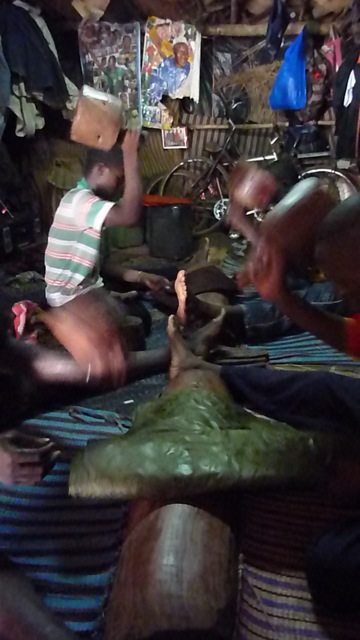
In the U.S., most of us have some minimal expectation of privacy Imagewhen we’re in private spaces–homes in particular, and businesses to a lesser degree. If somebody wants to take a photo of you in such a space, they ought to ask you first. The same rule applies in Bamako. For instance, after ducking into a market stall in Magnambougou to watch young men beating starch into bazin cloth, I asked if I could shoot them, and they agreed (see right).

In public spaces, however, that expectation vanishes. When you’re walking down the street, driving in traffic, or eating an ice cream cone at a sporting event, anyone can snap your picture, for any reason.

But for many Bamakois, the expectation of privacy extends into public spaces. I can’t count how many times I’ve been verbally challenged by some passer-by after pointing my camera at a monument, building or street scene. “Don’t photograph me!” they shout, as if my sole purpose for being there is getting a candid shot of them.

On one such occasion a young fellow actually crossed the street to confront me after spotting me pointing my camera in his general direction. I’d been using my Lumix’s video function to get some traffic footage I might be able to edit into a video about the city. The young man was an ambulant vendor working a busy intersection, and he was concerned that he might have figured in some of my images. “Who told you you could photograph here?” he asked brusquely, before summoning half a dozen of his vendor colleagues to join him. The fact that I spoke to him in Bamanan did not help calm him down. At his insistence, I showed him the footage I’d just taken of taxis, private vehicles and minibuses plying the street, and he managed to find a half-second of the 30-second video in which part of his body was visible between passing cars. He demanded that I delete the video, and I obliged. “You’re lucky I’m a reasonable guy,” he told me; “Most other people would have taken your camera and smashed it on the pavement.”

I’d have gone to the cops in that case, I said. “They’d just tell you that you were in the wrong,” he responded, and his friends nodded in agreement. I’m pretty sure they’re mistaken, but in Bamako it doesn’t matter so much what the law actually says.

Okay, even if I did take your photograph, I asked, what’s the problem with that? “You’d take my picture to your country and show it to people,” he said.

Well yes, I thought, that’s rather the point of photography, and after offering an apology (which he did not accept) I went on my way, assuming that my interlocutor was just being a douche-bag. And he probably was. But later it dawned on me: sutura.

Image

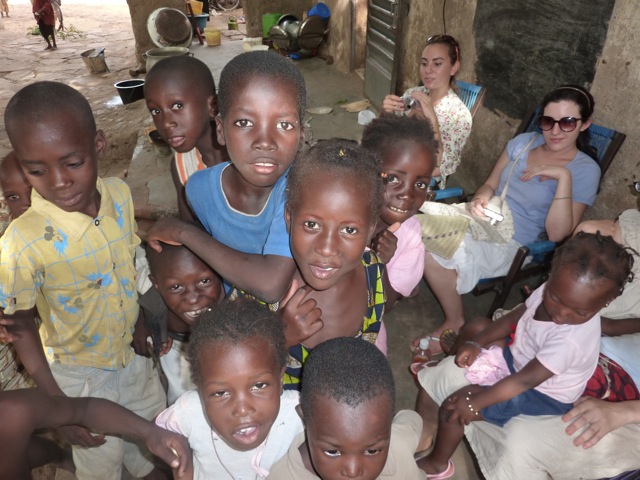
Malian kids LOVE to be photographed

Sutura is a Bamanan-language verb that’s hard to translate. It appears in a common spoken blessing, “Allah k’an sutura” (May God sutura us). It has to do with maintaining dignity by preserving secrets. Being a street vendor is a low-status occupation, and this vendor perceived being photographed, however inadvertently, while on the job as a violation of his right to sutura. Since a photograph could conceivably compromise his dignity, the onus was on me, the photographer, to ensure that he didn’t appear in my images. Sutura may be the antithesis of the Facebook-era ethos of transparency, but it’s still a widespread expectation in Mali. [Sutura also means “to help [someone] out” in the Ivoirian hybrid Nouchi language.]

See that guy shaking his finger at you?

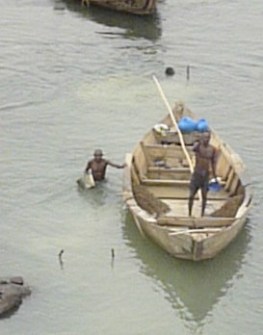
A few weeks later I was on the King Fahd Bridge and saw some fishermen in their narrow canoes, called pirogues, in the Niger River down below. I got out my Lumix and shot. It was only later, when I reviewed the images on my computer at home, that I could see one of the fishermen shaking his finger at me. “Don’t take my picture,” he was signaling. Even in that very public setting, he was concerned about preserving his privacy.

As you can see, I don’t feel always obligated to honor people’s desire for sutura. In this case, you can’t make out the guy’s face anyhow. But after several such encounters I began to wonder: How do other people shoot images in Bamako’s public spaces?

I asked three professionals about this — an American photographer (female), an American videographer (male), and a videographer from Burkina Faso (male), all of whom had worked extensively in Bamako. And they all had the same approach: Whatever objections someone may have to being photographed or filmed in a public place, just ignore them, as politely as possible. Find a new angle and carry on.

That’s an option. As an anthropologist I should be sensitive to the concerns of the people I study. But I also can’t accept the burden, before shooting in a market or on a street, of asking permission from anyone who might wander into the frame; that would render public photography impossible.

There are, of course, certain things at which you should never point your camera in Bamako. Any government building, any person in uniform, and any embassy (especially the U.S. Embassy!) is off-limits. In January, one of my Lehigh students learned this the hard way after taking some pictures of the lovely landscaping outside the U.S. Embassy. But that’s nothing specific to Mali, it’s true in many places.

The post on the Lens blog suggests that taking pictures in public places has been getting more difficult in the U.S. lately. It’s still lawful to do so, but you’re more likely to get a hard time these days photographing certain people, especially police and security guards. But most normal Americans don’t expect to have privacy when they go out in public.

A Lehigh student and a neighborhood child in Bamako, January 2012

In Mali, it’s often been the case that the person with the camera is a (white) foreigner, while the person being photographed is a (black) local. But that’s changing along with technology. One day while walking through the Badalabougou market, I noticed a kid of perhaps 14 walking in my direction, holding his cell phone in front of him and staring at it intently. As he drew near, holding up his phone right in front of me, I heard a telltale artificial shutter-click sound. I’d just been photographed, and without my permission. That’s okay, I thought. Turnabout is fair play.

Postscript, January 2022: The 2020 documentary “Stop Filming Us” grapples with these issues very productively.

Posted in Uncategorized | Tagged , | 50 Comments

My own private dojo

On learning a martial art in Bamako

First I should insist that I know next to nothing about martial arts. I began studying aikido, which means “the way of harmony,” only two years ago, and when I got to Bamako in August 2011 I wanted to continue learning it. The lessons I received, and the experience of receiving them, were revealing over the months that followed.

On the international sports scene, Mali is better known for its soccer, but it’s also home to a sizeable martial artists community. In poor countries, the martial arts have the attraction of not requiring expensive equipment or practice facilities; usually all you need is a simple uniform and an open space to train in. The most widely practiced martial arts in Bamako are karate and taekwondo. Daba Modibo Keita, the 2007 world heavyweight champion in taekwondo, may be Mali’s best hope for a medal at the 2012 Summer Games.

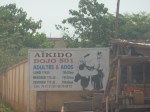
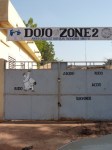
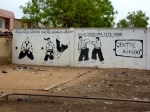
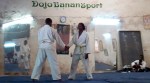
Aikido, which spread from Japan only after World War Two, is less commonly practiced in Mali. Nonetheless it’s well established: in 2006, the vice president of the Malian Aikido Federation estimated that over 3000 people practice aikido in Mali. The city of Bamako is home to at least a dozen different aikido dojos, or training centers. Some are dedicated martial arts facilities, with four walls and a roof. Others are makeshift outdoor spaces. Near the artisanat, I visited one dojo housed in a childcare center, where adults trained in the evening on a tarp stretched over the same sandy courtyard where toddlers played during the daytime. Some of these dojos are visible in the gallery below.

Back in the 1960s Bamako was briefly a node in aikido’s nascent global network. Three Soviet aid workers learned the art, then unknown in their homeland, at the Bamako Judo Club from one master Van Bai, a Frenchman of Vietnamese origin. (Malians sometimes recall his name as “Henri Wambaye”.) A few years later these Soviet students brought aikido from Mali to the USSR — illustrating the unpredictable pathways of the transnational diffusion of culture.

My first contact with aikido in Bamako was at “Camp Para,” a dojo and gym in the Djicoroni neighborhood, across the street from the entrance to the 33rd Parachute Regiment base. I found the Camp Para environment a lot like a Malian public school: a large number of students (80 or more, most sessions), learning mainly through repetitive drilling and rote memorization without much time for context or subtleties. They even took roll-call. After a strenuous warm-up, beginner students spent half the session practicing punches, blocks and footwork (the tenkan steps so vital in aikido). They spent the other half sitting around the perimeter of the mat, swatting mosquitoes and watching instructors put the more senior students through their paces, trying to make out the master’s commands over the din of the stereo from the adjoining gym. I doubted I could learn well in this setting, and the fact that Camp Para was a 15-minute cab ride from home would make getting there and back three times a week both costly and time-consuming.

My garage, pre-dojo

So I started my own dojo, arranging with Camp Para’s head instructor to have some of his black belts come to my house instead. We set up shop in the empty one-car garage. The only requirement was a good soft floor covering to cushion falls, an essential part of aikido practice. Rubber floor mats like we use in the U.S. are expensive, so most Malian dojos improvise with tarps covering sand or some similar material. We spread a 12-cm layer of sawdust and rice chaff over the floor, moistening it slightly to make it cohere before nailing a blue polyurethane tarp tightly over a wooden frame around the edges. Three nights a week, one of the black belts would give instruction. I invited my friend Issou, a tailor who was at the same level as me (i.e., an absolute beginner), to train with me. Occasionally we were joined by other students from Camp Para seeking extra practice.

Garage + 20 sacks of rice chaff + tarp + wooden frame = dojo !

Issou and I got outfits. Luckily Bamako has an ample supply of second-hand martial arts uniforms, which come from Europe and North America along with many other varieties of yugu-yugu or used clothing. A martial arts outfit is known as a gi in Japanese, but Malians and other French-speakers call it a kimono. (I was always uncomfortable referring to my outfit as a kimono, which just seems like the last thing tough guys would wear: “Before I kick your ass, let me slip into my kimono.”)

We spent several weeks on basic movements which my U.S. training had largely bypassed. I found aikido practice in Bamako more physically rigorous than in my U.S. dojo: between practicing footwork, punches and blocks we always worked up a good sweat before even getting to the waza, or grappling techniques. I also became conscious of the swish-swish sound our feet made on the tarp, a sound I never heard when practicing on rubber mats back in the U.S. This sound became a valuable training aid: in aikido, one only picks one’s feet off the floor when getting thrown, and most foot movement entails sliding or shuffling steps. When we heard our feet swishing over the tarp we knew we were moving them correctly.

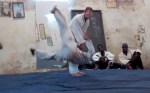
A couple of months after beginning my training, I attended the Malian Aikido Federation’s annual exposition at Bamako’s Omnisport complex. Aikido devotees came from each of the country’s eight regions, and taekwondo and kung fu were also represented. You can view a short video of this event below. I found the ukemi (vaults and falls), showcased between 0:29 and 0:49 in the video, stunning in its execution — like Evel Knievel stunts without the motorcycle. It made me wonder if anyone’s ever done ukemi over a flaming pit or a shark tank.

I never got very good at ukemi while in Bamako, but I learned plenty of aikido and made good friends in the process. Although the practice style was quite different from what I was used to (more regimented, more aggressive and physical, less reflective), I benefited from great instructors and dedicated training partners. In the roughly nine months of practice at my home dojo, we only had to cancel four classes, twice when I was out of town and twice in the wake of the March military coup. Nowadays I’m practicing in Bethlehem, Pennsylvania, but I look forward to returning to Bamako someday and resuming my training there.

Maybe I’ll even start another dojo of my own….

Posted in Uncategorized | Tagged , | 6 Comments